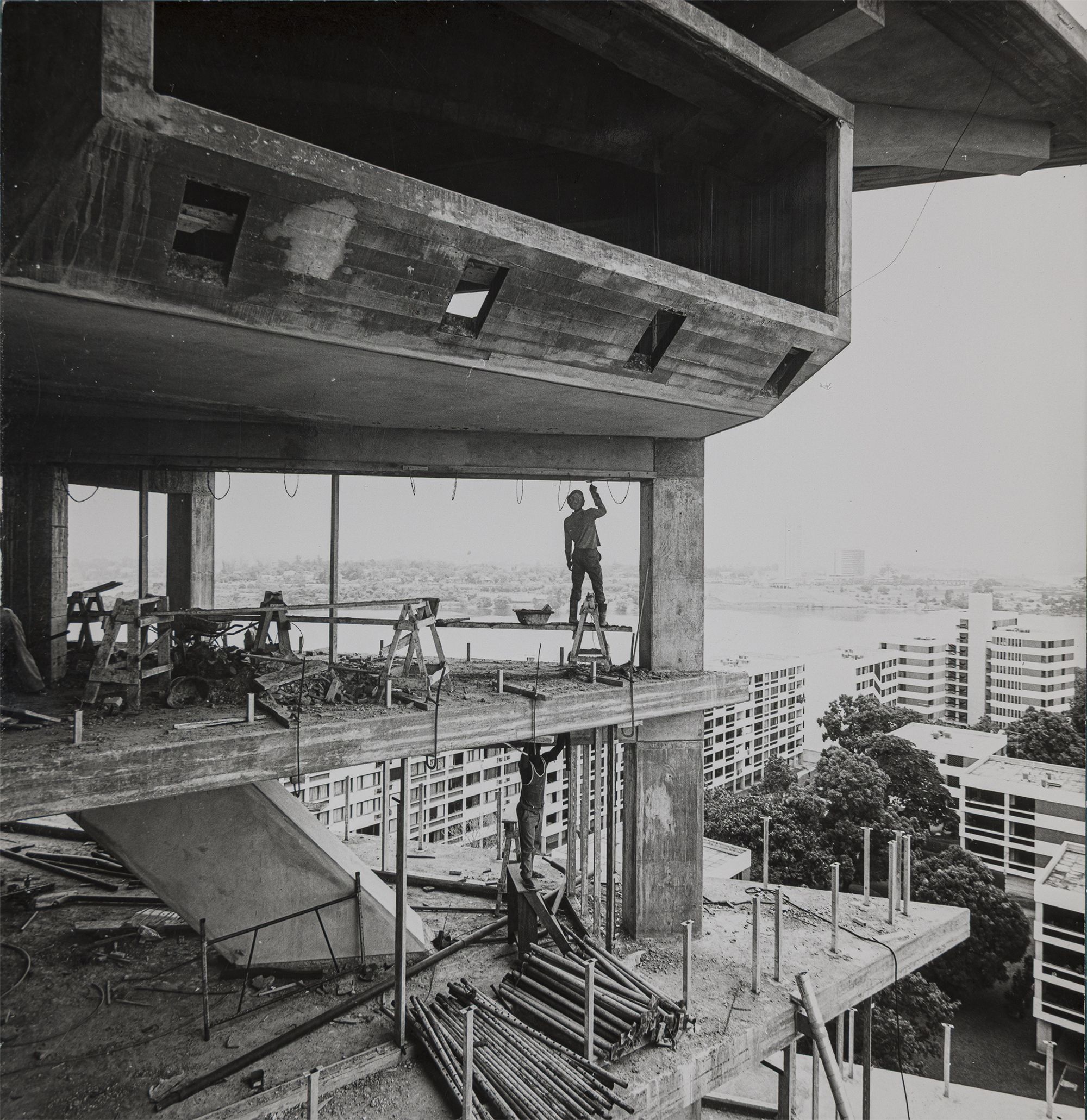
Workers constructing the upper floors of La Pyramide, Abidjan. Photo by Architect Rinaldo Olivieri, courtesy of The Museum of Modern Art, New York.
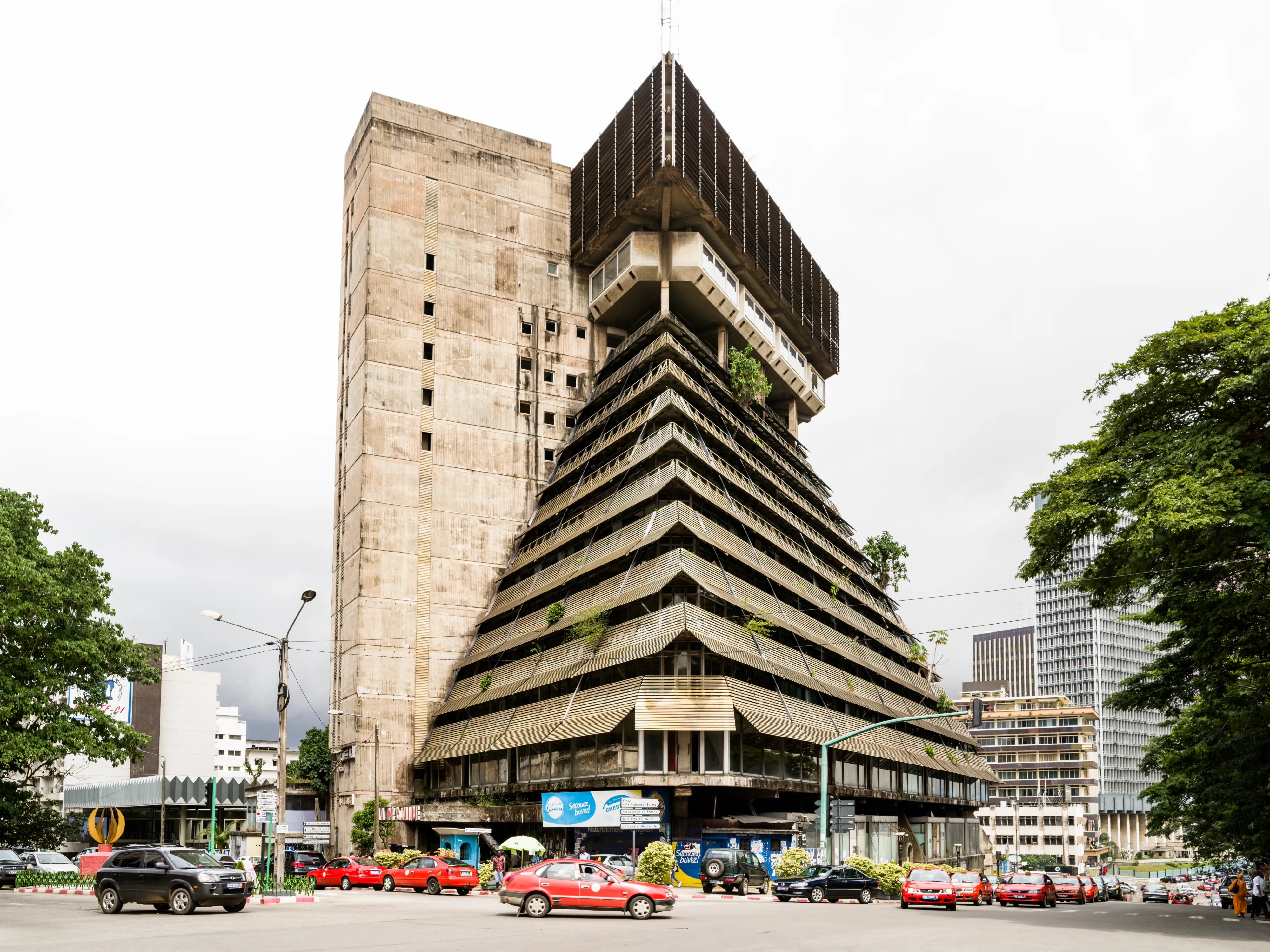
La Pyramide, Abidjan, Côte d’Ivoire completed from 1968–73 by Architect Rinaldo Olivieri (1931–1998). Photography by François-Xavier Gbré, Courtesy of The Museum of Modern Art, New York.
In 1958, addressing the first All-African People’s Conference, the Ghanaian prime minister and decolonization theorist Kwame Nkrumah proclaimed: “This mid-20th century is Africa’s. It is the decade of African independence.” He wasn’t kidding. Ghana’s liberation from Britain, a year prior, triggered a veritable cascade toward self-determination across the region. In 1960 alone, seventeen African countries declared their independence. Eighteen more followed suit the next year, and by the decade’s end, thirteen additional nations had attained sovereignty. Nkrumah’s pronouncement wasn’t just prescient; it contained the kernel of Pan-Africanism, the idea — a catalyst for the region’s freedom movements — that all people of African descent should strive in solidarity toward prosperity, a prospect that fueled a potent optimism for a unified African future.
A taste of the moment’s unbridled hope is palpable in the opening gallery of the Museum of Modern Art’s latest showcase of an overlooked slice of global architecture. Architects of Liberation (AoL), co-curated by art historian Ikem Stanley Okoye and Martino Stierli, the museum’s Chief Curator of Architecture and Design, delves into the built Modernist legacies of seven western African countries: Benin, Cameroon, Côte d’Ivoire, Ghana, Nigeria, Senegal, and Togo, all former British or French colonies. The architectural deep dive spans projects from the late 1950s to the late 80s.
The exhibition starts buoyantly: Upon entering, a tone-setting dark foyer conveys the period’s energy through archival footage projected onto two big walls. The fast-moving images show bustling street scenes and festivals; the novelty of rapid urban development and widespread jetliner service; workers and politicians, crowds and construction sites — in short, young societies brimming with busy potential. The introduction captures a special time in African history, a vibrant juncture in which art, literature, and music flourished in the wake of successive births of modern states. Heightening the anticipation of what’s to come, the room is filled with the sounds of “Indépendance Cha Cha,” a Congolese anthem, composed by Joseph Kabasele, that became the de facto soundtrack for independence fights throughout Sub-Saharan Africa. In a nearby vitrine, Nkrumah graces a 1953 cover of Time magazine, proof that excitement about the African promise also spread far beyond the continent.
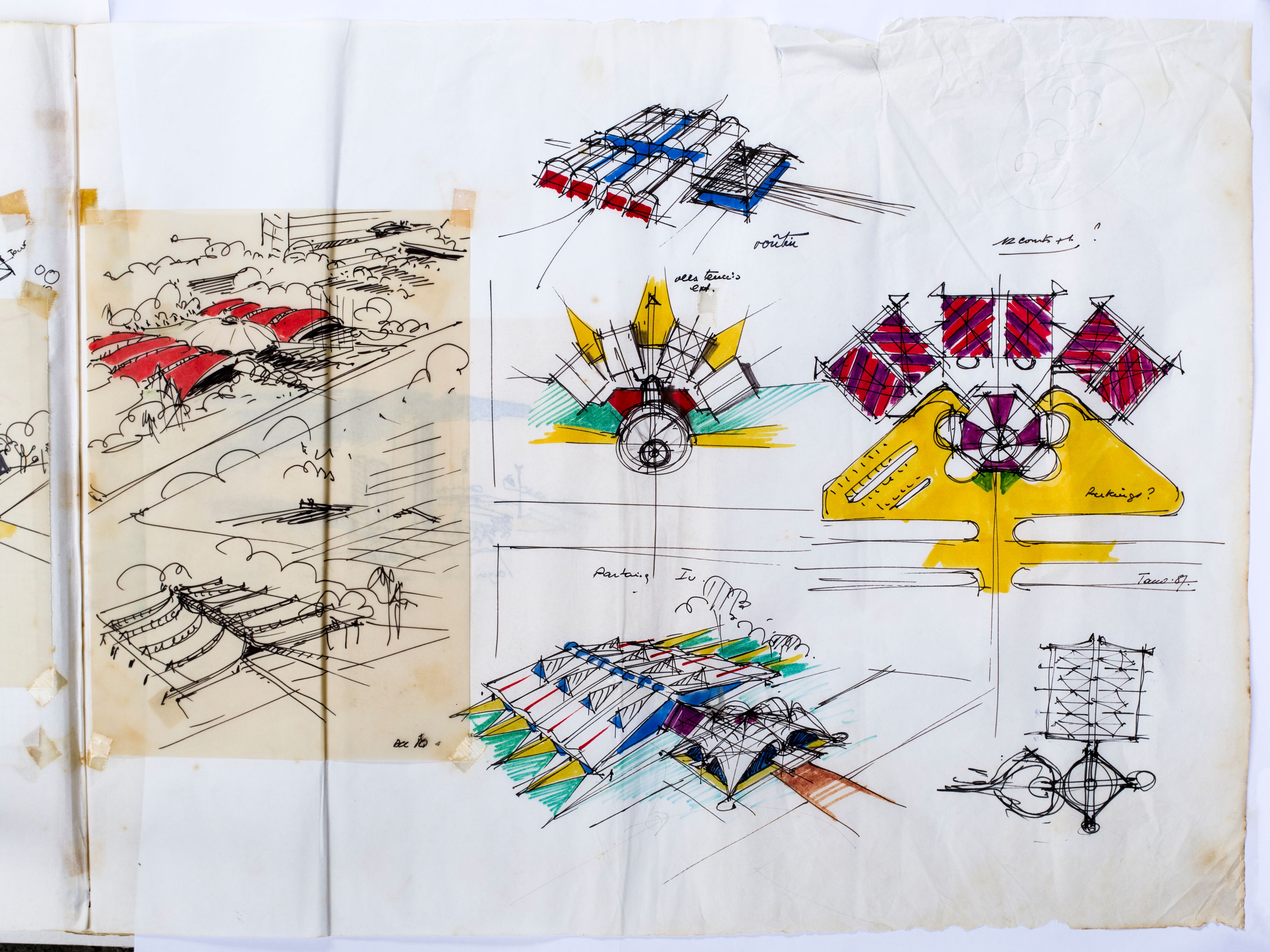
Jean Léon (1937–2002), Hôtel Ivoire Tennis Center, Abidjan, Côte d’Ivoire (unrealized) preliminary sketches, 1982; Colored marker, pen, and cut-and-taped tracing paper on paper. 19 1/2 × 24 7/16 in. Courtesy of Studio Jean Léon Archives.
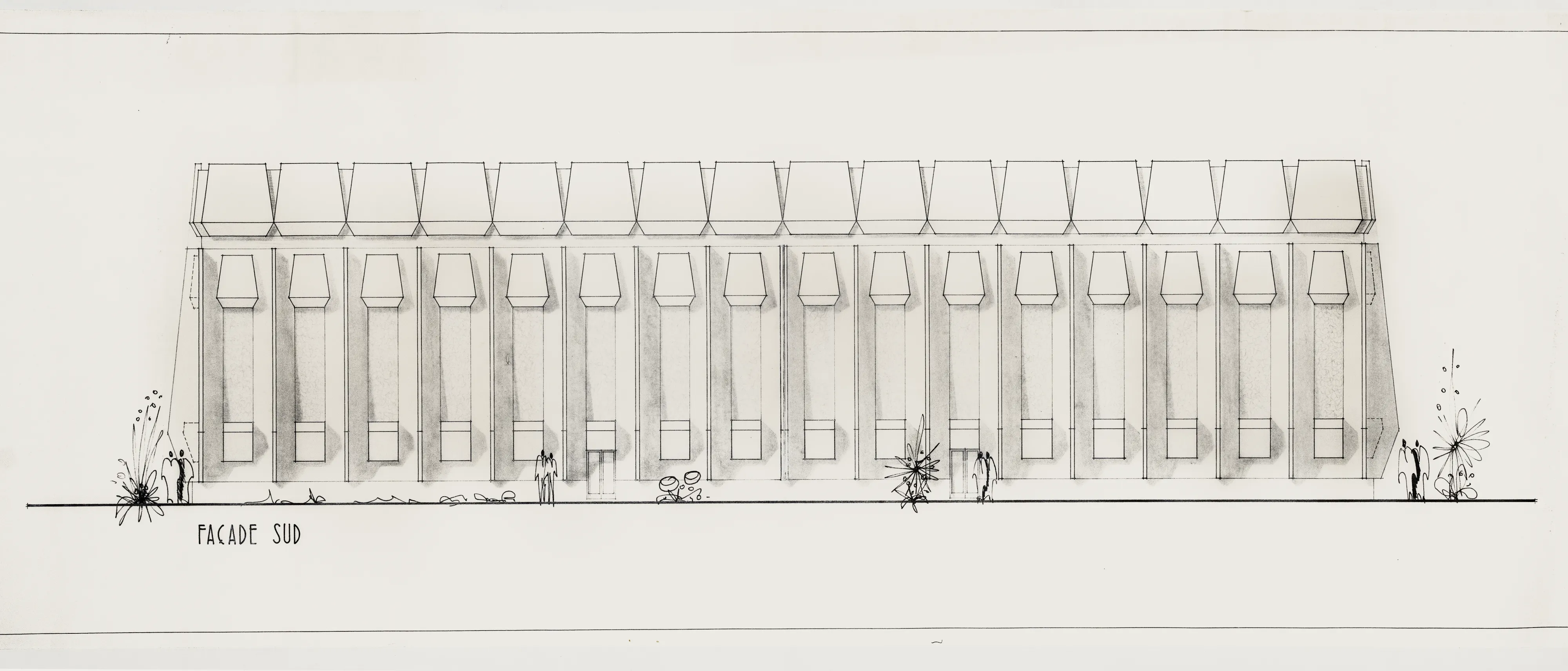
Cheikh Ngomh Ngom (1935–2025), Faculty of Law and Economics at the University of Dakar (now Université Cheikh Anta Diop, Dakar, Senegal), elevation drawing, 1979; Pencil on paper. Courtesy of Cheikh Ngom Archive.
AoL posits that architecture, too, became an emancipatory medium, enlisted to address the scary “now what” question these nascent nations faced. Specifically, the freshly autonomous states turned to buildings, and to the architects who designed them, to define a confident self-image and project it to the world. The task was urgent and inevitably aspirational. Since what needed to be telegraphed was progress, architecture alone was not the answer — it had to be the latest architecture. That is what placed these newly independent West African nations within MoMA’s modernist wheelhouse roughly a half century later. It’s a convincing premise, one which also presents the show with an awkward tension: glancing over the labels, it becomes clear that the vast majority of featured projects list a European architect as their main author. There was a practical reason for that: the fledgling nations had few native, formally trained architects, in part because there were no facilities to train them. That condition was quickly and impressively remedied. As part of a huge investment in education, multiple universities, some with architecture schools, were founded in the region from 1960 onward, a development explored in AoL’s final gallery dedicated to academic institutions.
There remains an irony in the fact that leaders who were actively trying to distance themselves from legacies of colonial subjugation had to invite architects from the imperial superpowers, mainly France, to help shape what a self-governing nation-state could look like, not to mention assist in building roads, institutions, and homes. At least the authorities in charge knew how to leverage the situation, mandating that foreign practitioners be paired with young local talent, which makes the projects on display in the exhibition fertile training grounds for a nascent professional class. AoL is organized around seven themes, ranging from the macro — state-led infrastructure efforts to reorganize the territory with water dams, airports, and so on — to the micro — chic domestic interiors that wouldn’t be out of place in a vintage issue of AD.
Balancing a somewhat ho-hum exhibition design (as always at MoMA, produced in-house), the research evident behind each display is never less than thorough (also a MoMA hallmark). Each gallery is anchored by a spotlight project, often accompanied by a special basswood model crafted by Cooper Union students. Yet even the projects that don’t get this special treatment make it hard to believe these structures and their makers have mostly been left out of the established canon. Anyone with a passing interest in 20th-century architecture knows that, say, São Paulo and Marseille harbor Modernist gems, but no one thinks of Abidjan or Dakar as hotbeds of masterful buildings from the 1960s and 70s. Alone for bursting the fiction that “paradigmatic” architecture could only be produced in hegemonic locales, AoL is eye-opening.
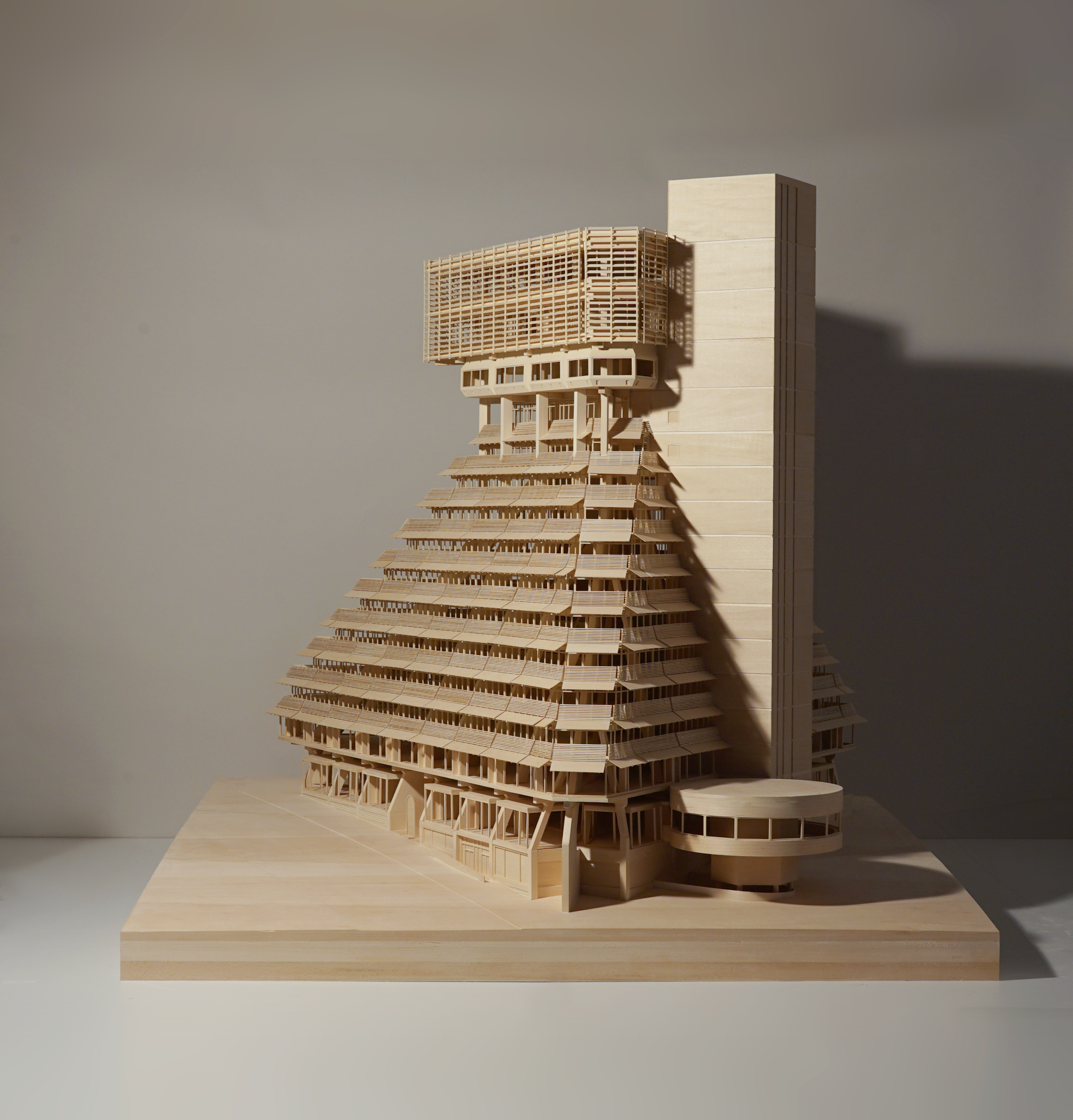
Model of La Pyramide, by Julian Palacio, James Lowder, Angelis Heredia, Tae Kim, Gain Meemongkol, Sofia Mercado and Julian Yang, 2025; basswood, plywood, 3D-printed wood filament. 45 x 46 x 46 in. Scale: 3/16 in =1-0 in. Photography by the artists.
After that first gallery with Kabasele’s catchy rumba playing on loop, a winding sequence of ample rooms contains a polyphony of sections, elevations, plans, photographs, and maquettes —but above all, one architectural banger after another. Here’s a small, subjective selection of marvels I’m still thinking about weeks after repeat visits:
i) A beautifully preserved railway station from the late 1980s, designed by Émilien Douala Bell and Jacques Nsangue Akwa in the Cameroonian port city of Douala, features a sweeping grand hall whose rainbow-colored concave canopies — the underside of an inventive roofscape — are a perfect demonstration of how, before air conditioning became ubiquitous, architects dared to come up with audacious, elegant solutions to ventilate their designs.
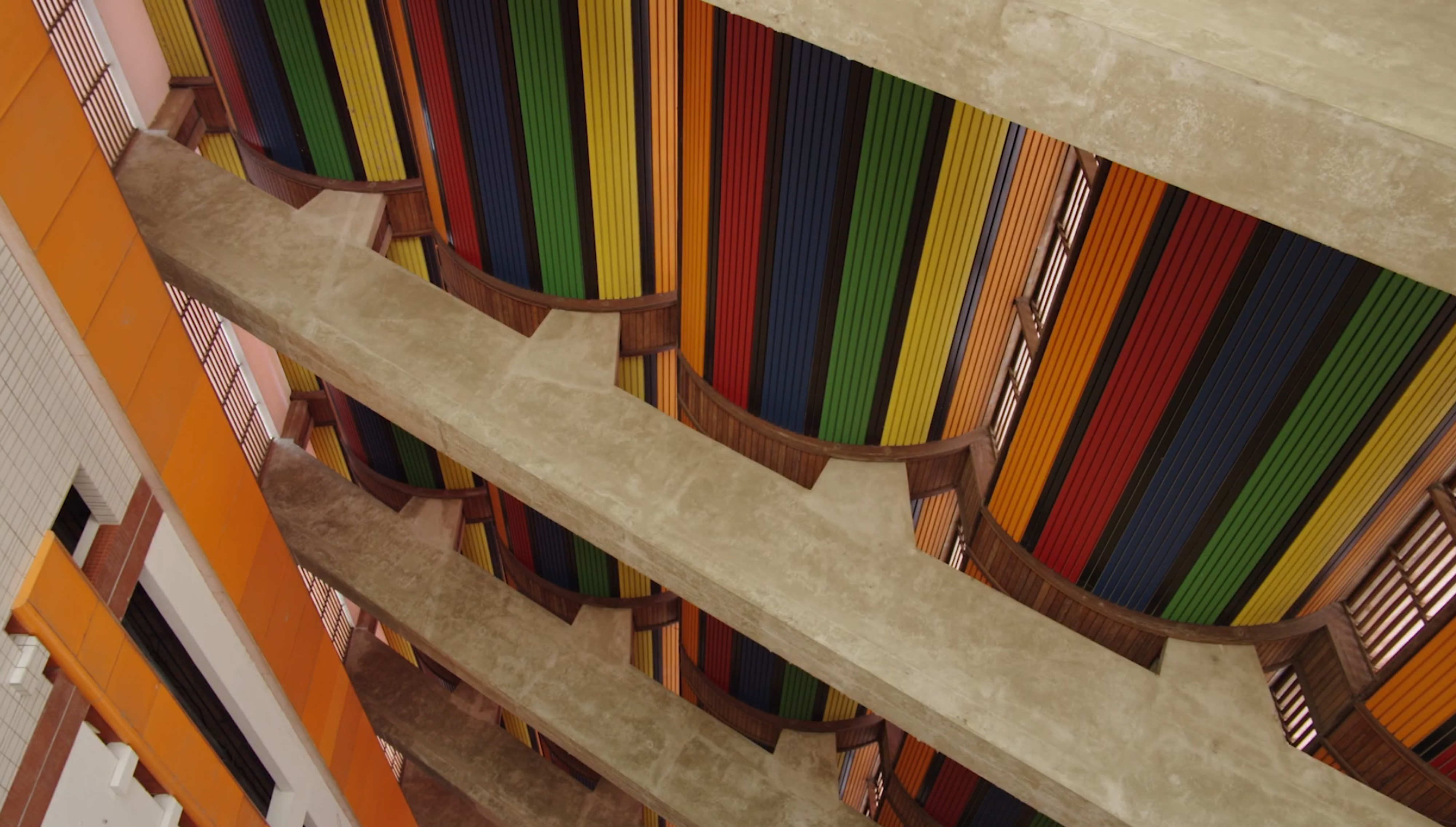
Jacques Nsangue Akwa (1927–2016) and Émilien Douala Bell (b. 1935), Gare de Bessengué, Douala, Cameroon, 2025; film still from documentary footage. 2025. Footage by Henry KD, commissioned by The Museum of Modern Art, New York.
ii) At first, Abidjan’s “la Pyramide,” completed by Rinaldo Olivieri in 1973 to house offices, shops, apartments, and a panoramic restaurant, appears as a futuristic fantasy, its bravado perhaps explaining its current condition as a ruin. A closer look, however, reveals Olivieri’s desire not just to articulate a bold singular vision, but also to develop a strain of modernism uniquely suited to the specific context. The aluminum louvers that wrap around the building are actually bioclimatic brise-soleils, shielding the building’s glass façade from the region’s intense sunlight.
Workers constructing the upper floors of La Pyramide, Abidjan. Photo by Architect Rinaldo Olivieri, courtesy of The Museum of Modern Art, New York.
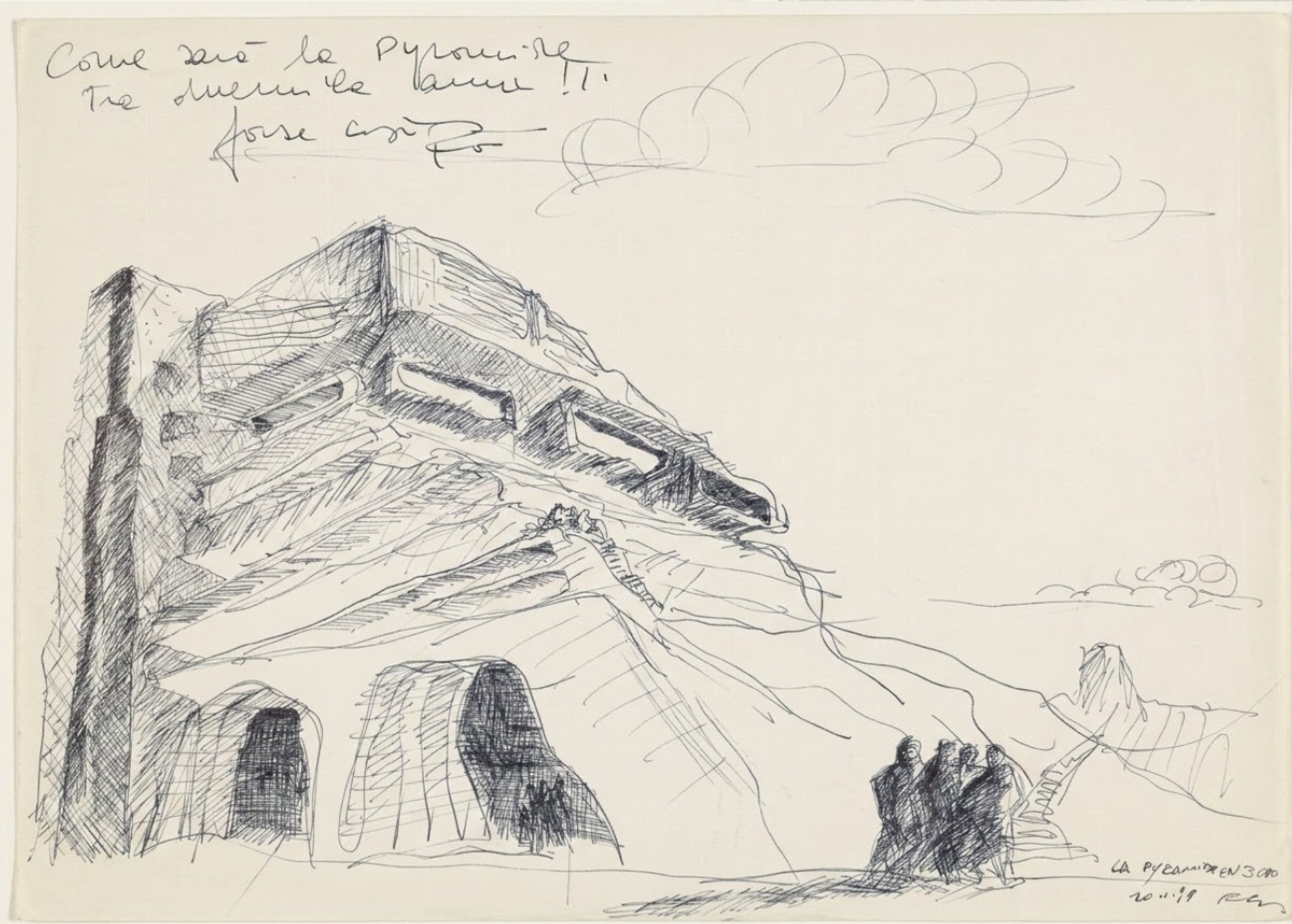
Rinaldo Olivieri (1931–1998). Sketch inscribed “What will La Pyramide look like in 2000 years? Perhaps like this.” January 20, 1979. Ink on paper, 9 5/8 × 13 9/16 in. (24.5 × 34.5 cm). Rinaldo Olivieri Archives.
iii) The Brutalist auditorium of a girls’ school in Yamoussoukro, Côte d’Ivoire, designed by Jean Léon in 1978, is still in use: a sci-fi apparition in concrete, embraced and cared for by the local population. A mini-gallery is devoted to Léon’s sui generis experimental creations, which seem immune to the passing of time and changing styles. Their ingenuity strikes anyone seeing them for the first time with the same impact they must have had when they first landed in the Ivorian landscape.
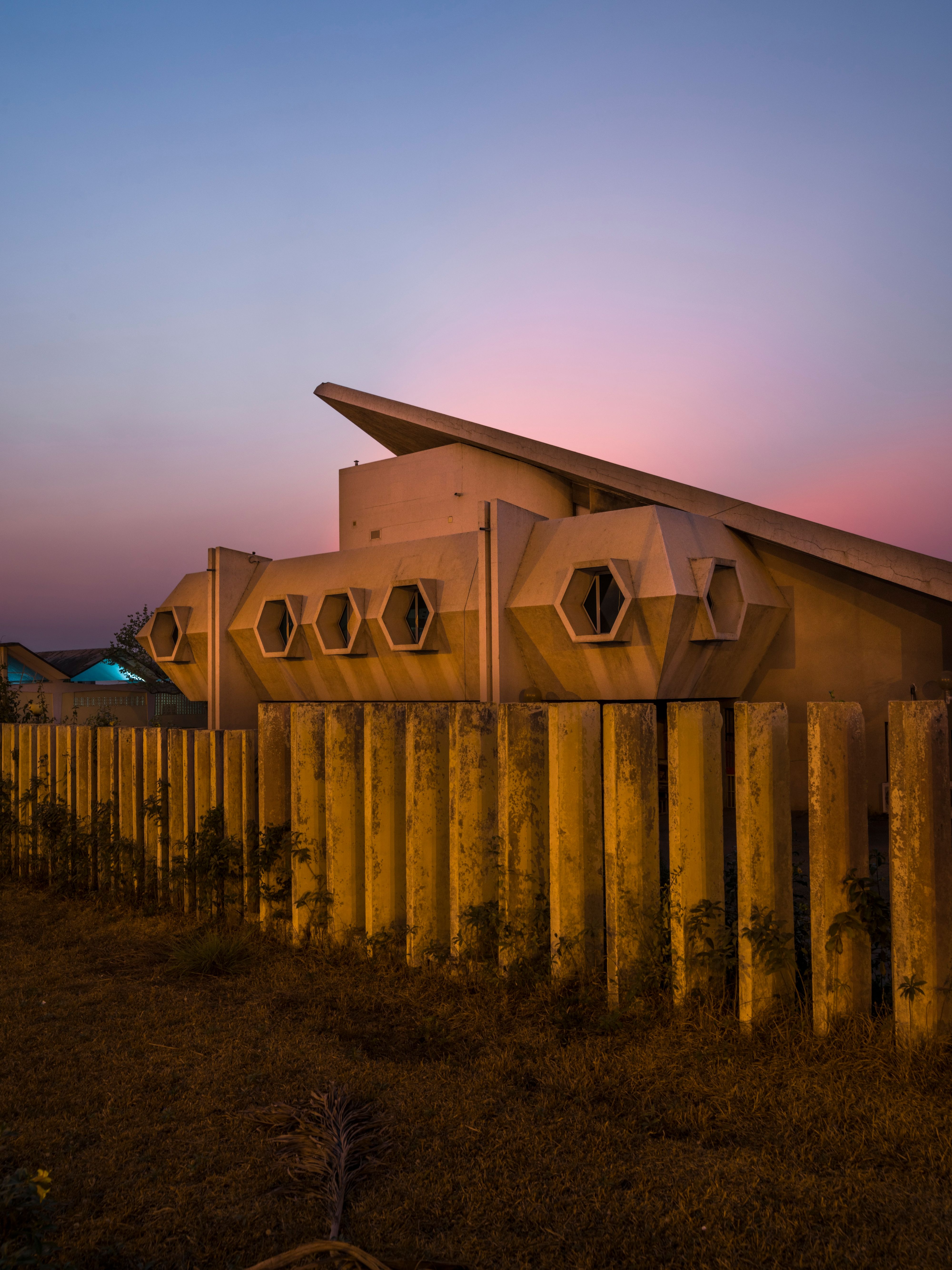
Lycée Mamie Adjoua auditorium, Yamoussoukro, Côte d’Ivoire completed in 1978 by Architect Jean Léon (1937–2002). Photography by François-Xavier Gbré, Courtesy of The Museum of Modern Art, New York.
iv) Still, to this observer, it’s Dakar’s CICES, a 19.5-hectare ensemble of pavilions, exhibition halls, and plazas completed in 1974 by Jean-François Lamoureux and Jean-Louis Marin, that steals the show. Composed of endless iterations of triangles, CICES — amazingly, the duo’s first built project — was designed to host trade fairs, which served as important regional exchange points, fostering both ideological and economic integration among neighboring states.
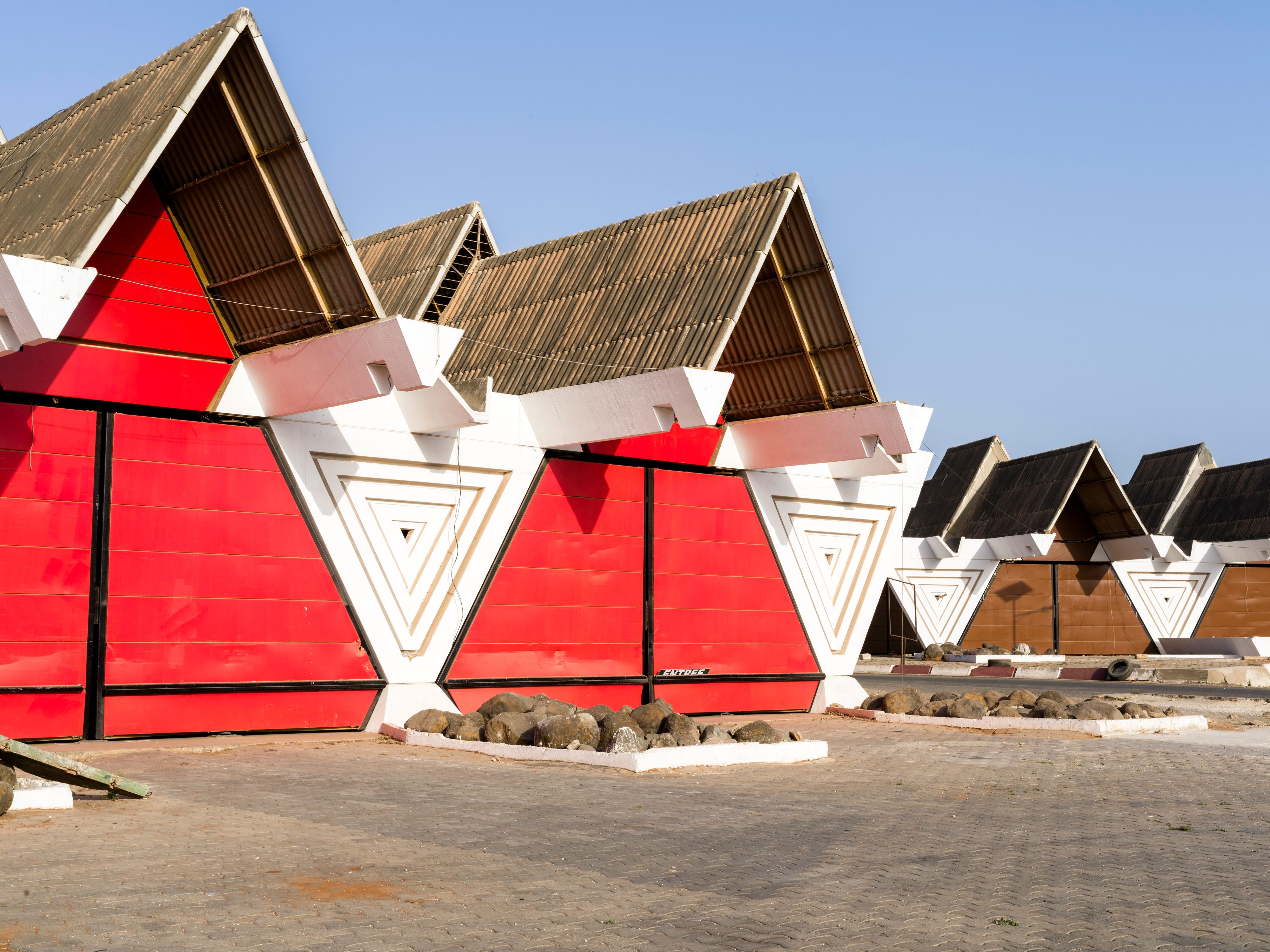
Centre International du Commerce Extérieur du Sénégal (CICES), Dakar, Senegal completed from 1971–74 by Architects Jean-François Lamoureux (b. 1943) and Jean Louis Marin (b. 1943). Photography by François-Xavier Gbré, Courtesy of The Museum of Modern Art, New York.
v) And let’s not forget Togo, the smallest of the countries included, which makes a memorable appearance with Daniel Chenut’s Hôtel de la Paix, completed in 1974 in the coastal city of Lomé. Sadly, the spectacular project now sits abandoned and at risk. A favored gathering spot for well-to-do locals and visitors in its heyday, the building retains a civic function even in its state of advanced decline. Today, however, its importance is emblematic, not just for Lomé but for the precarious state of many Modernist buildings across Africa.
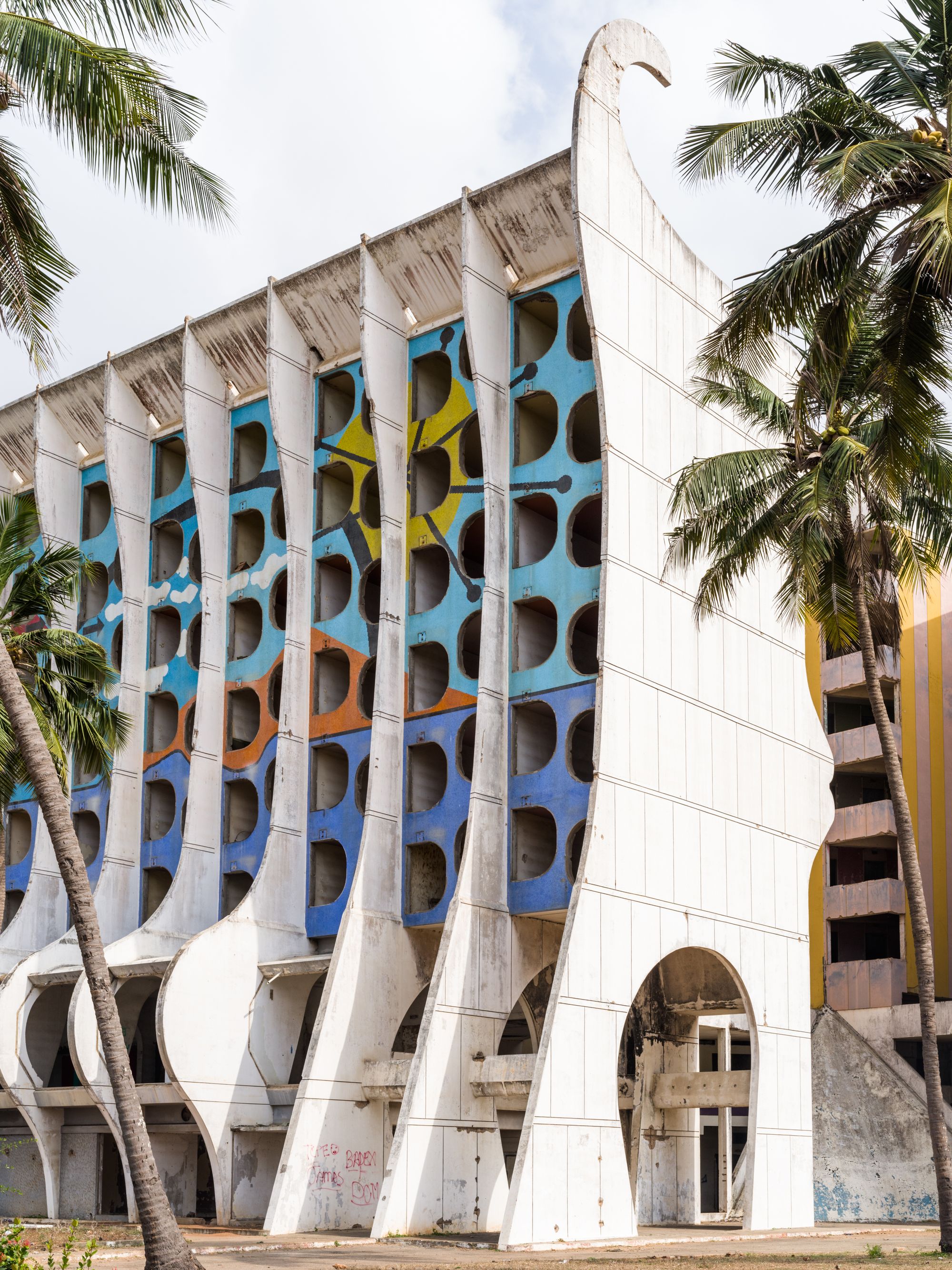
Hôtel de la Paix, Lomé, Togo completed from 1972–74 by Architect Daniel Chenut (1927–1981). Photography by François-Xavier Gbré, Courtesy of The Museum of Modern Art, New York.
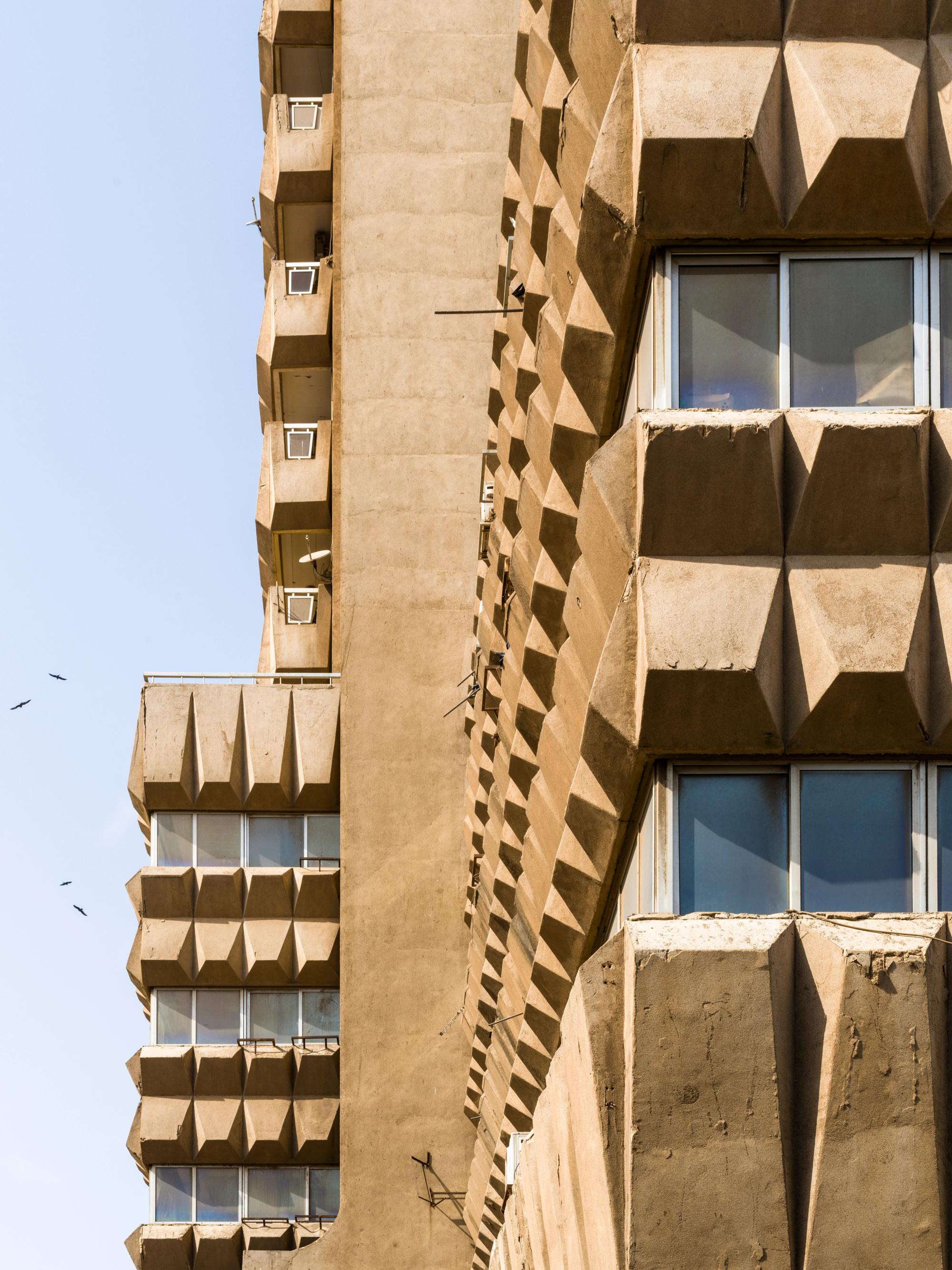
Fayçal Building, Dakar, Senegal completed in 1984 by Architect Cheikh N’Gom (1935–2025). Photography by François-Xavier Gbré, Courtesy of The Museum of Modern Art, New York.
But the exhibition is titled Architects — not Architecture — of Liberation for a reason. In four instances, the focus shifts from a project to the person behind it. Among them is Cheikh N’gom, the first Senegalese architect to establish an independent firm, who marked Dakar’s post-independence skyline with a peculiar blend of modern and traditional elements. Most indelibly, his residential mid-80s Fayçal building is covered in what looks like armor, in fact, precast concrete “scales” that lend the tower a strangely compelling rusticated appearance. Another notable discovery, and the rare named female voice in the show, is Hannah Schreckenbach (1932–2022), an architect born in East Germany, who, disillusioned with socialism, decamped to Ghana, where she spent over two decades designing post offices, community centers, and parliament extensions for a state-run development company.
A through line of AoL is the polyvalent concept of Africanization. In terms of labor, Africanization could refer simply to the training of a sizable local workforce, which had to learn new skills from scratch to help realize ambitious construction schemes. In aesthetic terms, however, it invoked the question of how best to adapt an imported vocabulary to local culture and climate, and eventually give rise to an authentically African way of producing modern architecture. Rather than simply tailoring international building practices to the circumstances of this part of the continent, the architects showcased in AoL, including the foreign ones, sought to reinvent Modernism according to indigenous realities, beliefs, and convictions. This discourse gained momentum in the 1970s, not long before Western PoMo heads started contesting the validity of modernism’s supremacy and labels like “Critical Regionalism” began being tossed around.
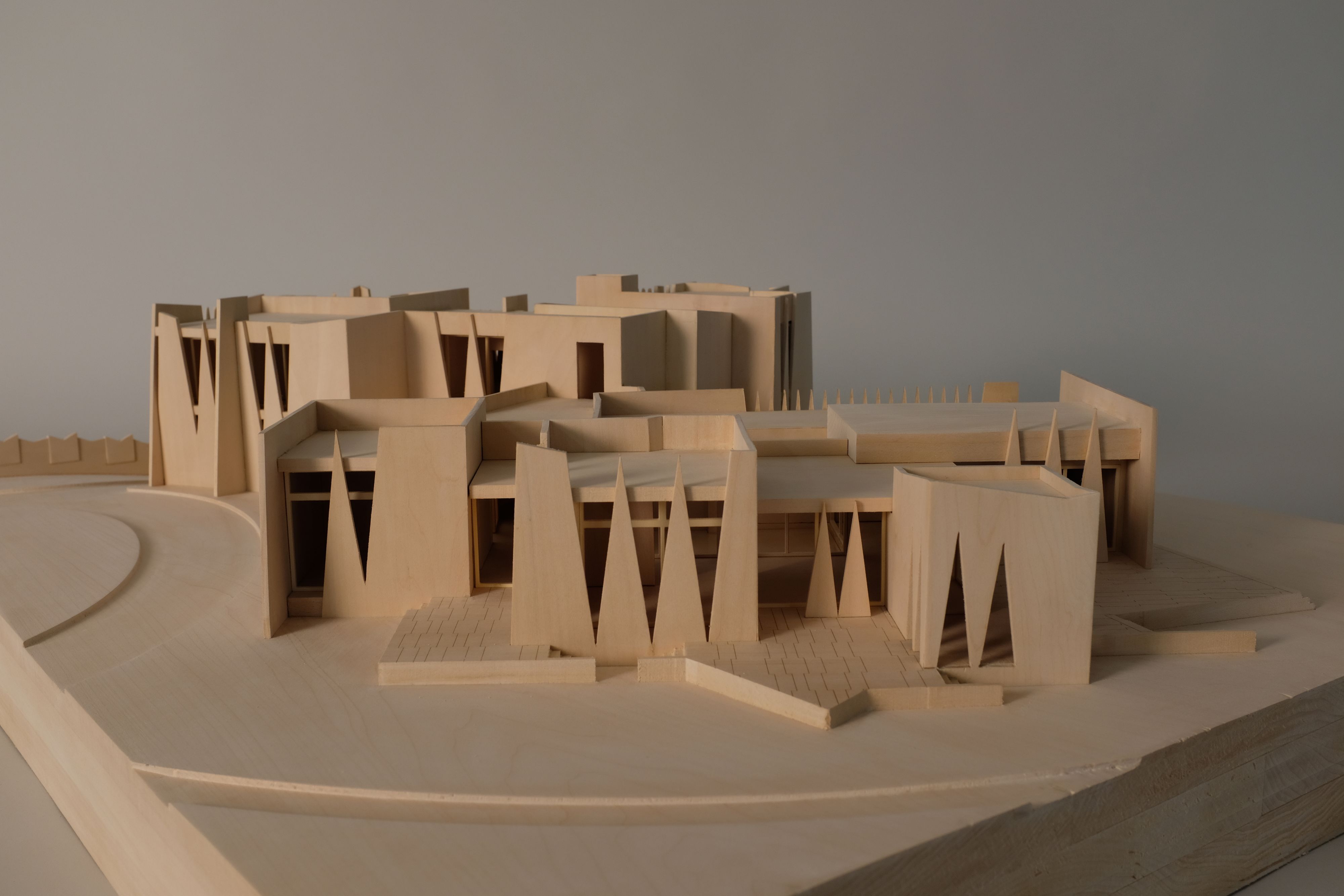
Senghor House, by Julian Palacio, James Lowder, Evan Chiang, Tzu Kuan Liao, Kassidy B. Miller, Nd Yang, Vi Phan, 2025; basswood, plywood. 9 x 36 x 27 in. Scale: 1/4 in =1-0 in. Photography by Evan Chiang.
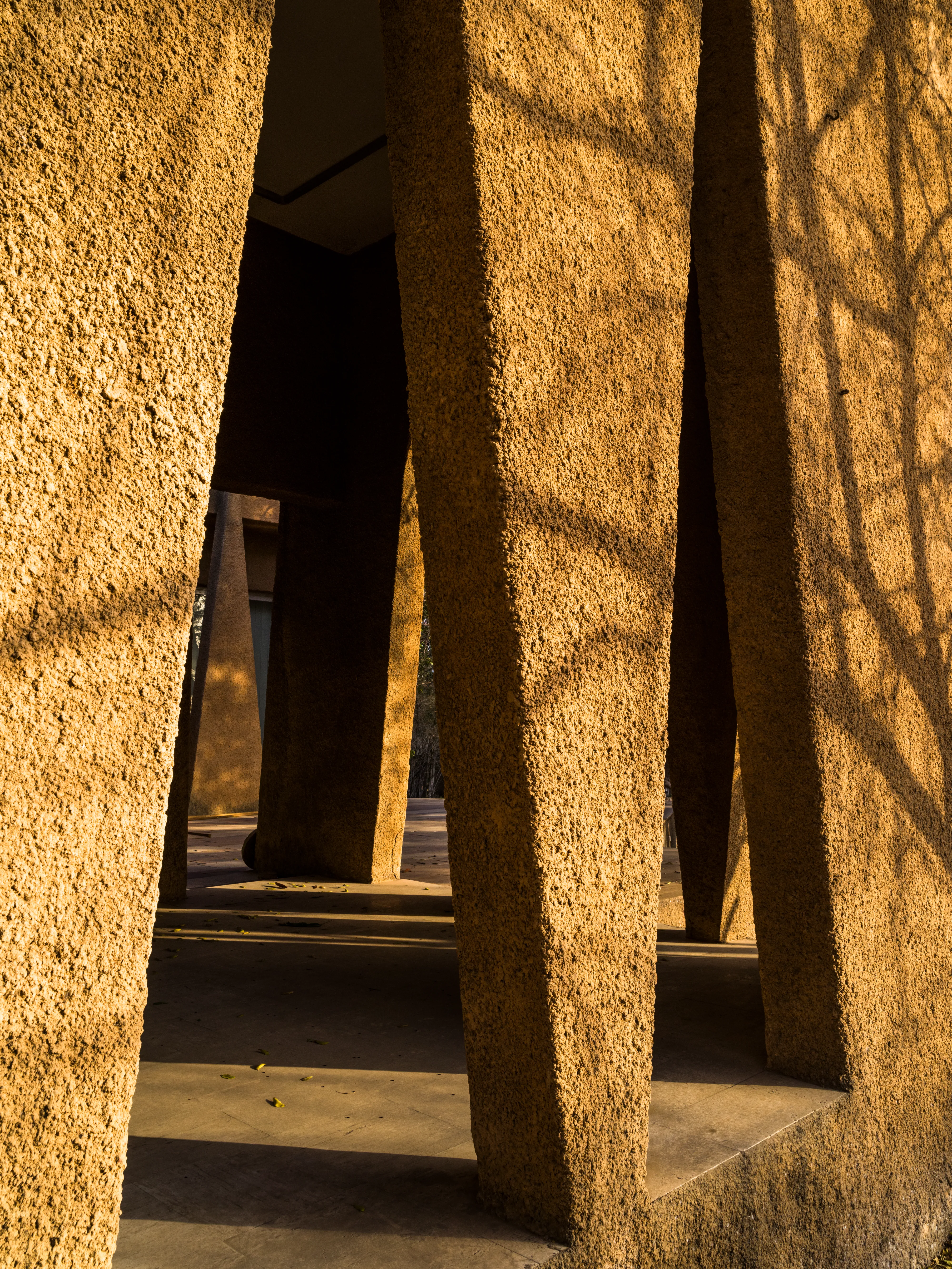
Senghor House, Dakar, Senegal completed in 1978 by Architect Fernand Bonamy. Photography by François-Xavier Gbré, Courtesy of The Museum of Modern Art, New York.
In practice, formal Africanization can look disarmingly literal, drawing on centuries-old forms of Sahelian architecture. This is evident in the works of Fernand Bonamy, such as the house he designed in Dakar for Léopold Sédar Senghor, Senegal’s first president, who was also a poet and one of the masterminds of Negritude, an influential intellectual framework aimed at reclaiming pride in Black identity and African heritage. Built between 1975 and 1978, the Senghor house’s rough-hewn materiality, angular buttresses, and abstract geometries reinterpret the monumental earthen architecture of Mali and Sudan, reflecting a cross-regional preoccupation with fusing modern and vernacular building methods.
In spite of its theoretical underpinnings, AoL remains accessible and absorbing. This is in part because the show is in many ways a story about cities. Its stars are Dakar, Lagos, and Accra, among other West African metropolises whose explosive post-Independence growth demanded the infrastructure, high-rises, and mixed residential typologies on display. It was visionary architecture that facilitated the transformation of these former colonial hubs into pulsating modern urban centers, each with its own flair. Lagoon-side Abidjan, to name just one, emerges as particularly cosmopolitan. Rarely does one leave a museum exhibit craving to get lost in a far-flung town.
By any measure, Okoye and Stierli’s accomplishment, which was years in the making, is enormous. The show consists almost in its entirety of previously unseen material. While the region’s colonial histories are well-documented, until now there was a dearth of research on the period AoL examines. MoMA’s survey is a significant step toward correcting that imbalance. It is also a rescue operation. Some of the exhibited items were found deteriorating in moist cellars and several surviving projects seen in these galleries face an uncertain future. MoMA’s validatory stamp could increase the odds that one or more of these derelict buildings are saved. (There’s hope: Lomé, for instance, has an incipient preservationist community.)
As upbeat as the exhibition begins, it’s hard not to leave feeling a little wistful. There is an elegiac connotation to the material assembled, but not simply because so many of the featured architects are no longer alive. In its radical idealism, Architects of Liberation reminds us of a time when people trusted architecture as an instrument for the betterment of many, not just the glorification of a privileged few. In the days of Senghor, Nkrumah, and their peers, architecture was truly believed to serve a public purpose. Both that relevance and function began to fade with the advent of neoliberalism in the 1990s and are now but a distant memory.
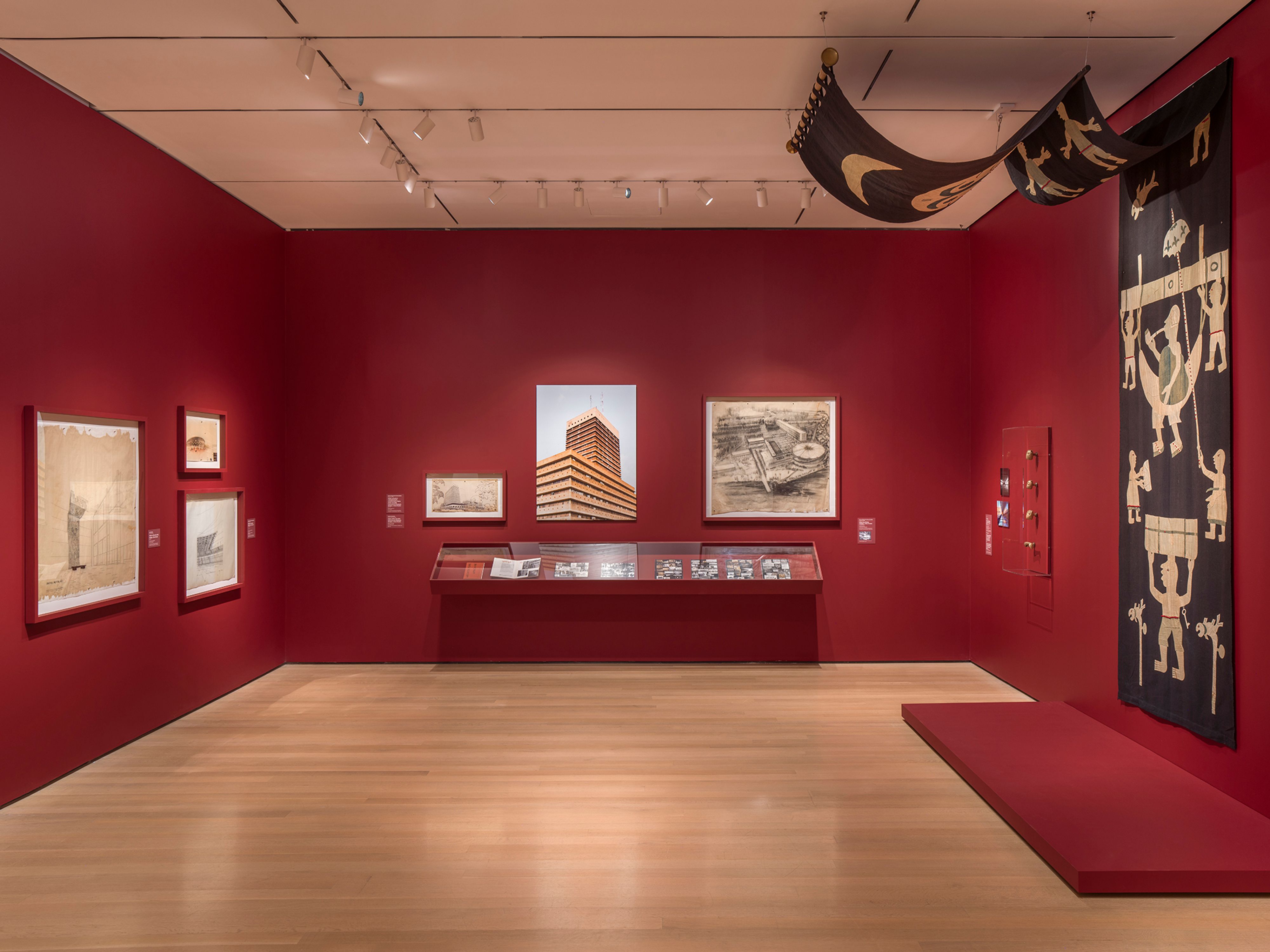
Installation view. Photography by Martin Parsekian. Image Courtesy of The Museum of Modern Art, New York.