Photograph by Ian Byers-Gamber Courtesy of the Princeton School of Architecture.
Photography by Ian Byers-Gamber. Courtesy of the Princeton School of Architecture.
Founded in 2000 by architectural historian Beatriz Colomina, Princeton University’s Program in Media and Modernity — known simply as M+M — has become one of the most influential and idiosyncratic forums for thinking about architecture not as an autonomous discipline, but as a field constantly shaped by images, technologies, politics, publishing, exhibitions, and other forms of mediation. Over the past 25 years, the program has operated as part seminar, part research platform, part curatorial laboratory, bringing together architects, historians, artists, theorists, editors, and filmmakers to test how architecture circulates, communicates, and transforms in the world. (One of its early projects, Clip/Stamp/Fold: The Radical Architecture of Little Magazines 196X–197X, was also an inspiration for PIN–UP.)
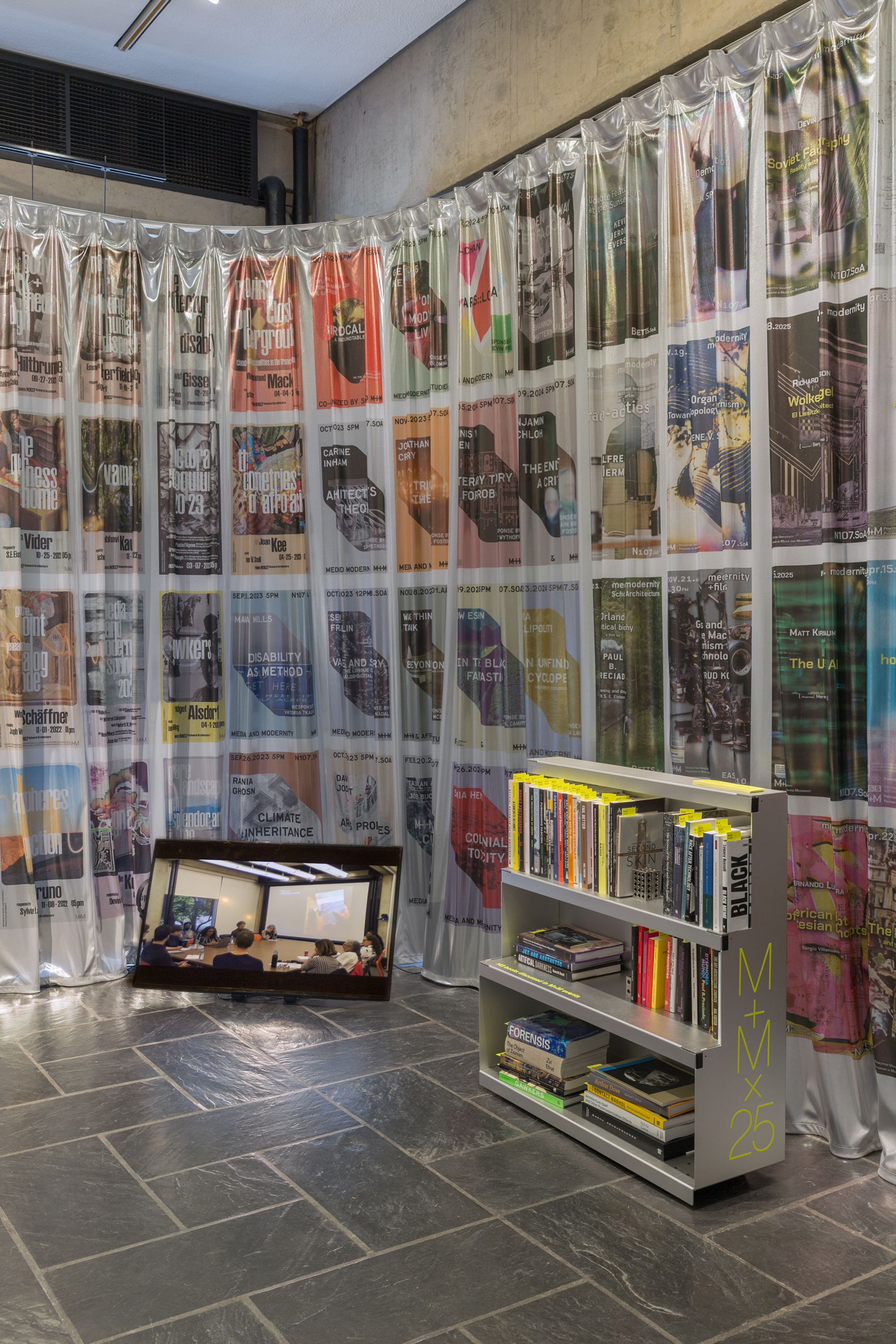
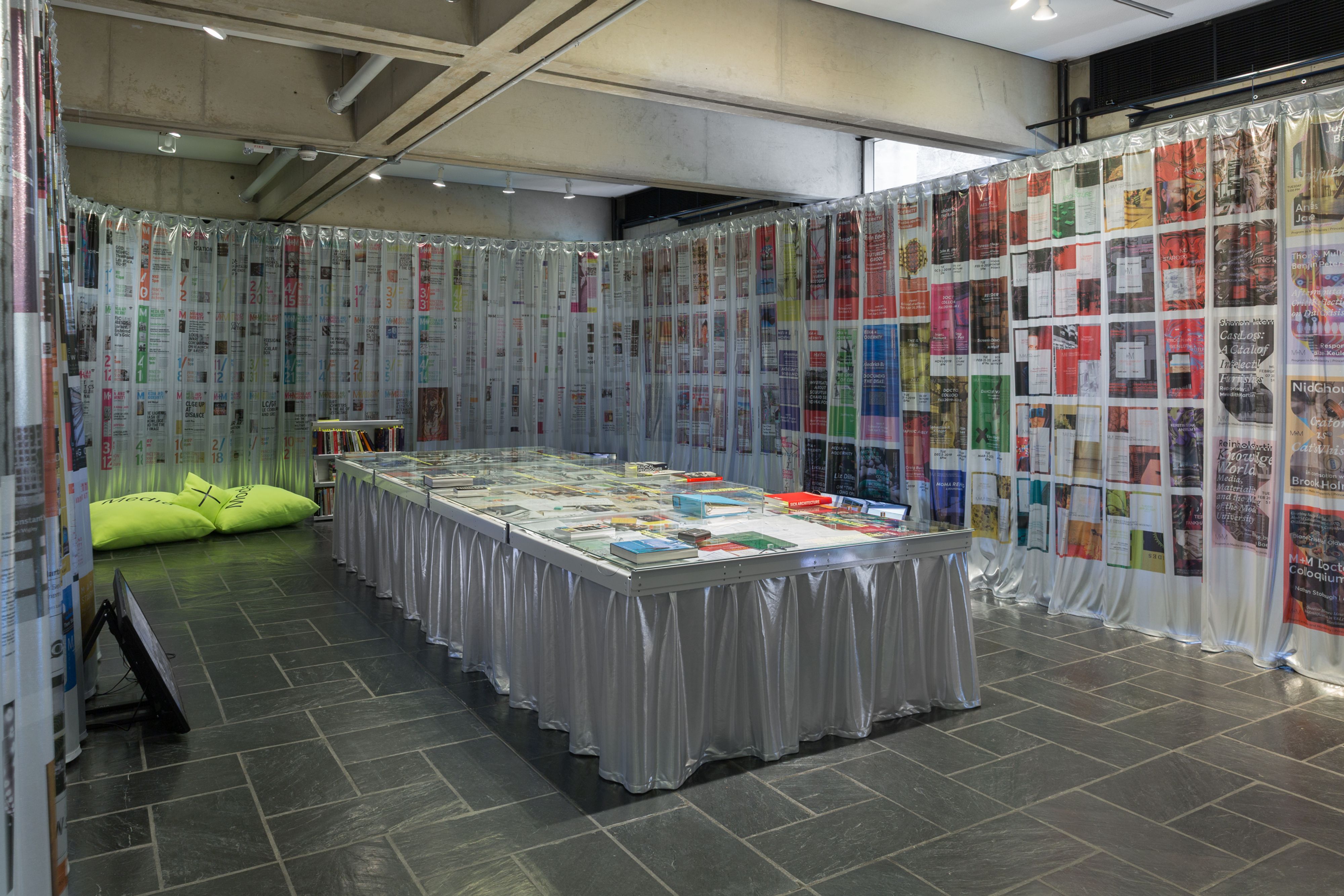
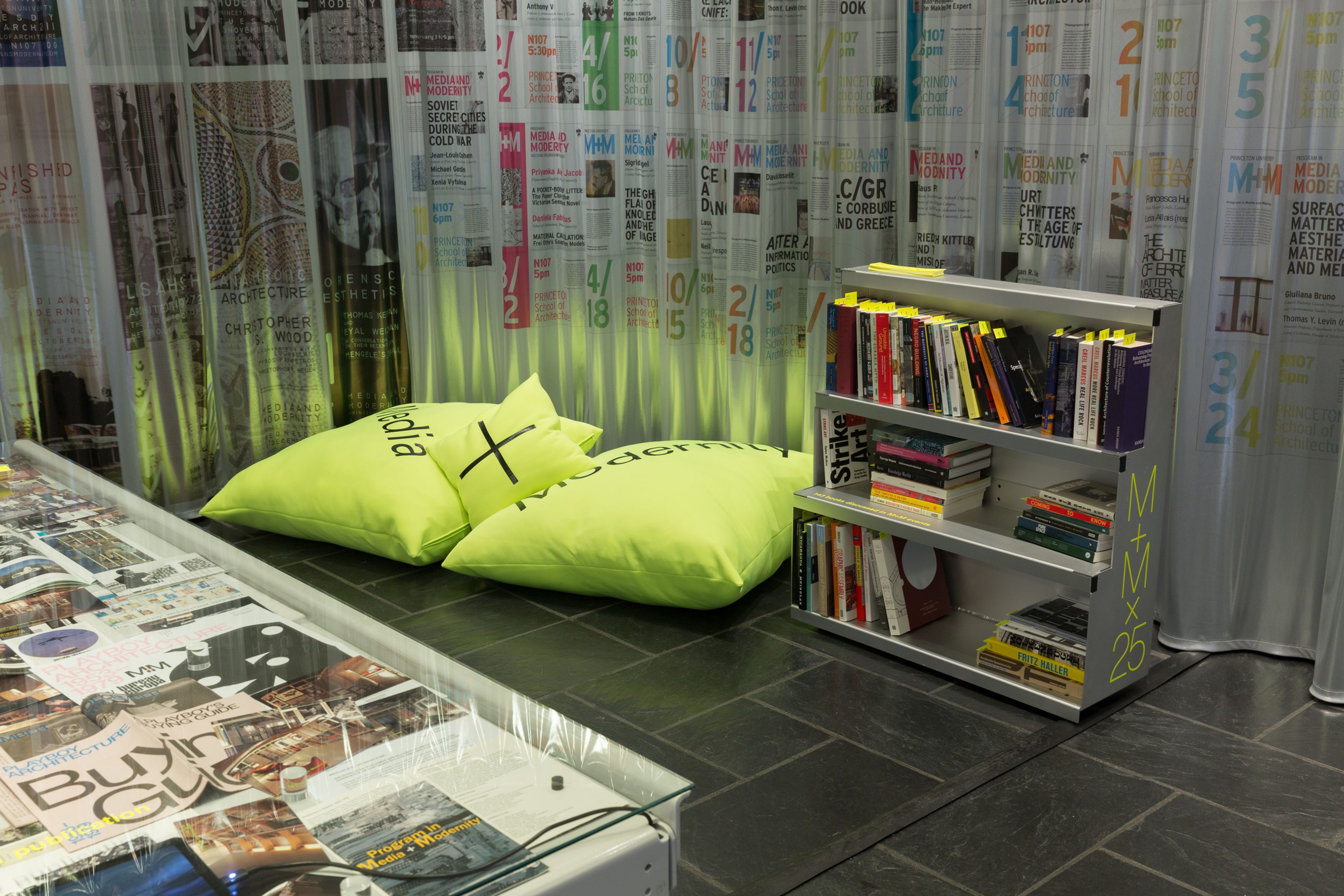
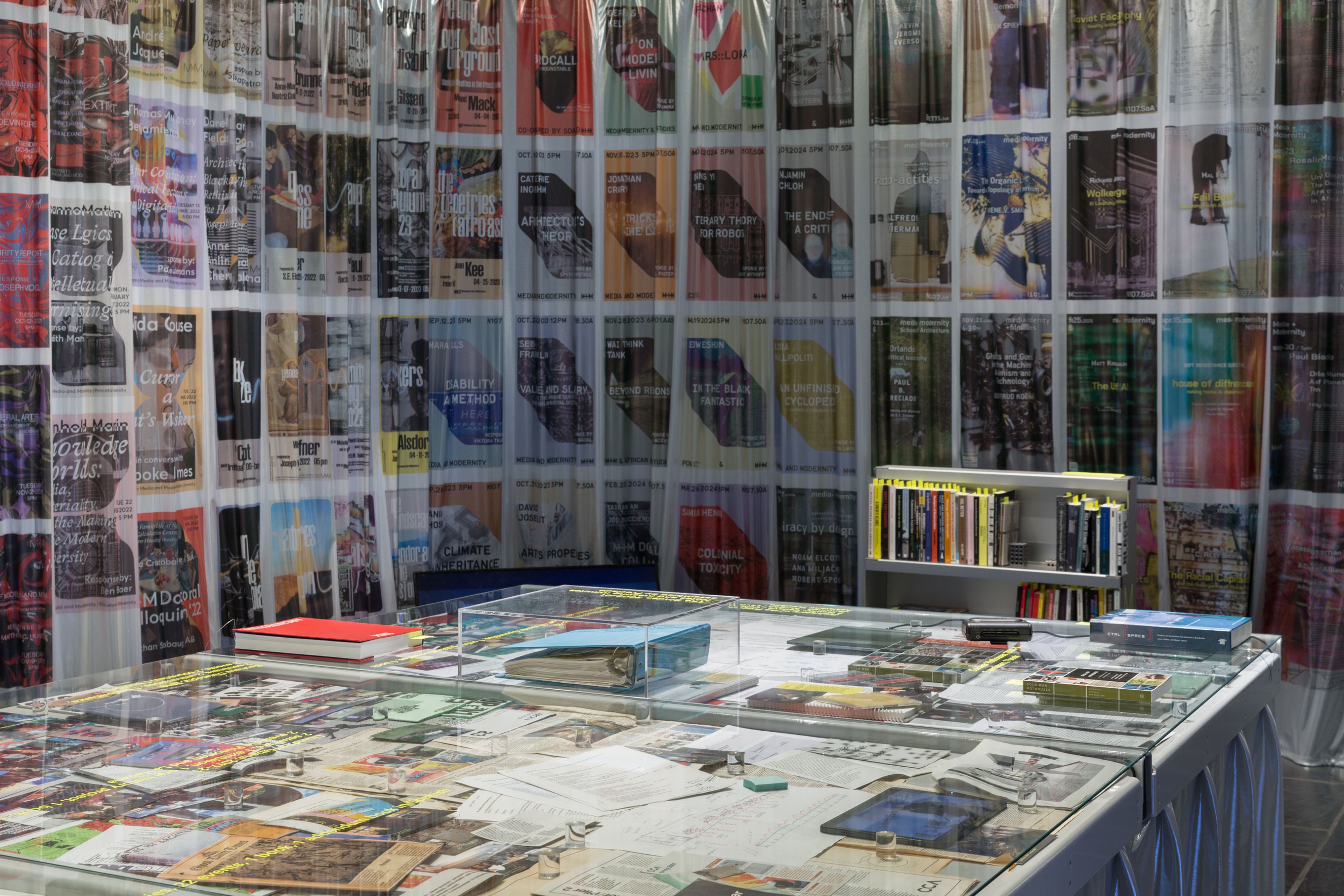
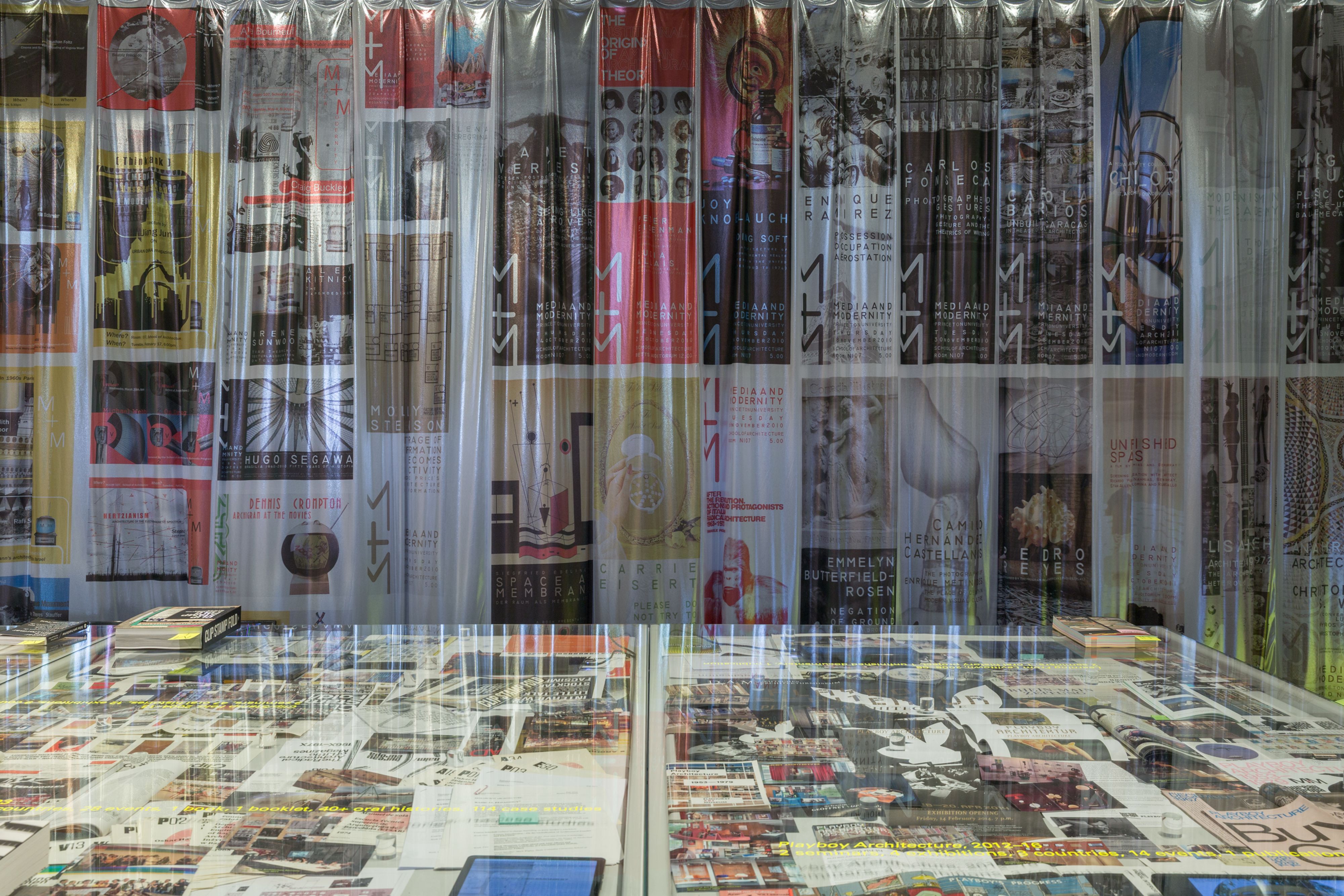
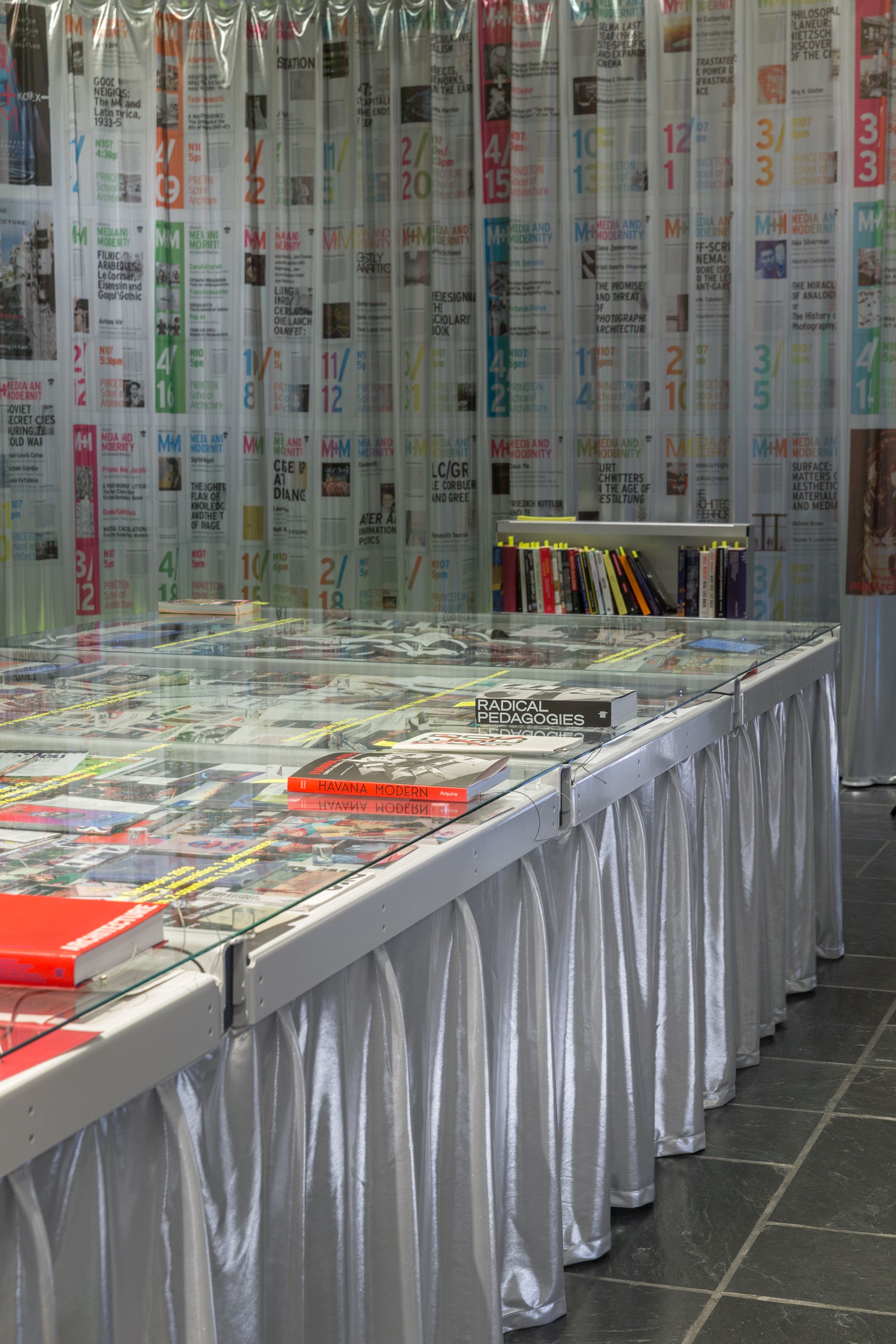
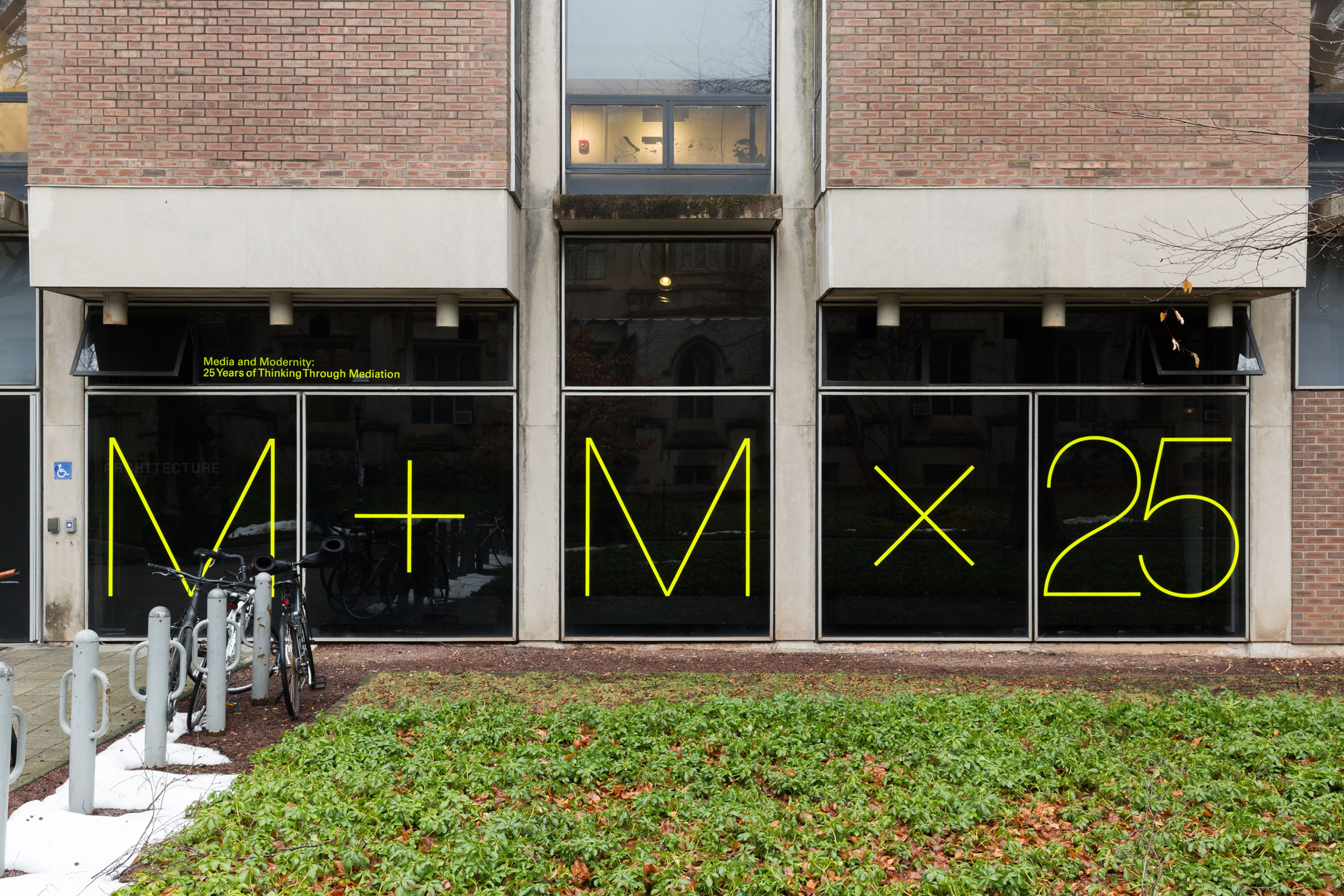
To mark this 25-year collective experiment, Princeton’s School of Architecture presented M+Mx25, an exhibition curated by Beatriz Colomina, Foivos Geralis, and Antonio Cantero, and designed by Agency—Agency, the practice led by Tei Carpenter. The conversation that follows took place inside the gallery, surrounded by a floor-to-ceiling iridescent silver curtain imprinted with the vertiginous density of all the event posters produced by the program: a chronological record of more than 351 visiting speakers over 25 years, and of an interdisciplinary alchemy of bodies, practices, modernities, media, environments, and geographies.
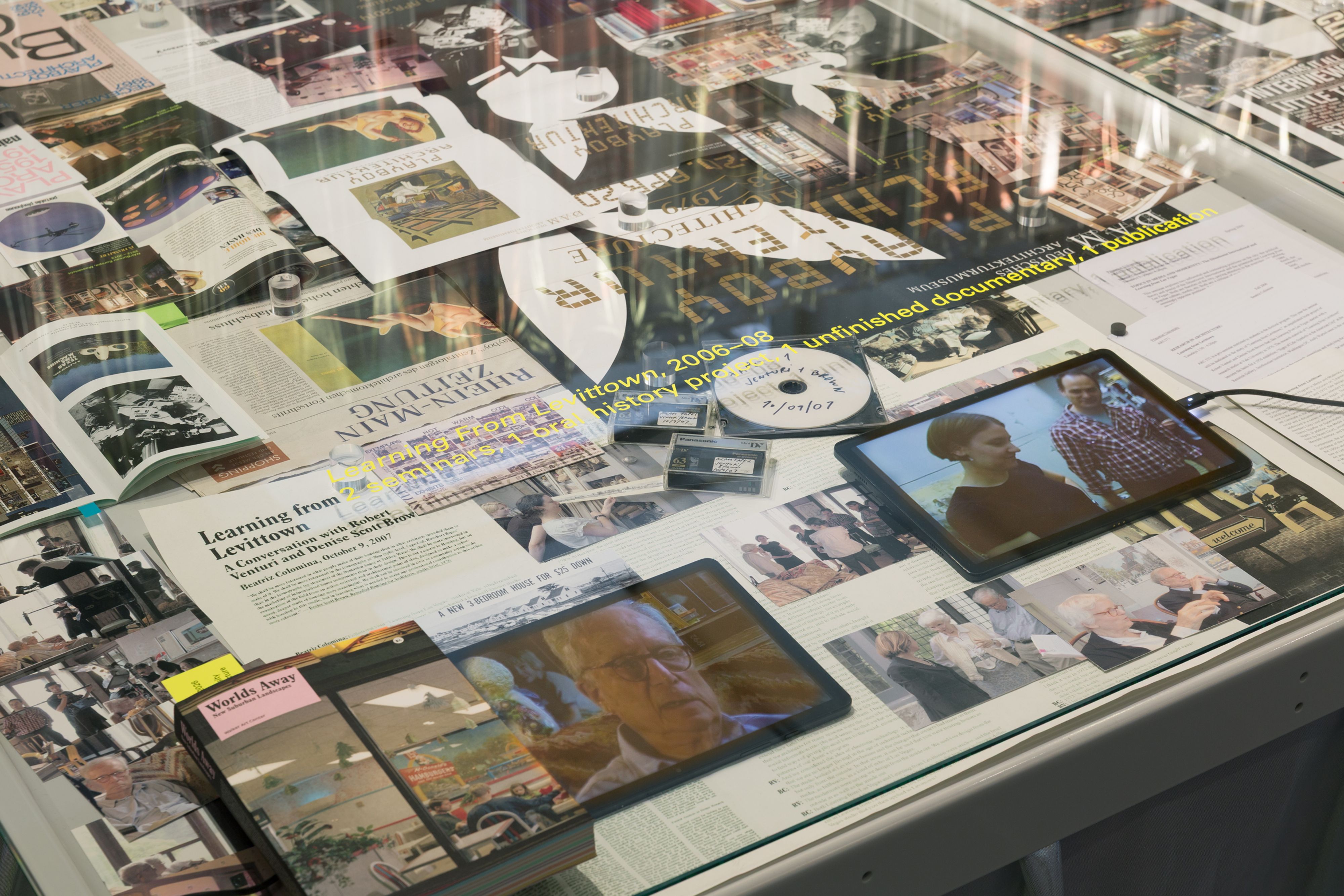
We sat around a long horizontal vitrine, with its own silver skirt, documenting a series of major M+M research projects that produced exhibitions and events around the world, as well as books including Anxious Omniscience: Surveillance and Contemporary Cultural Practice; Cold War – Hot Houses; Clip, Stamp, Fold: The Radical Architecture of Little Magazines; Learning from Levittown; Radical Pedagogy; Playboy Architecture; Liquid La Habana; and Sick Architecture. Large yellow cushions on the floor invited visitors to lounge, watch videos of M+M activities, or browse some of the 130 books presented by the program over the years. Gathered around the table (with me, Valerio Franzone) were some of the faculty who launched the program — Beatriz Colomina, Eduardo Cadava, and Hal Foster — and some of the Ph.D. scholars who helped run it, among them Paul B. Preciado, Craig Buckley, Lydia Kallipoliti, Joaquim Moreno, Pep Avilés, Evangelos Kotsioris, Iván L. Munuera, Iason Stathatos, and Foivos Geralis. Together, they reflected on M+M as a 25-year experiment in radical pedagogy, research, production, community, and communication.
Photography by Ian Byers-Gamber. Courtesy of the Princeton School of Architecture.
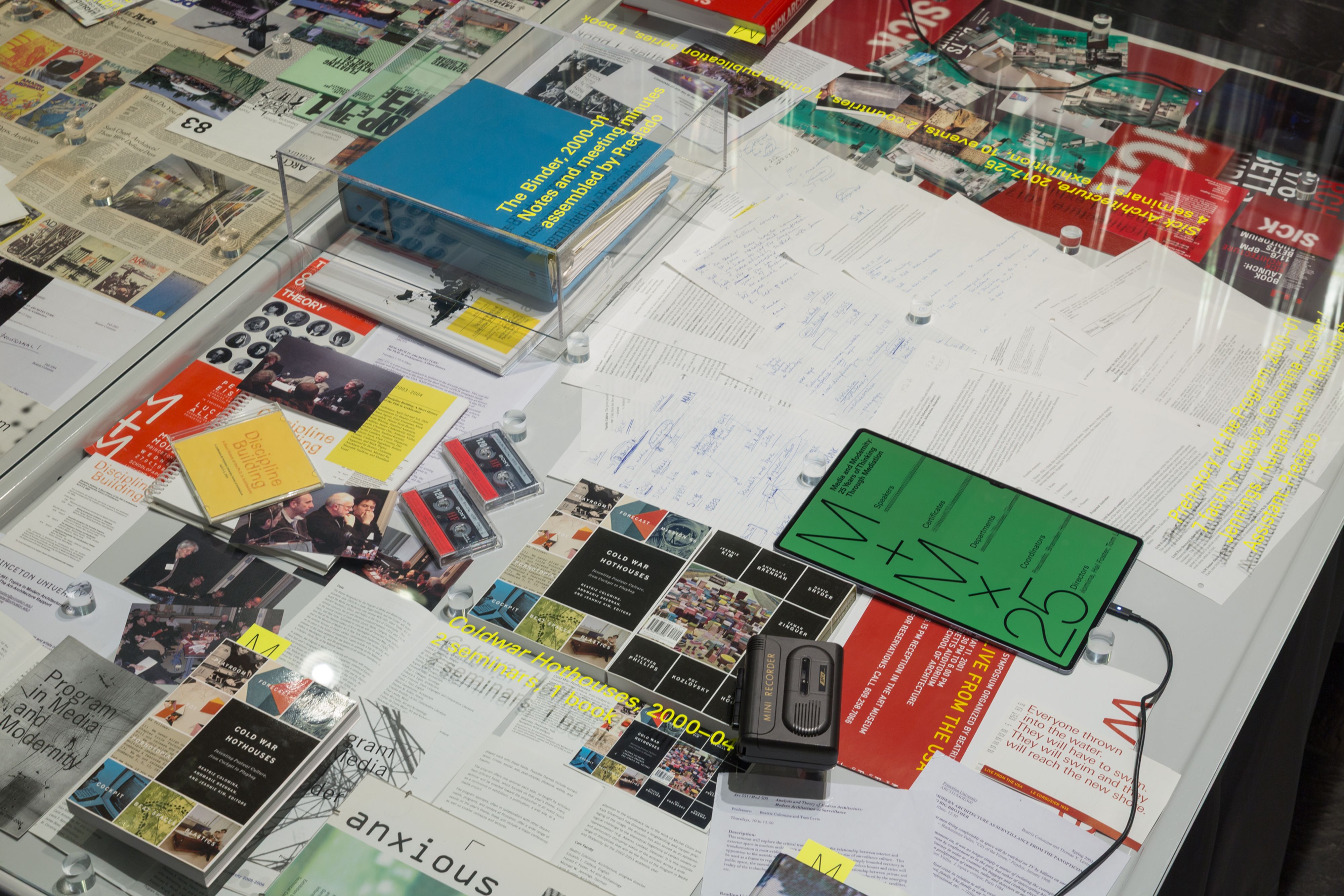
Valerio Franzone: How was the Media and Modernity program born? I find it crucial that in the foundational acts, documented in the blue binder in its own vitrine at the end of the table, you present collective authorship as an imperative, as is evident across all your projects. Given that the M+M was born in the star-architects era, what did collective authorship mean to you?
Beatriz Colomina: M+M was a collective from the beginning. It began in 2000 when a group of us here at Princeton, including Eduardo Cadava, Hal Foster, Tom Levin, Mike Jennings, Anson Rabinbach, and Laura Kurgan, who later went to Columbia University, began a conversation about inventing an interdisciplinary program. It was a year of meetings, all recorded in the blue binder along with emails, notes, and annotations. Paul Preciado, who was then a Ph.D. student and the “secretary” of what would become M+M, put it together. As is often the case with “secretaries,” Paul was a key voice. The binder is an amazing, sometimes hilarious, uncannily prophetic piece of documentation. From the beginning, we discussed interdisciplinarity not as the importation of one discipline into another, or the juxtaposition of disciplines, but as a crossover, an occupation of the interstitial spaces between disciplines. The question of what is authorship in the age of new media immediately came up. We shared the view that it was inherently collective and collaborative. This became an organizing principle. In fact, the ambition was that M+M was itself a form of new media. Media on media.
Eduardo Cadava: Yes, this was the inception. It was a survival hub, a site of gathering.
BC: Exactly. Our gatherings were a hub for survival and resistance against the shit that was happening in our own departments. Paul, do you remember that the school of architecture was about to collapse in 2000 because many faculty members were leaving? I was about to leave too when Hal told me about the possibility of launching an interdisciplinary program that was more focused on the faculty around the University than on individual departments.
Paul B. Preciado: These genealogies are great. I was not coming from architecture but expanding it into other disciplines was already where I stood, given my background in philosophy, gender, and queer studies. Still, Princeton was a place where architectural theory was being reinvented. What was amazing and beautiful about the program was that it offered us something truly experimental. At the time, architectural theory was less normative than other disciplines like sociology, philosophy, or art history, because it had a shorter history and also because of being more porous, it absorbed other methodologies other languages, which has pros and cons. This organic and cannibalistic structure of M+M was fascinating and offered many opportunities. When we started to work on this idea of Media and Modernity, I think that also was very much coming from you, Beatriz, with your obsession with understanding architecture as media. I think that was avant-garde at that point. It was easier for me to inscribe myself within M+M than in a classical history of art or architecture program, because it allowed us to follow very unusual trajectories, such as working on Playboy, which was completely insane. But back then, we didn't realize how new what we were doing was. To see all the material in the exhibition is very beautiful.
We brought gender studies or post-structural philosophy into architecture, and architecture into gender studies and philosophy. It was like understanding architecture as the human exoskeleton, as a general way of thinking, reinscribing it into a longer history of the cultural evolution of bodies, and, on the other side, thinking of architecture as a political infrastructure of society. It was crucial to introduce a much more political language within the reading of architecture, like Foucault’s language on “biopolitics” or Butler’s notions of “performativity” making a dialogue between disciplines essential. Hal can comment on this, as he has introduced psychoanalytic readings in the history of art. Only now do I realize how conservative the history of art and of architecture is. Especially in the history of architecture, the link between capitalism and architecture is so strong that it was embedded in how architecture was taught at the time and was rarely discussed. Even fascism was not fully addressed in the discussions on architecture; it was coming up through anti-colonial, gender, or psychoanalytic readings. But all that came through the M+M program and contributed so much to everything I've been doing since. I feel so privileged to have had the chance of being there from the beginning; it was fantastic. What an adventure.
Photography by Ian Byers-Gamber. Courtesy of the Princeton School of Architecture.
VF: I agree that the history of architecture and art can be conservative, and architectural theory can be as well when it remains trapped within its boundaries. So, going through everything the M+M did and its methodology, I wonder if, being multiple, mutable, non-binary, and, consequently, non-conservative, can be called a queer program.
PP: I wouldn't say queer, because it would be almost a reduction. It is interesting that, because of the program's porosity, it was easier to introduce gender, queer, and decolonial methodologies than in other research frameworks—remember, the discussions in many universities about when anti-colonial methodologies could be used to read classical literary texts, for example. Instead, because of the program's open-ended structure and thanks to Beatriz's methodology of examining infrastructure, images, and packaging, which no one in philosophy was doing, I had the freedom to do something out of the box, like researching the relationship between the pill and the Panopticon. There's a need to reread the history of architecture against the grain, against industrialism, colonialism, and capitalism, and the same goes for queer, non-binary, or trans genealogies within that history, which is still not done completely. So, I wouldn't say the program is queer. Still, it is funky because it is very open and porous, which is great. Obviously, queer methodologies influence it, and hopefully, other emerging critical methodologies will do the same.
Hal Foster: Paul, as you just said, the program is porous: to other disciplines and departments, and to practice as well. It wasn't open just across campus but also to other sites, particularly New York, and that was crucial. There are a couple of Princeton-specific conditions that were key factors. Princeton has historically been quite reserved about contemporary practice, and that was also embedded in the architecture school. By 2000, there was a critical mass of modernists who were also theorists, which I don't think was true historically here. So, thinking about us, having no real venue, we had been drawn like bees to flowers. It was crucial that Princeton, in a way, was late and that there was an urgency and energy to come, talk, and make together. But there was no place for it before this collective enterprise, this program. Then, there were also some obvious but crucial world-historical conditions. 2000 marked a turning point in media technologies, and it was urgent to discuss our position. It was also a decade or more into very advanced neoliberalism, a whole new stage of modernity, which architecture featured very prominently, because the New World Order needed a new world infrastructure. But I believe architects and designers were insufficiently skeptical of their role in this construction. It's also a time of widespread discussion of pragmatism and post-criticality, and many of us were opposed to this direction in the field. So, new media is shaping new humans, and a second or even third Modernity is to be reflected on and intervened in. And that's why the seminar's laboratory model, your invention, Beatriz, is so important, because that methodology allowed the research to get back into the world.
EC: Alongside what Hal and Paul said about porosity, one of the great things about M+M is that it has its home in an architecture school, but it reconceptualizes architecture altogether. What made architecture here is that it was never just itself, because this program has facilitated an entire network of relations–across different disciplines, borders, and collaborations–keeping it vibrant and always in transformation. It has been a model for a transdisciplinary set of practices and for wildly inventive theoretical work.
HF: Probably, there wouldn't be an interdisciplinary Ph.D. in the humanities without the precedent set by M+M.
BC: Other cross-disciplinary programs that emerged later are much more institutionalized and have more means. But I'm glad we are different, because it allowed us to move in more devious and ideal ways. I want to highlight two things: first, this experimental aspect, because what does it mean to do a program for 25 years that is from the beginning experimental and has to keep resisting its own institutionalization? Second, the idea that the program is itself a medium, a way of communicating to the world, that necessarily evolves too.This is the point of the M+Mx25 exhibition, to document the paradox of a 25-year-experiment at the intersection of pedagogy, research, and media production — a program defined by a strange combination of stability and fluidity. On the one hand, the relentless stability of effectively a single ongoing 25-year-seminar held almost every Tuesday evening in the same room with hundreds of guest speakers, many of them visiting multiple times. Some of us being there in almost every event, joined by an ever-evolving cast of new faculty and graduate students. On the other hand, the fluidity of ever-shifting fields, questions, and modes of investigation and communication.
Photography by Ian Byers-Gamber. Courtesy of the Princeton School of Architecture.
VF: This exhibition, rather than merely portraying the program's activities, depicts its methodologies in both research and pedagogy. Consequently, different visitors can make different readings of M+M: chronological, by topic, by idea, or by encounter, and each is valid. What is the curatorial idea?
BC: The exhibition comes out of our accidental archive, all the material traces that the program left behind. It's an archive in progress, because the program continues. It is like an archaeological excavation of an ongoing construction experiment. If you look at the curtain around us, it documents the fluidity of questions over a quarter of a century. Our very first event on Le Corbusier was held in conjunction with an exhibition at the Princeton Museum, which had recently found the scrolls of sketches he drew during the lecture he gave here in 1935. There was Rem Koolhaas, Peter Eisenman, and a galaxy of other stars. Yes, that was the age of stars. But our discourse immediately started to evolve away from such familiar territory. It shifted from an archaeology of media focused on surveillance, radio, and television in the early years to emphasizing environmental, social, material, equity, and ethical issues. It's a very interesting shift. The curtain shows all the ideas coming into the room from all around the university and all around the world, as if condensing and digesting an expanded, ever-growing and changing terrain. On the other hand, the table documents everything that came back out of M+M, the kind of explosion out into the world in the form of research exhibitions, films, performances, symposia, and publications.
Foivos Geralis: Somehow, the idea of all these M+M outputs was already outlined in the blue binder. There's a duality between what happens here, in the seminar room N107, and is all recorded as if in the "black box" of an aircraft, and what radiates out. To put together the exhibition, we had to resolve this tension. So, on the curtain are all the events in the room next door, and on the table are the collaborations between faculty and students from different departments exported to the world.
BC: In a kind of inversion, the outer curtain is the implosion: every idea we brought here to Princeton over 25 years. The central table-like device is like the nuclear reactor, the explosion: everything generated in the interdisciplinary seminars that M+M also ran each semester that then went into the world. What Foivos was saying is crucial because a black box is usually not open to the public. The reality is that the M+M is in the School of Architecture, but it's not of the School of Architecture. Instead, it is like a spaceship that connects different worlds within the University and beyond.
VF: This table is neither a display-like device as seen in other exhibitions nor a typical archive; instead, it is open, allowing you to add or move pieces according to new logics — your next project — and, ideally, for visitors to reorganize it. It is the desk of someone still producing; it is evolving, dynamic, and operational.
BC: Yes. It's a living archive. The exhibition was Antonio Cantero's idea. He came here as a post-doc, even though we don't have post-docs, and started to organize everything into an archive. This happens every year since the program started. People that want to do their Ph.D. in M+M, people that want to be post-docs… But we don’t have Ph.D.s, or post-docs or anything much for that matter. People have always imagined M+M as being much more than it is. This has always puzzled me. But now when I look at the exhibition, and all the stuff that came out of the archives, I realize that it is much bigger than I thought it was. The mythology of the M+M, and how it works in people's imagination, is another interesting question. As is the surprising fact that at the heart of all M+M’s reflection on media is a deeply analog experience, a single usually over-crowded room in which bodies and brains gather. As they say about the 1960s, you have to be there.
FG: Somehow, we also inverted the program's history: the most analog components of the exhibition are on the table, with hand-written notes, drawings, syllabi, ephemera, cassette cases, books, etc. and everything else has been digitized on this silver curtain, which is reflective and, consequently, incorporates the visitors—with the monitors below it showing 3 terabytes of recordings from 25 years of events on a loop.
VF: Without selection?
FG: No selection. In this room, visitors can listen to any event, and on these mobile shelves are the 130 or so books that were presented by the guest speakers in the Tuesday evenings seminars. It allows each visitor to study M+M differently. As you were saying, this is a working archive.
BC: Valerio, you were asking about pedagogy, and this is what one of our early documents states: "One of the aims of the M+M is to explore new pedagogical strategies within the area of multimedia technologies. M+M believes in collective authorship and trans-disciplinary project development. The M+M seminars are oriented towards the production of a multimedia event: from conferences, to exhibitions, to print and online publication, to digital and media projects." Basically, the M+M says no to research without multimedia production. So what's happening on this table is built into the program's DNA.
Photography by Ian Byers-Gamber. Courtesy of the Princeton School of Architecture.
VF: It is a highly subversive DNA because it challenges conventional norms of research in both topics and approaches. For example, I can think of your last project, Sick Architecture.
BC: That's the last exhibition and book we produced. We are already working on new ones, and Sylvia Lavin and I have been teaching a seminar on Nuclear Architectures for the last two years; it's a historically relevant and again urgent topic. We are planning an exhibition in Japan. Also, with Jose Lira, we are doing an exhibition, which will open in August in the Museum of Contemporary Art in São Paulo, based on our joint seminar on the question of living alone. The exhibition combines the work of artists with the work of Ph.D. scholars from different fields here and at USP. The working title is Solo: The Arts of Living Alone Together. M+M is an ongoing experiment.
ED: What Beatriz is saying about this ongoing experiment is extremely important. This exhibition is an effort to mark our 25th anniversary, but everything in it points to how mobile and expansive the project is: nothing is fixed or determined in advance. That anyone can come here and reorganize everything differently marks the possibility of a political gesture. The same happens whenever anyone enters an archive and reorganizes it under different terms. This act helps reconceptualize and rethink the materials at hand.
VF: But exhibitions and archives don't usually allow it.
EC: Yes, it's extremely important to register that it's a living, active archive, and that archives have as much to do with the future as with the past.
VF: Because they are a tool for generating new things.
EC: Exactly. Whatever we're trying to mark doesn't stay in the past.
BC: Right, somebody else will make something of it. Ivan, you were involved in a whole river of things: the seminars on Architecture in the Age of Pandemics, before COVID; the exhibition and book Liquid La Habana: Ice Cream, Rum, Waves, Sweat and Spouts, the performances of The Perversions of the Bauhaus, Bauhaus Datatopia at the Floating University in Berlin, during which you also did Bauhauswelle (Bauhaus On Waves)…
Ivan L. Munuera: Absolutely. But first, I want to return to Valerio's comment on Media and Modernity and star architects and note that even though M&M is not about the stars, we shine like disco balls because we reflect and expand many of the possibilities and things happening elsewhere. The most beautiful part was the unexpected character: somehow, there was never a long-term, strict setup agenda or calendar. Often, we organized things in a week, like when we found out that Cooking Sections was passing by and we invited them. Our very long conversations about possibilities and who had something to say were always an excuse to discuss the topics we wanted to discuss. Interestingly, it was about searching for everything happening both inside and outside Princeton to generate implosions that bring new, stimulating ideas from outside the university, and explosions that establish unprecedented collaborations. It was the case with Ruben Gallo, who was working on a project in Cuba, then started teaching with Beatriz, and then together we formed Liquid La Habana; a similar process happened with Sick Architecture and many other projects. It was a beautiful sort of experimental archaeological site, because it was a constant layering of simultaneous events tested with new ideas for transforming them into different media through collaboration and discussion.
VF: During the pandemic, I watched many online lectures. In particular, I remember presentations by your Ph.D. students on what later became Sick Architecture. In that moment, you were the only ones addressing illness and architecture.
BC: We started reflecting on this topic in 2016-17. Then, during the pandemic, when we were all blocked at home, our friends, Nikolaus Hirsch and Nick Axel from e-flux, asked, "Weren’t you doing a class or something on architecture in the age of pandemics?" I said, "Yes, for some years now". So they proposed publishing the seminar papers as a series on e-flux. Then it grew into an exhibition at CIVA in Brussels, and finally, the book Sick Architecture.
VF: Iason, did you also participate in Sick Architecture?
Iason Stathatos: I started during COVID; it was a very particular moment. As students were in a state of isolation, they went even further in experimenting, in their writing, with media that moved beyond traditional forms, in order to understand the historical terms that had shaped conditions similar to what they were experiencing themselves. In a way, that transitory, online phase reinforced what Beatriz called the mythology of Media and Modernity. This is reflected in the variety of different poster formats seen on the exhibition wall. During COVID, when Clemens Finkelstein was the coordinator, and without the need of printing physical posters, communication took a form that was closer to social media posts. As we transitioned out of COVID, when I assumed these responsibilities, and as we moved back to in-person events, we decided to keep some of these strategies, for example multiplying GIFs and launching a brand-new website. Digital media affects visibility, indeed. The emails we received from around the world increased significantly. We went from the usual requests to do Ph.D.s with us to requests by researchers for access to old lectures. I think it would be fair to say that every person who ever participated in the program would be able to point to a single specimen among the many different posters on this wall, and to an event that proved transformative for their research. The exhibition finally fulfills these different desires, allowing people both to rewatch our lectures and, in some cases, to watch them for the first time.
Photograph by Ian Byers-Gamber Courtesy of the Princeton School of Architecture.
VF: From the Ph.D. seminars to the recent book, it wasn't a reiteration across various media, but a different development of the project, correct?
BC: Every time it was different. Each media transforms not only the message about the architectures of illness but the research into it, and, in reverse, illnesses like Covid transform the media. With Covid, our ongoing research into pandemics throughout history took on a new urgency, transforming us, the research, the media, but also, crucially, our many audiences.
Ivan L. Munuera: I was co-teaching the seminars on pandemics and architecture with Beatriz when COVID happened. That event challenged many common beliefs: we thought that pandemics belonged to the past, that they did not affect certain geographies or bodies; even though we knew that it was not an excuse, it was the way we were living our lives. What is interesting about the Media and Modernity is not that it predicts the future or explores the past, but that it takes the pulse of the present in many different ways: how people work on specific topics, how they collaborate, and how they discuss various disciplines with different audiences.
Lydia Kallipoliti: The isolation of the pandemic is a metaphor of a typical Ph.D. program. A Ph.D. is usually a fairly isolated exercise, while the M+M is not. It was extraordinary that we not only had to curate our own individual research, but also develop what Foivos called outputs — exhibitions and publications — that forced us to engage the outside world. There were real deadlines, to travel to complete the interviews and take the hammers to put everything on the wall on a specific date, which then infiltrated our own work. I think the kind of necessity to land these ideas was transformative. It’s interesting, Beatriz, that you were mentioning a spaceship. In many ways it was, and I love spaceships, as probably a lot of you know, but it was also, at the same time, a kind of landing exercise for all of us to create very tangible media in the world. This experience influenced Ph.D. pedagogy at Princeton and permeated our work, giving us a unique sense of collective authorship and versatility.
Craig Buckley: I arrived from curatorial and cultural studies, not from architecture, and I completely agree: it's unusual to have a Ph.D. program in which students curate and install exhibitions and write and edit articles and books as part of the pedagogical project. These media were not part of the seminar but emerged as a natural development midway through the semester, thanks to the M+M program's space and impetus to produce them.
VF: In this historical moment, when we should discuss the political role and agency of architecture and all its forms of practice, everything discussed here is fundamental. Let’s stay with pedagogy, which is a crucial part of this ongoing experiment. Evangelos, how much was Radical Pedagogies researching avant-garde pedagogies of the past, and how much was it reflecting on the program’s own radical identity?
Evangelos Kotsioris: The M+M was a second education for many of us, beyond the formal educational programs we were in, because everyone came from different environments. It was an opportunity to build a wider constellation of references — authors and approaches — for critical theory than the traditional syllabus, thanks also to the flexibility we discussed. Radical Pedagogy emerged from Beatriz's seminar, and one thing that stood out was her insistence on working with small building blocks that can be assembled into something larger. Many people in Ph.D. programs get paralyzed by the pressure to produce outputs. The biggest virtue of the M+M was its emphasis that synthetic work is as important as analytical work when putting something together, especially when working in the real world, through the design and feedback loop. We used to write a class paper, develop it into a term paper, turn it into an article, which becomes an exhibition, and maybe a book. I strongly support this model of multiple explorative stages, rather than getting it right all the way to the end; it's also a great pedagogical process. When working on the Radical Pedagogies book with Beatriz, Ignacio G. Galán, and Anna-Maria Meister, we had to shepherd so many authors, more than a hundred, that it was like editing 15 or more journal issues.
VF: Was the process always the same: seminars, an exhibition, and a book?
BC: Not always. Sometimes the goal was a film or a performance. Sometimes there were many exhibitions. Radical Pedagogies was first shown at the Lisbon Triennale in 2013, then Rem invited us to the 2014 Venice Biennale, where it became much bigger and won a prize; and in 2015, it went to the Museum of Modern Art in Warsaw. Every time it changed; for example, in Warsaw, we collaborated with scholars on the other side of the Iron Curtain, where very interesting experiments had been conducted. The book gathered all the accumulated layers of this and added more. Every book is more than a documentation of research. It generates new questions and new research.
EK: The other thing about putting a work out in the world is getting feedback on things you missed. This project benefited greatly from voices that fell outside our radar, because it started more as Euro-American but became more global.
BC: Evangelos, you became a curator at MoMA, and, interestingly, many people in the Ph.D. program didn't consider becoming professors of architectural history.
EK: There are two aspects. First, I came to Princeton because I was interested in the making aspect of research, and working on the exhibition made me realize that it is possible to contribute to the discussion and the discipline while also being accessible to everyone. Second, some people in the program found this model challenging to work with. They felt that collective authorship was difficult, and that it would be easier if everyone wrote their own piece. For some others, especially those who came from places where collaborative projects in architecture school are the norm, it felt like an opportunity to pool our research and writing, and see if we could achieve something richer than any one of us could have produced independently.
Photography by Ian Byers-Gamber. Courtesy of the Princeton School of Architecture.
VF: Joaquim, you were also part of Radical Pedagogies, right?
Joaquim Moreno: There's a beautiful offspring of Radical Pedagogies, from when it was exhibited in Venice: The University is Now on Air Broadcasting Modern Architecture; and it is about integrating new media and pedagogy. The Media and Modernity was unique because it generated a large, widely disseminated brain, in which everybody trusts one another — it is a very special network. I'm probably from the first generation, one of those who saw those beautiful brochures. Are they in the exhibition?
BC: Yes, they are included. Valerio, at the beginning, when there were no websites, we used to make these little brochures and distribute them at the start of the year to introduce the program to new students. So, the artifacts on this table show the evolution of media: the brochures, that huge tape recorder, which we used in 2000, the video cassettes, and the DVDs of the film we did with Denise Scott Brown and Robert Venturi. At some point, we had a large website originally designed by Lydia. Then Ivan came and said, “The important thing now is to be on social media," and he put everything on Instagram and Facebook. All this shows how each coordinator shaped the media and technology we used.
JM: Unlike many colleagues, I came from an architecture school. When I got to Media and Modernity and saw the brochure, I thought, "Isn't that the way to enjoy the university as an idea?" and wondered why no one had ever done it before. I am speaking from the point of view of a student landing in a big knowledge pool and positioning themselves within the immersive fun of the university, navigating a knowledge base that is evidently beyond the narrow confines of architecture . And it's that particular wealth, where you can dissolve yourself, having a brain outside your brain, that fluctuates across disciplines, that made M+M enticing. That brochure was the image of that. The M+M was a way for people to be both guests and hosts, a form of very sophisticated hospitality, in the old Derrida sense, and there was also the acknowledgement that architecture was not just a profession, but a form of knowledge-making embedded within other disciplines. Then, at the end, there was the most disarming old-school object based way of learning: "Can you make an exhibition out of your research?" "Can you make a film?" "Can you process something so it will change and be interactive?" Most of my subsequent work was tied to the experiments happening at M+M and the way it makes intelligence flow across borders. A big part of my brain belongs to you all. Thank you.
Lydia Kallipoliti: Joaquim, it's interesting that you describe the crossing of disciplinary boundaries as an act of intelligence, love, and euphoria, and somehow, it is. But I also want to mention that, at a large university, it's difficult to bring different disciplines together because each field is extremely rigorous about defining its boundaries. Bringing different fields together is an act of transgression. Within the context of the Clip, Stamp, Fold, which Craig and I were part of, we went to small villages to interview people no one remembered anymore. So questions like "What is evidence, historically?" or "What is an archive?" were not about going to an established archive, such as the Canadian Centre for Architecture, but about talking to people and making that part of the evidence used to construct historical knowledge. Now, fieldwork in architectural history is considered revolutionary, but we were already doing it 25 years ago. These questions and swimming through different fields have been extremely important for a lot of us, but also painful. While I was doing my Ph.D., I never understood what Paul referred to as the conservatism of architecture and art history until I started working. Anyway, it is a gift to have been a very small part of this program.
VF: What is the university's involvement?
BC: When doing Clip, Stamp, Fold, for example, I didn't find any interest at the University Museum, so I proposed it to Storefront for Art and Architecture, and they accepted it right away, but didn't have the money. We received a grant from the Graham Foundation and, to stay within budget, mounted the exhibition ourselves. The exhibition evolved and was held in 12 cities around the world and reviewed by more than 100 media outlets. So the University's initial disinterest was actually great in launching us outwards. You know, when they got very engaged? With Playboy Architecture. A journalist from the University came to talk to us and photograph us working on the exhibition. They published it in one of their journals.
VF: I can imagine; investigating architecture through the lens of the collective imaginary portrait by Playboy is not just a radical experiment but kind of punk-like shock, and consequently very attractive.
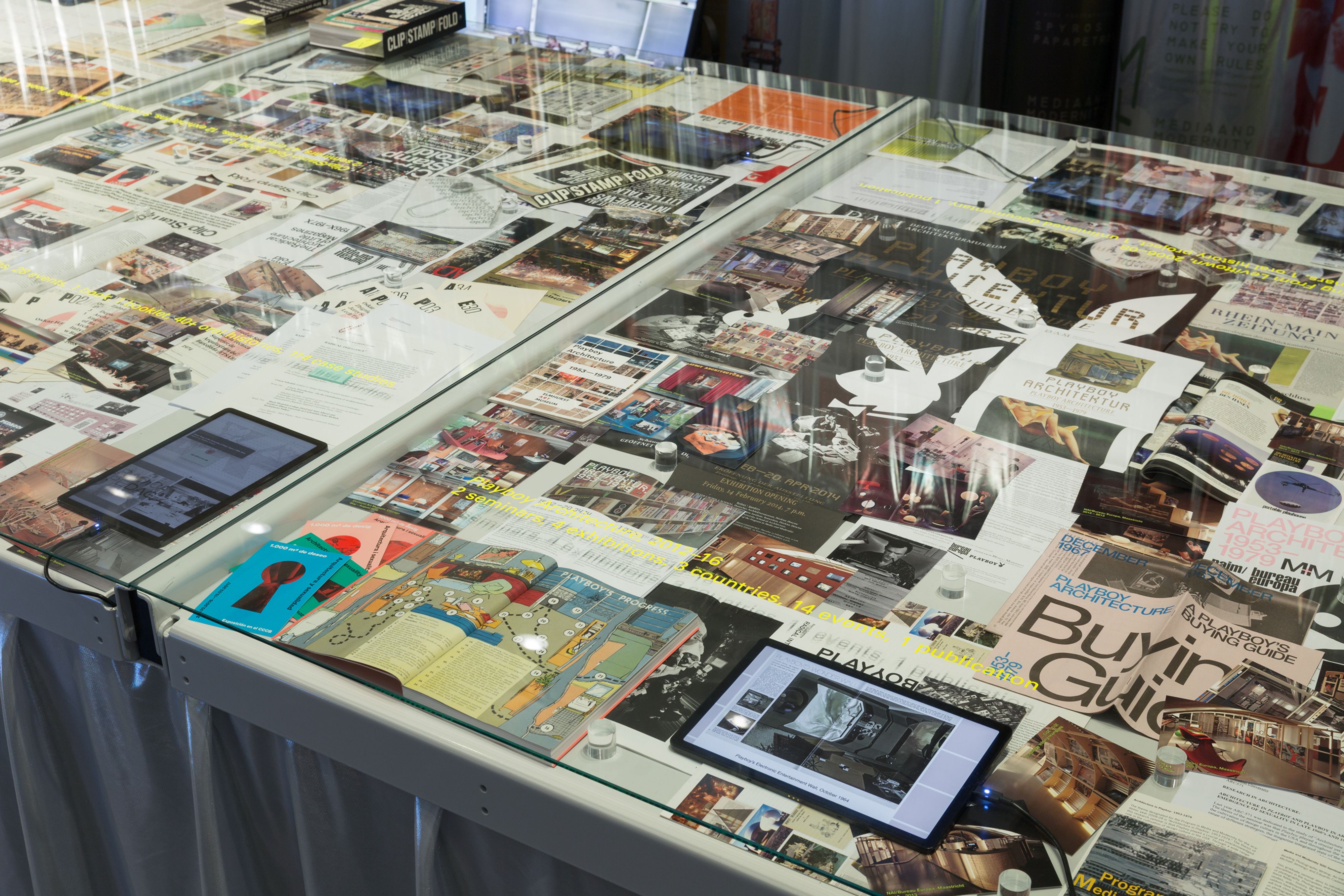
BC: Chip Lord of the radical group Antfarm came to M+M for a talk. I was looking at his CV to introduce him and it was the usual thing: Domus, Lotus, ...and suddenly Playboy! Why was he in Playboy? Craig did an interview with Hans Hollein for Clip, Stamp, Fold and he said his Playboys were confiscated at the border in Moscow. It turns out that many architects of that generation were in Playboy and reading Playboy. So we started researching the relationship between Playboy and architecture. We went through all the issues, studying the advertisements and articles, and realized that architecture was there from the beginning: from Mies van der Rohe in the 1950s to the 70s avant-garde. We did a seminar in 2008–09, Playboy & Architecture—1953–1979, and then a series of exhibitions in the NAi in Maastricht, the DAM in Frankfurt, and the Elmhurst Art Museum by Mies in Chicago. Pep was very involved.
Pep Avilés: I came from a conservative education in architectural history, and I was the only trained architect in my cohort. The program was extremely important for my scholarship; it was a game-changer. It produced a new cartography. There was something very reproductive in M+M from the very beginning: the idea of expanding, both internally and externally, towards new venues and interdisciplinary intersections. Certain topics deserve collaborative efforts, and those efforts can crystallize in this medium. Expanding our projects into other fields was eye-opening. But there was also something else very interesting: the triangulation between the critical, the polemical, and the pedagogical in all the projects. The program meant a re-education for many of us, especially those trained in architecture.
Photograph by Ian Byers-Gamber Courtesy of the Princeton School of Architecture.
Photograph by Ian Byers-Gamber Courtesy of the Princeton School of Architecture.
VF: Let’s remain on Clip, Stamp, Fold: The Radical Architecture of Little Magazines, 196x – 197x, both the exhibitions and the book, because there are several things to highlight. First, during the explosion of digital media, you conceived an exhibition about small editorial experiences from a time when knowledge circulated under a very different paradigm. Then, all those magazines represented the definitive break with modernism and tradition. Finally, this project, like others you have done, affirms that experimentalism in architecture also comes not just from design but also from other forms of practice. How did it all start?
BC: There was an incredible explosion of little magazines during the 60s and 70s. At the time we started the project, there was a lot of interest in the experimental architecture of that period, but the engine of the movement had not yet been revealed. At first, we thought of Archigram and the other usual suspects, but quickly we zoomed into the vast explosion of forgotten publications. To research everything, we divided ourselves among the languages that we knew. For example, Lisa Hsieh went to Japan and unearthed Architext, a magazine that followed Metabolism, but nobody knew anymore. This is an example of what we were saying before: sometimes a project starts from an archive, but it always creates a new archive. With Clip, Stamp, Fold and Radical Pedagogies, we built the archive by going all over the world and interviewing the people behind these magazines and educational experiments. Researching these little magazines, when the internet was first blooming, was an act of archaeology that actually sparked an interesting revival: all of a sudden, many small independent magazines emerged again.
LK: It's also important to highlight that back then, when there was no internet, physical mail was an infrastructure for disseminating ideas. A lot of the people we interviewed said this. The Whole Earth Catalog stated in its mission that it wanted to organize knowledge and create a new system to disseminate it. Steve Jobs later said that the Whole Earth Catalog was a precursor to search engines. So magazines and mail were very important connective tissue, a medium for bringing people together and organizing knowledge. That moment represented an important historical genealogy and pool of knowledge that was first tapped into through this initiative. We found a lot of information in the larger magazines, some of which were following these smaller realities. Looking at Casabella or AD, where I discovered Street Farmer, was crucial to understanding the relationship between the establishment and these more ephemeral and countercultural realities.
CB: The research was a mix of interviews, where each conversation led to another and to a new discovery, and further archival research. Going back to what Evangelos was saying about the tension between individual and collective research, there's so much pressure in academia to produce your own scholarship; that is what's rewarded. Still, this fragile yet exceptional program encourages collective production precisely to follow these tendrils out, so many, in fact, that one could never have followed them individually. It is only when many people discuss and work together that they can bring such a complex landscape back into shape.
BC: It was great to see the enormous effect it had on your individual research.
EC: The collaborative effort is the heartbeat of the program, and I want to emphasize something Beatriz said before, which has become clearer and quite moving as this discussion has unfolded: just how essential everyone has been to the project. It's not just that our work changed over these 25 years in response to changes in our fields and society, but also because of all of you. We learned as much from you as you learned from us. We owe you a lot.
EK: I watched the video of the exhibition opening, and Eduardo, you mentioned that we live in times when it's harder to speak freely, the humanities are under attack, and anything not STEM-related gets put in the crosshairs. Producing work that also shows value and relevance to a broader public, and as a curator, is extremely crucial. Sometimes, this important work produced on this spaceship is perceived as self-absorbed or entirely internal, and thus not useful to society. But I think many of these outputs demonstrate that, unless you keep your eyes open to the present moment that this work is narrating, you are not really living in these times.
VF: Thank you, everyone. It has been a truly stimulating conversation. We have raised many relevant questions—questions we should be asking ourselves more often in these times—regarding the role of architecture and of the other disciplines intertwined with it, the nature of their relationships, the agency of the various forms of architectural practice, the changes that collective practices can bring in society, where architects stand on technology and media, and much more. I must say that I particularly appreciated your chorality; it is a truly rare quality. Thank you very much.
Photography by Ian Byers-Gamber. Courtesy of the Princeton School of Architecture.