NIGHT AT THE MUSEUM
Béatrice Grenier and Jeanne Gang Talk Museum Architecture, the New Fondation Cartier, and Exhibition Making
by Abraham Thomas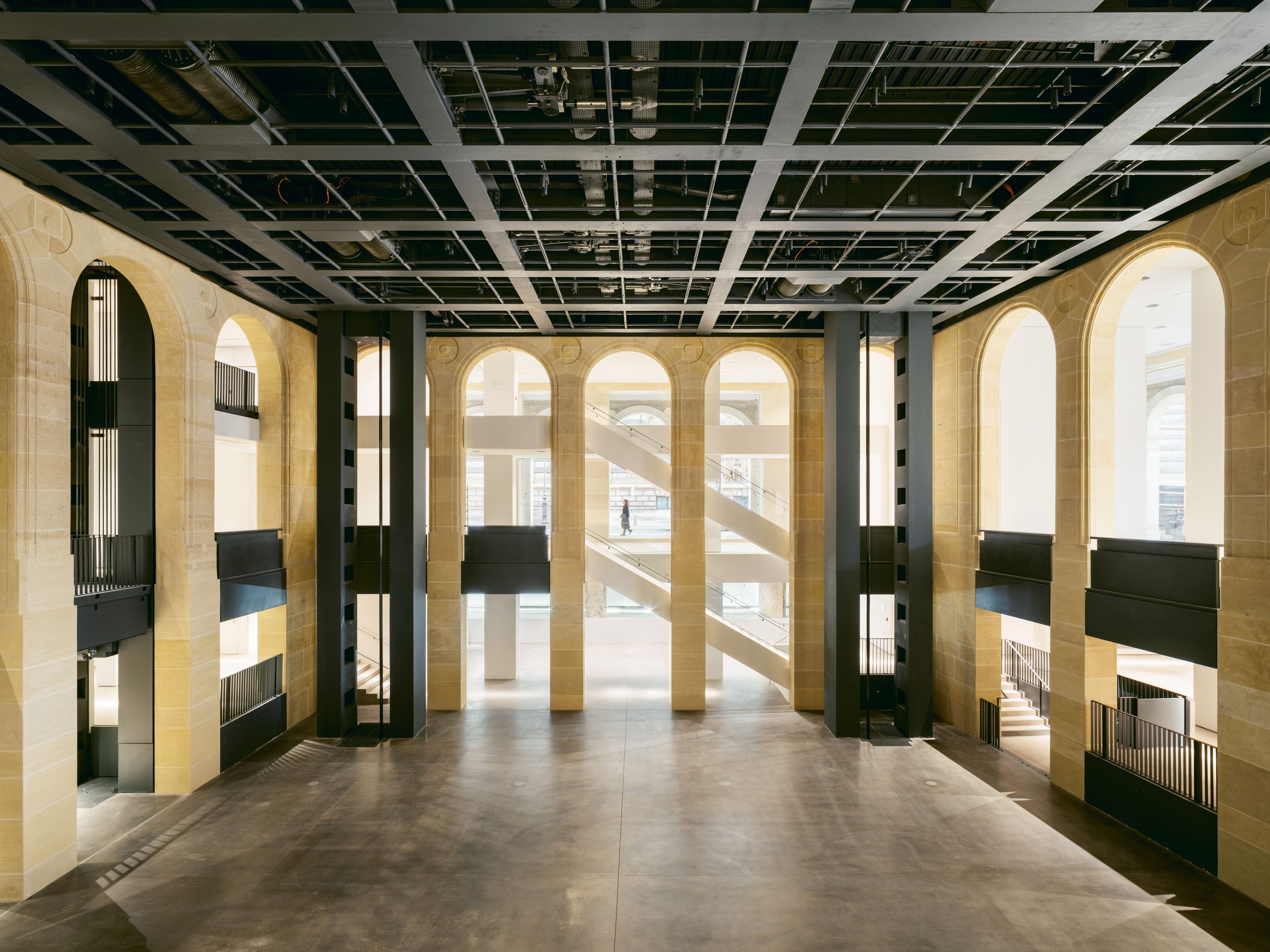
The first courtyard of the Fondation Cartier’s new exhibition spaces at 2 Place du Palais-Royal is an image of contradictions: the mechanic modernity that Jean Nouvel’s architectural project adds to the historical context provocatively clashes with the iconic arcades that line the Rue de Rivoli, synonymous with Haussmann’s city. ©2025 Jean Nouvel/Artists Rights Society (ARS), New York/ADAGP, Paris Photo © Martin Argyroglo.
When the Jean Nouvel-designed Fondation Cartier pour l’art contemporain was relocated to Paris in 1994, it completely upended what the French City of Light — and the world — had understood of gallery design and exhibition making. Rejecting dominant notions of the “white cube,” Nouvel opened the gallery up to its garden and urban context, constructing the eight-story building on 261 Boulevard Raspail entirely out of glass and steel. Six years ago, when Nouvel was again commissioned to relocate the center to the place du Palais-Royal, the mission remained to design a space that was at once fluid and preserving of the architectural and urban traditions surrounding it, while asserting architecture’s role in engineering exhibitions. With the determined flourish of museum architecture in an era marked by the digital, Béatrice Grenier, curator, writer, editor, and Director of Strategic Projects and International Programs at the Fondation Cartier, has been reflecting on the staying power of the museum and its role in pushing the boundaries of contemporary architecture. With her book Architecture for Culture: Rethinking Museums (2025), Grenier considers the typology in relation to multiple themes: from technology to landscape — the latter which she covered in an essay in PIN–UP’s Museum Issue. To celebrate the book’s release in the U.S., Grenier sat in conversation with Jeanne Gang, founding partner of the architecture and urban design practice Studio Gang, for an in-depth conversation around museums for cultural value. In this conversation moderated by the Met’s Daniel Brodsky Curator Abraham Thomas (with questions from the audience), the practitioners think around the museum of today, discussing horticultural grafting as a metaphor for building, how museum architecture could define cultural policy, and why, sometimes, history is written on the second try.
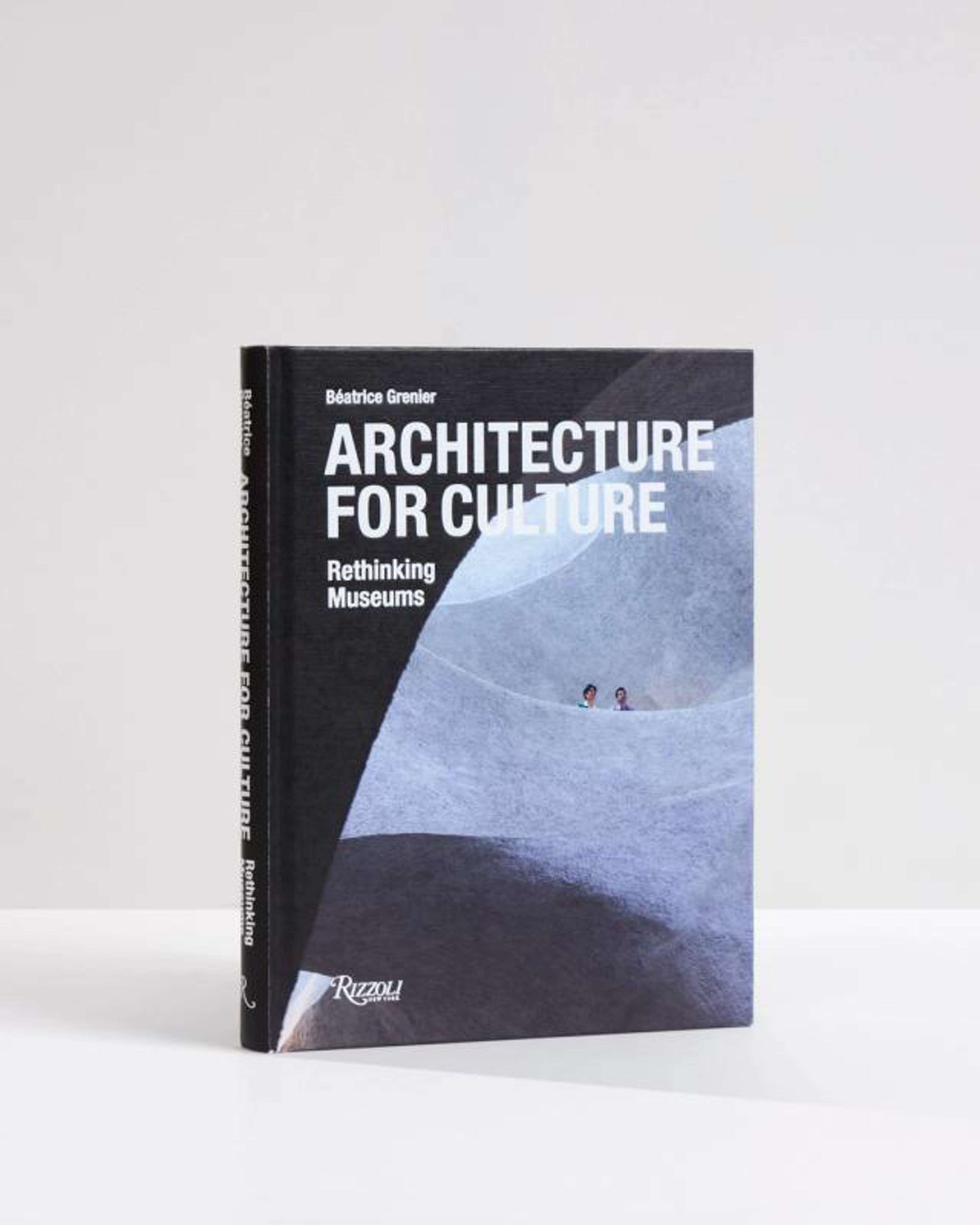
Béatrice Grenier, Architecture for Culture: Rethinking Museums (Rizzoli, 2025).
Abraham Thomas: Béatrice, it’s such a pleasure to be here to talk about your recent book, Architecture for Culture: Rethinking Museums. To me, it’s an especially timely book as so many new museums have opened since it was published at the end of last year — from Princeton University Art Museum and Studio Museum in Harlem last year, to the New Museum and the new Rockefeller Wing at the Met earlier this year. Why this book and why now?
Béatrice Grenier: There were many reasons, but what first sparked me to write this book was that I really wanted to understand why the physical proliferation of museums continues today. It seems like knowledge is more accessible than ever now: in books, on our phones — I mean… [Sighs.] We are able to connect with heritage in so many different ways. Yet, surprisingly, the physical museum hasn’t been dislodged in the urban setting. It seems that we do need this really physical, architectural space to define the museum. The second reason was the fact that throughout my education — which my thesis supervisor might not be happy to hear — I found there to be a lack of art historical answers to why the museum is necessary in a city. Looking more broadly at how architecture and art history curricula are designed, they are always studied separately, with architectural theory and history on one side, and art history on the other: one department has the library and one documents the objects. And we talk about the museum like that too: as building and as an archive of history, separate from each other. This project is about trying to bring the two together, questioning how it is that architecture asserts what a museum is, defines its form, creates the conditions of viewing art, and, in many ways, is the protagonist of how art history ends up being written. My third reason for writing this book is very personal. Six years ago, I started working on the new Fondation Cartier museum right in front of the Louvre, in the center of Paris. In a city composed of museums, where everything is a sort of museum and the place is a microcosm of art history, the question at the center was, “Why build another one?”. You’ll have to search for the answers by reading the book. [Laughs.]
AT: You have done something very powerful with the structure of the book, where you have nine “The Museum Is …” chapters, each with these really compelling endings like “The Drive-Through” and “The City,” which are all metaphors and propositions about what future museums could be and do, versus what they are today. What is the section called “Sprout” about?
BG: Because I’m a curator, I think in concepts. I didn’t want to give a definite history of the museum, because there’s too much, so the idea was to conceive the book as you would an exhibition: selecting paradigm shifting speculative contemporary and historical examples defined a new typology. “Sprout” emerged from looking at Jeanne’s work around museums — specifically her early sketches at the beginning of the Little Rock’s Arkansas Museum of Fine Arts project, which were of a burgeoning literal sprout running through the whole building. As is the case with the Metropolitan Museum, you often see museums as architectural cadavers askew with extension upon extension as galleries get added, collections grow, and the idea of the museum changes. But what Jeanne conceived in Little Rock was the idea that architecture should not just superimpose a new architectural style or discard of what has been done, but continue the museum’s life based on a philosophy of grafting. Applying this horticultural idea of grafting to architecture is really beautiful in its suggestion of architecture as a form of co-authorship, especially in cases of museums where you’re building upon a history, a discipline, a project or typology. It allows the museum itself to define another program and way to program — not just being hypocrisies, endlessly adding to the spiral, but changing things from within.
Jeanne Gang: The idea of grafting started with me thinking about how to reduce carbon emissions and reuse things without keeping them stuck in the same identity they began with. When grafting, you take a very strong root stock and try to create a way for that new graft to live — and that’s not about reproduction but the extension of life. It’s about growing tastier fruit or more beautiful flowers. [Laughs.] Thinking of things through that framework, it’s about asking, “How can an institution continue to live?” and “What are the rules by which it’s going to continue to function?” Just slapping something new onto an existing building doesn’t really meet the criteria, because it might kill that “plant”. You really do have to be in dialogue with what was there, but also consider how things can be unearthed. With our Arkansas Museum of Fine Arts project, it had many things that a museum would want, such as educational spaces, a theatre, and collections, but because the building wasn’t able to extend into its environment, the museum wasn’t fulfilling its mission. We really had to scrape away from what was there to free the museum up to what it wanted to be.
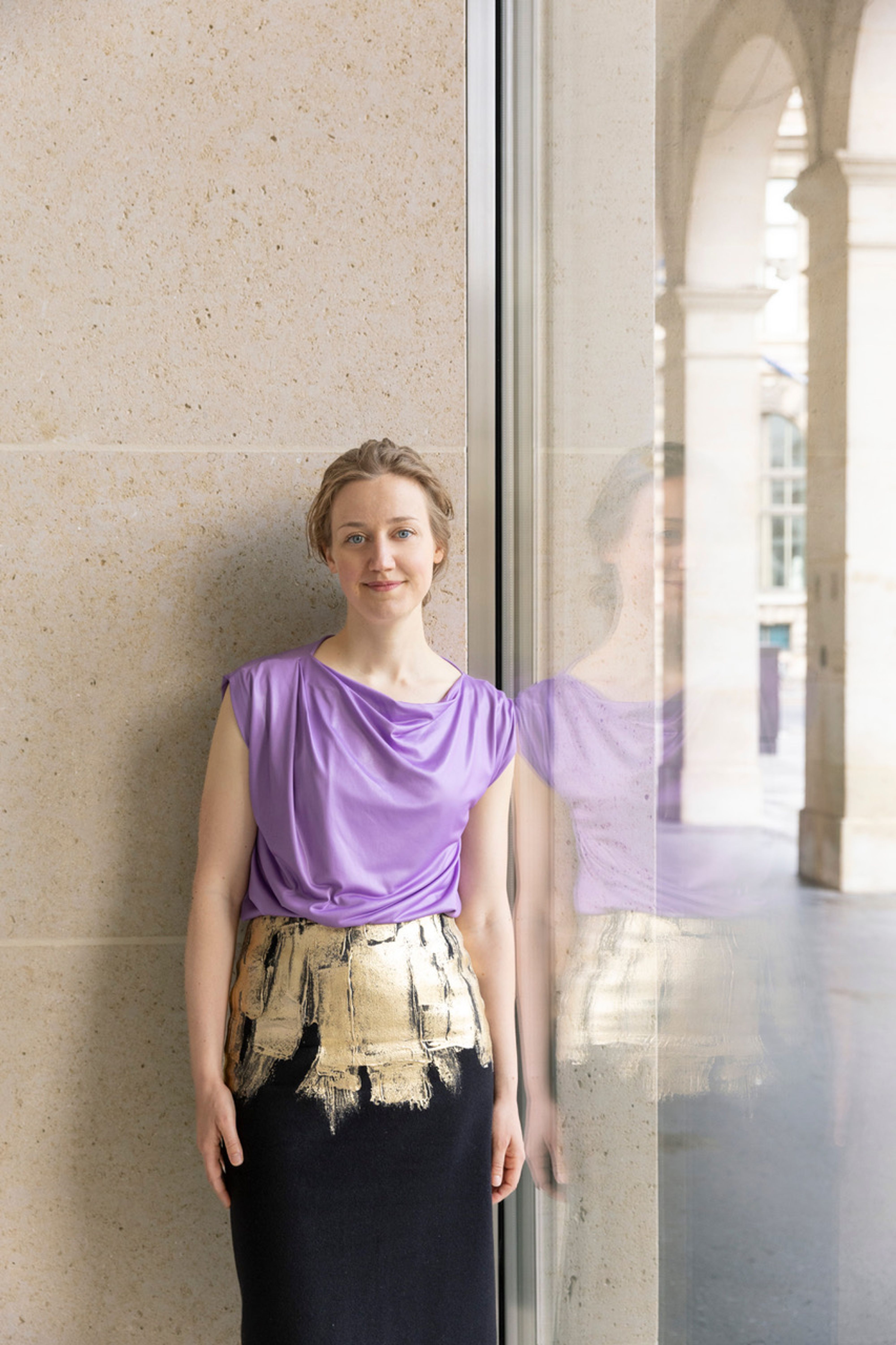
Béatrice Grenier photographed beneath the arcades of Fondation Cartier pour l’art contemporain’s new Jean Nouvel-designed home at 2 Place du Palais-Royal, formerly the Louvre des Antiquaires. Image courtesy of the Fondation Cartier pour l’art contemporain.
AT: You preserved and revealed a beautiful art deco mural on that site. And at the Richard Gilder Center [for Science, Education, and Innovation at the American Museum of Natural History], you revealed, for the first time, a view onto one of the original buildings.
JG: This type of work is a bit like archeology in that you scrape and judge what is valuable underneath. When you’re adding on to a building, you really have to understand what exists.
BG: In addition to grafting, another incredible thing that you introduced with the American Museum of Natural History was a formal proposition for the city of what architecture can represent in our relationship to nature. I really insisted on presenting that project as an example in the book when talking about the landscape dimension of the museum’s potential.
JG: I really love how you approached those concept chapters because the book is not about different styles of buildings from different eras. It gets to the core of how these buildings are organized and their relationship to the collection, the visitors, and the outside. What you highlighted about the American Museum of Natural History in “Landscape” — that maybe instead of being an institution that’s set within a landscape, it brings the landscape in — is true. It really starts to speak to the content of the Museum with their natural collections, and puts it into a setting that is unusual for a museum but seemed appropriate with this feeling of discovery and flow that you face when moving through the cavernous space. We built that space by creating a structure on existing columns, so the arching and cave-like form is actually essential to the building, supporting the new floors. It also has no finishes, so it feels raw and like the collections within the Museum.
AT: The entrance on Columbus Avenue feels so radically different compared to Central Park West, which has that very austere, Beaux-Arts façade. Its grotto-like entrance feels so much more welcoming and organic, and it’s a much more seamless entrance from street level, which I love.
JG: Because those two entrances are on an axis with each other, we really wanted to keep them in relationship while still having some differences. For the new Columbus Avenue entrance, we used the same [Milford Pink Granite] as the original Central Park West entrance, even reopening the same [1930s] quarry it was sourced from in Massachusetts, and sourcing from there. With the buildings themselves, I don’t even see the Center as a total departure because there are a lot of curves in the original building. I see them as compatible and related, and that kind of graft can live because there’s a commonality there.
AT: Another one of my favorite sections of the book, which also has one of the best titles, is “The Drive-Through.” Béatrice, you cover a number of projects there, opening with the Centre Pompidou and discussing ideas ranging from the billboard to responses to technology such as the car. Can you talk a bit about that section?
BG: I was obsessed with thinking about how museum architecture responds to the technologies of the times. Because, of course, art has always been a form of technology — and we are, again, in a period of immense technological innovation, I wanted to look back at different moments where technology completely changed urbanism forever. It was about thinking about what the museum of that time was and asking what the museum of today should be. Looking at the 60s and 70s, when the car became the most widely available technology for the widest range of people, I went back to Broadacre City, where Frank Lloyd Wright anticipated that the car would change and project the city everywhere. It was the idea that you would go into your car, turn on the radio, and have the city there, ubiquitous. Because Renzo Piano and Richard Rogers originally imagined Centre Pompidou’s function as a billboard, with the façade as a screen that students and the public could use to communicate, and the billboard is the ultimate architectural form that can have a relationship with the city at the scale of the car, that’s the museum that architecturally defines that era to me. The Piazza in front of the Forum was precisely meant for a very literal and physical dialogue with the city. It didn’t materialize then, but during the 2024 Paris Olympics, Nike, the marketing geniuses that they are, used the Pompidou’s façade as it should have been: for advertisement.
The corporate relationship with the public museum is a very delicate subject and a lot of people were taken aback by that. But, it was a culturally important gesture, because it allowed the museum to speak to these younger audiences who would have never entered into Centre Pompidou. It brought together all my thinking in the book around architecture’s agency in defining a cultural policy that can create a paradigm shift. Also, the building’s exposed escalator structure inspired [Tinker Hatfield to expose] the air cushions in the Nike Air Max.
AT: Reflecting on Archigram and Cedric Price’s Fun Palace as references for the Pompidou, there was that promise that architecture could define new forms of art and institutions — even if that didn’t end up happening with the Pompidou.
JG: I like that the architecture is coming into the conversation because, like Béatrice said, it’s always been separated from the study of the art itself. That there is a kind of reciprocity between the architecture and the objects inside the museum brings me to the chapter about the machine and flexibility. One of my first projects at OMA was Maison à Bordeaux, which was a house for a disabled client with a room that could move vertically through each floor of the house, allowing him to access these different spaces. When I first saw the model for the new Fondation Cartier, [with the movable platform gallery spaces], I was flabbergasted because I thought it was hard doing that for a house. Imagine doing it for a museum. [Laughs.] But that’s exactly what you did.
BG: Not me. Jean Nouvel. [Laughs.] I like to think that sometimes the history of architecture and art is written with the second project, although the first project changes anything. In the end, the architecture of the Pompidou didn’t quite achieve the ideal of the Fun Palace — it didn’t move. But it did have this extraordinary historical impact, introducing the idea that cultural institutions could move — or at least include a mandate in their cultural policy to help transform the city. For decades the Pompidou’s programming showed this consciousness of responsibility to introduce technology into the city and identify new forms of art. A few years after its opening, it presented Les Immatériaux, which brought technological objects like the walkie talkie, photocopier, and computer into a museum setting for the first time, literally saying, “This is the new postmodern condition.” In the same way, I like to think that OMA creating something completely new for domestic space and mobility with Maison à Bordeaux emerged from Jean Prouvé’s 1939 Maison du Peuple, which took the idea that architecture should move from mechanical innovation, and had a movable floor mechanism to adjust to its different programs. The Fondation Cartier realizes the unfinished dreams of the Fun Palace, allowing the cultural institution to introduce a new architecture for every major exhibition. But it also creates a major shift in museography because it says that the museum is not only there to accumulate objects, but to produce change and ideas.
AT: Watching the street and object choreography from inside of the museum, in a way, is as you might do in a commercial shopping space.
BG: The building once being home to the Grands Magasins du Louvre is extremely interesting from an architectural standpoint, because the department store was so important in democratizing display and making objects cognitively available to the city. In the new Fondation Cartier, the city is inside the building but you are also looking at art outside the building. It’s the ultimate symbol of modernization vis-à-vis, right in front of the Louvre, which is a former palace that enclosed art from the city. And Jean Nouvel’s project is the complete opposite: the museum spills out into the city and there is no museum without it. Working with him on this project for the last five years really influenced my thinking about what the place of the city is in the museum, and vice versa.
JG: I appreciate that that crossover comes through in the book, because you could read some of these projects in multiple chapters.
BG: It’s important to leave the museum open for the audience’s appropriation. I don’t think there is a finite idea of the museum. New ideas are welcome, which is what gives the book its speculative tone. And this notion of fiction, especially in encyclopedic museums, is really important. That’s why I love the way the Met, for example, redesigned the roof and lighting of the European painting galleries in a way that has so much self reflexivity that it opens up the idea that Europe as a category is always changing, especially with its current fraught political climate. It shows that this instability of categories is really longstanding.
AT: Béatrice, you explore this idea of new narratives in the “Fiction” chapter, which brings up what you said about how temporary exhibitions exist within a permanent museum spaces. Jeanne, you’ve designed a number of exhibitions, including your own Studio Gang exhibition at the Art Institute of Chicago in 2012 and The Living Orders of Venice for the Venice Biennale last year. Could you share your thoughts on the role of temporary exhibitions to assign these new narratives?
JG: At the studio we think of the exhibition as a production of knowledge and an experiment that may one day find its way to a building. It’s really a chance to generate and test new ideas and concepts, and that’s why I really enjoy making them.
Audience Member: Béatrice, I love that you referred to painting a form of technology. Could you explain that and list some more things that are technology but often get overlooked?
BG: Today, the most critical place for museums to let technology enter is in our relationship towards nature. In 2024, Jeanne and I were invited to contribute to The Mondrian Initiative residency where we began exploring designing a museum that integrates not only the history of art, but natural history, creating a new temple for artifacts of nature as well as traditional artifacts like paintings. Working on this with [philosopher] Emanuele Coccia, we started to conceive the city itself, which is a human invention that is necessary to defining how we live, as a form of technology. And I think that the museum today is at this interesting point where it can play a role in redefining this technology.
Audience Member: As buildings shape the identities of institutions, the first Jean Nouvel building shaped a lot of what the Fondation Cartier is today. What will stay from that in this new building?
BG: Just as Jeanne’s role in giving the American Museum of Natural History a new identity was so important in redefining our relationship towards nature, one of the really beautiful attributes of the former Fondation Cartier was how the glass building intertwined with the surrounding garden, like an inside-out diorama. That played a huge role in the museum’s program, leading to exhibitions about the natural world as a form of art and putting botanical vocabulary into our culture. That is something we’re looking to preserve, especially since the natural world isn’t so apparent in the new architecture. Conversely, something that was absent from the former building, but is completely implicated in the new urban setting and architecture, is this openness onto the city — and the relationship with Paris’s historical center. That gives the institution a new responsibility, because it means it’s no longer programming for its own spaces, but has an incentive to communicate, reach out, and shape cultural policy.
Audience Member: These days we hear a lot about the museum being a place for social gathering and exchange within an evermore stratified and divided society. Having finished the book, how optimistic do you feel about that?
BG: I’m an eternal optimist about the museum. It’s possible, but not without serious cultural work. Curators have an immense responsibility to help shape that culture of inclusivity, dialogue, and collaboration, but it has to be done in real ways. It’s not enough to design spaces where one is supposed to gather. It’s about programming those spaces. It’s about designing exhibitions that rethink historical categories, democratize other types of technologies, bring in what we never think of as art and identify it as the future of the discipline.
JG: It’s not just about providing space for those interchanges to happen either, but about realizing that there have to be gaps in those spaces that provide human comfort. Humans need to be in dialogue with each other. We learn more from discussing what we’ve seen than we do from reading the plaque about what we’ve seen. For the architecture to make those kinds of spaces it needs to be a looser fit, like in the American Museum of Natural History, where we designed various spaces to just sit. It’s about thinking about the way we interact. Gathering is crucial for where we’re at.
AT: I love seeing how the front steps of the Met get appropriated by the public, even though it’s technically part of the private museum. It’s so organic, it’s wonderful.
JG: With the [Memphis Riverfront Concept], we designed a public canopy with these giant swings with dimensions just large enough that you can swing with a stranger and feel comfortable enough to talk. I have seen it work, and it’s so exciting to think that maybe we just don’t know enough about dimensions yet to make it possible for people to have these exchanges all the time.
AT: One of the things I’ve always been interested in is how architecture might allow museums to project spaces where one can prototype ideas. We don’t do that very often. It’s often about showing the finished product in a big, polished exhibition. But to be able to use architecture in a way to create a space that’s a bit more vulnerable and ambiguous would be interesting.
JG: That you don’t always have to give information is something that the American Museum of Natural History thought about a lot for the [Davis Family Butterfly Vivarium]. Sometimes you just let people stand there and have butterflies land on them. That’s it! [Laughs.]
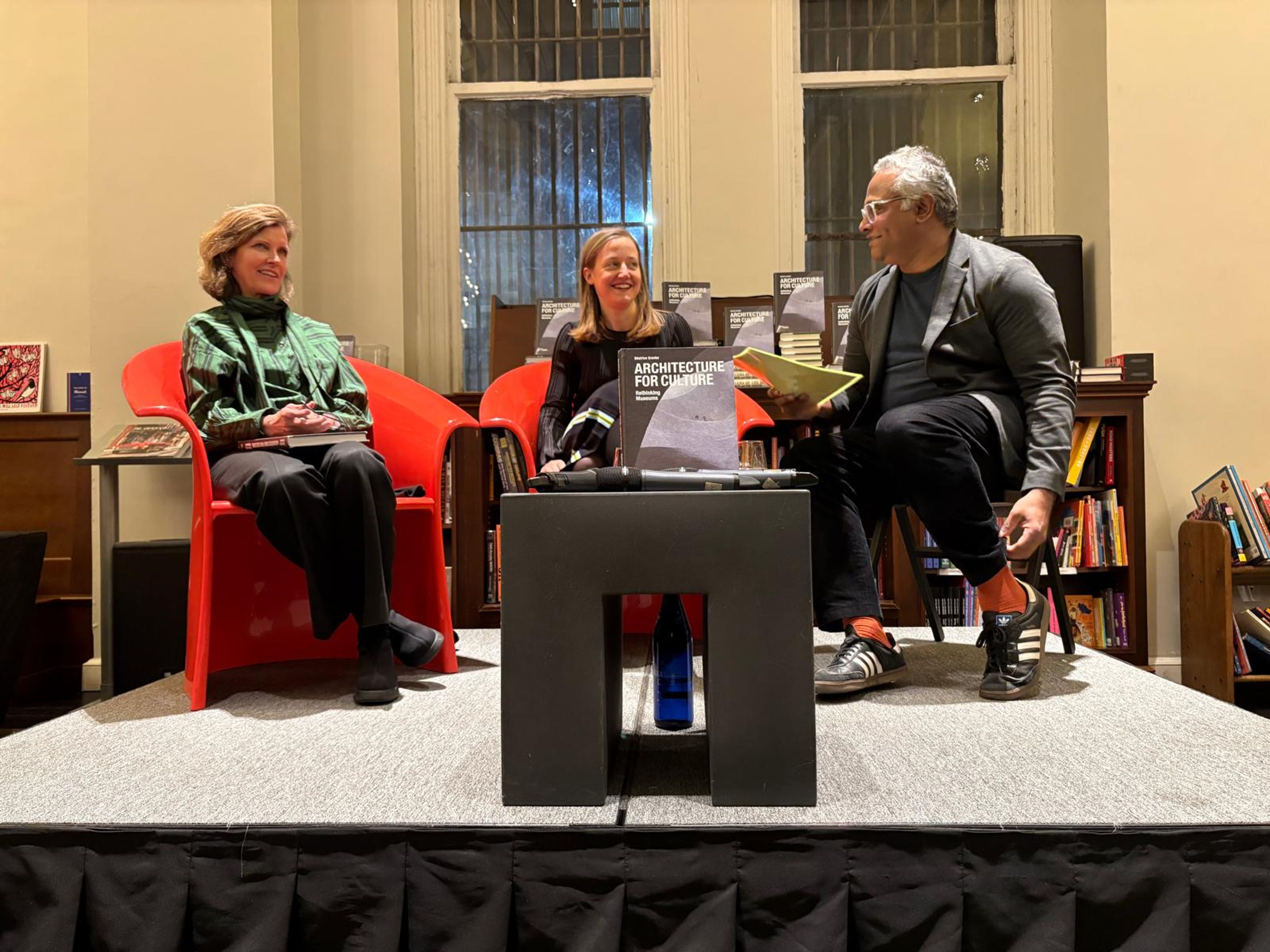
Jeanne Gang, Béatrice Grenier, and Abraham Thomas in conversation at Rizzoli Bookstore, New York City, January 6, 2026. Image courtesy of Béatrice Grenier.