SURVEILLANCE DATE
On Hidden-Camera Reality Shows and the Sets That Made Them
by Ellie Glass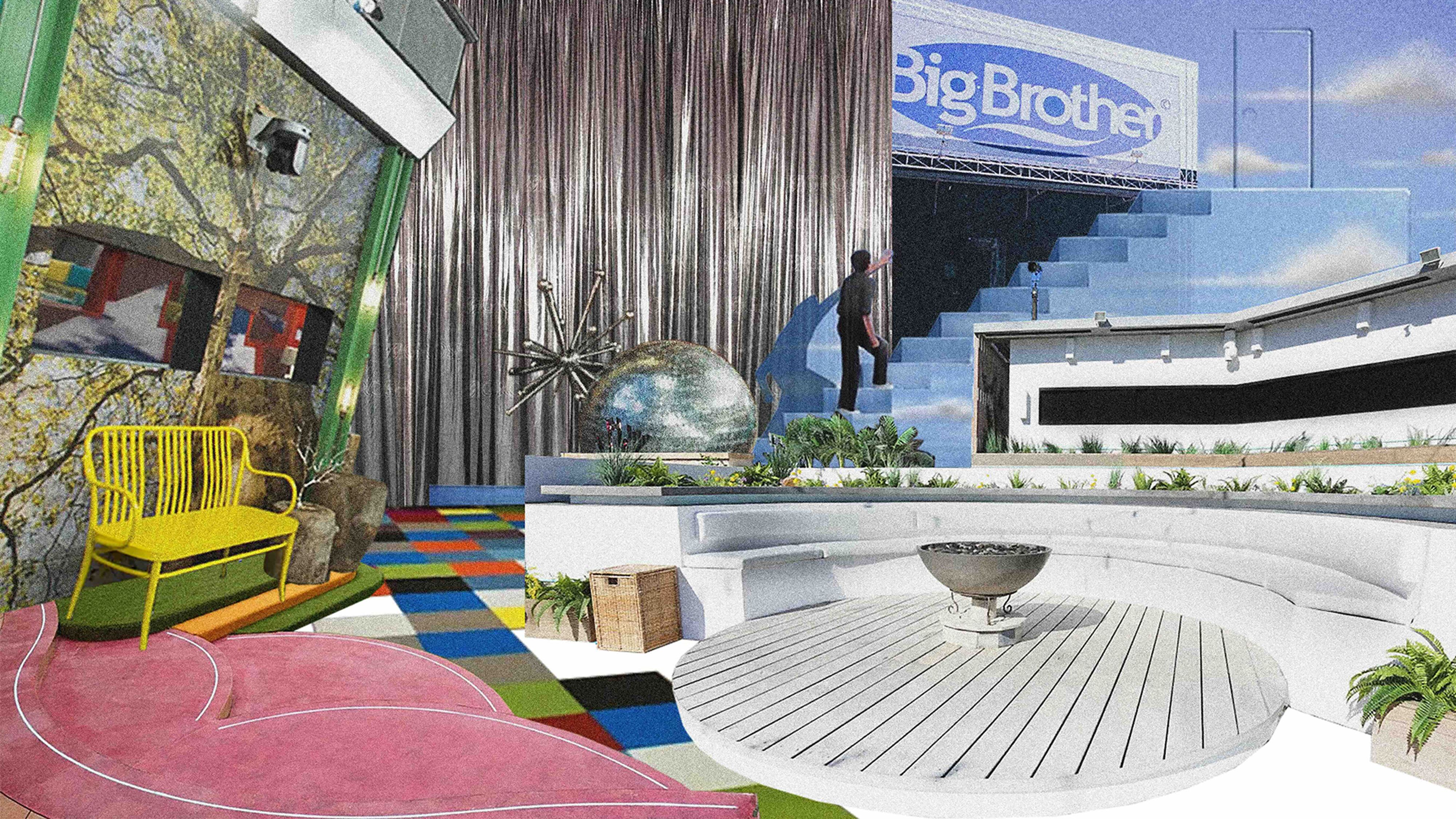
“The Villa is the pinnacle of an uncanny, staged architecture that has developed over decades, starting with The Truman Show’s cautionary tale against 24/7 surveillance and the reality TV sets that followed, building on its premise without heeding its critical concerns.” Collage by Kassidy Miller for PIN–UP.
A patio opens out to South Pacific breezes. Humid air sets the string lights swaying, and creates corduroy ripples across the swimming pool. Ferns, ivy, and pothos cover almost every surface. Mostly they are made of plastic, but they add life to the set without disrupting continuity — and, importantly, they can easily be moved so as not to get in the way of the cameras.
In recent years, Love Island USA has earned its way into the global order of dating franchises, edging out institutions like The Bachelor and The Bachelorette from the Zeitgeist. Aside from its dramatic romances and heavy-handed sexuality, part of what makes the series so compelling is its architecture. A panopticon lit by neon signs, the Villa successfully gives audiences what they most want: unfettered access. In an age where many voluntarily broadcast life’s most intimate moments to their followers, Love Island unlocked the optimal TV formula, satisfying a voyeuristic hunger with nightly episodes captured by roughly 70 cameras installed throughout the Villa.
The Villa is the pinnacle of an uncanny, staged architecture that has developed over decades, starting with The Truman Show’s cautionary tale against 24/7 surveillance and the reality TV sets that followed, building on its premise without heeding its critical concerns. Peter Weir’s 1998 film starring Jim Carrey centered on Truman Burbank’s life in the picture-perfect town of Seahaven, captured on thousands of cameras concealed amongst the crisp white homes. Viewers register the texturelessness of Seahaven with unease: it appears fabricated, like every blade of grass was placed by a man with a set of tweezers. As Truman discovers that his life has been manipulated and broadcast without his knowledge, every phony smile from a neighbor radiates uncanny falseness. He recalls happy memories with horror, his new knowledge coloring them nightmarish. For decades, a global audience went to The Truman Show for entertainment and comfort, justifying the surveillance and lies as a means to an end. As he tries to escape, the show’s producers employ every tactic to force him to submit and accept his powerlessness.
One year later, contestants of CBS’s Big Brother entered a panopticon by choice.
And so the great experiment of reality TV began in earnest. On the show — cheekily named for the totalitarian leader in George Orwell’s 1984 — a cast withstands over 80 days of surveillance for a chance at a six-figure cash prize. Constructed on a soundstage in Studio City, contestants enter the Big Brother house through a portal in front of a live studio audience. They emerge into a fluorescent-lit labyrinth fitted out with cameras both seen and unseen. The set has no windows to the outside, but instead dozens of one-way mirrors concealing the eyes of production. The open-air backyard, though walled in, simulates nature with AstroTurf and wallcoverings of blue skies, trees, or waterfalls.
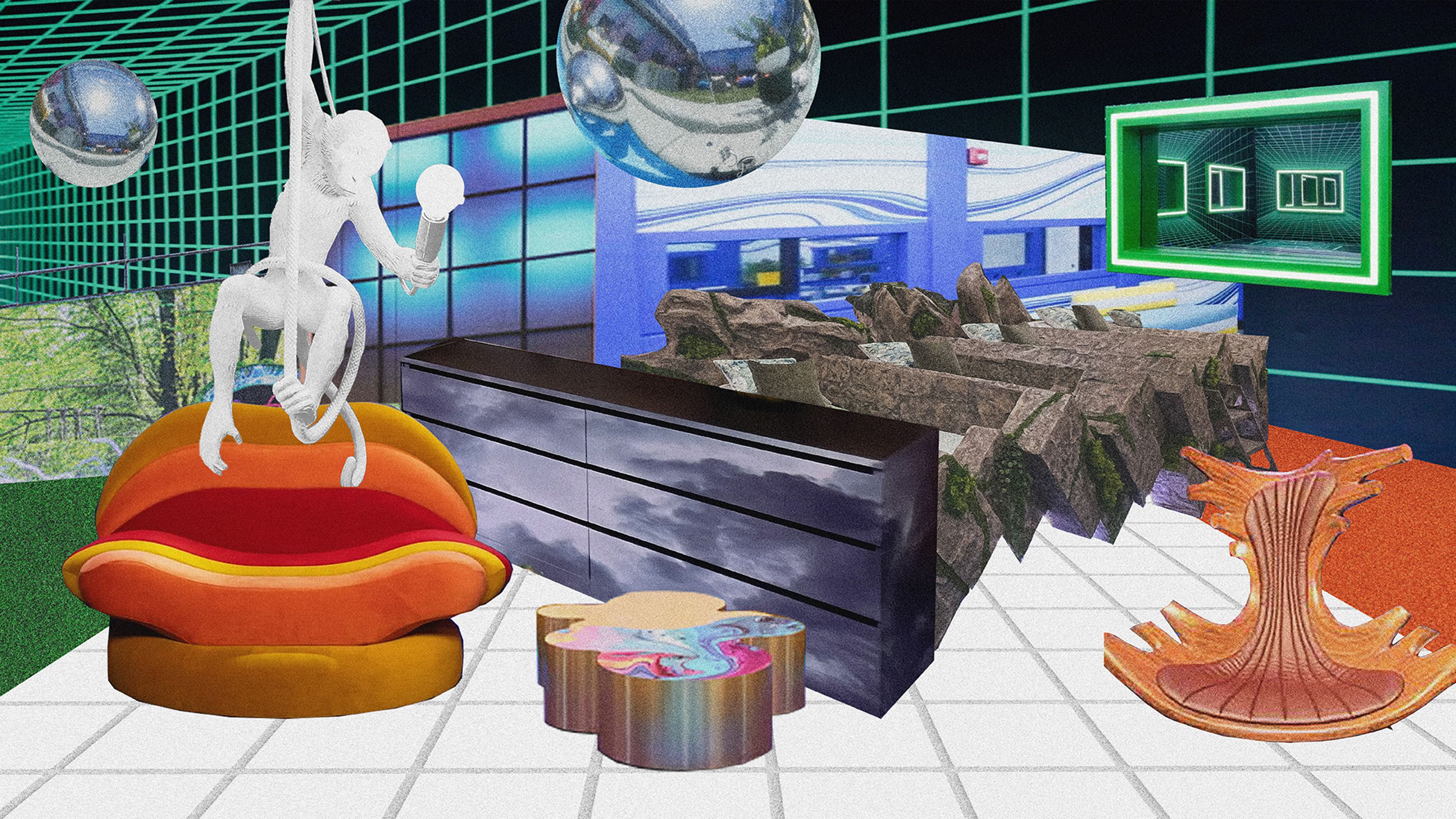
“A panopticon lit by neon signs, the Villa successfully gives audiences what they most want: unfettered access.” Collage by Kassidy Miller for PIN–UP.
Luckily, on Big Brother, natural scenery matters far less than the interior views offered to the audience, the result of prolific reality TV set designer Scott Storey’s work, whose credits also span RuPaul’s Drag Race, the MTV Video Music Awards, America’s Funniest Home Videos. Storey has designed the set for the past 20 years, driving the house’s distinct look and helping pioneer the production techniques of reality TV.
When the show began, the house was decorated in a “modern contemporary” style, but later seasons incorporated elaborate themes like “Southern California” or “Tokyo Pop.” Recurring design techniques include vibrant wallpapers covered in blown-up patterns; all-over frescos or finishes; Claes Oldenburg-esque sculptures of oversized objects; beds resembling cars, canoes, pool floats, fire trucks, airplane seats, crime scene chalk outlines, clouds and crescents. Cast members may believe that the house’s theme is relevant to the game itself, but any symbolism is a multicolored herring. The set is a background character, whose true utility is in service to the cameras, moving the plot forward in subliminal ways. “It’s important to be able to say, ‘Okay, I want the cast to behave this way. I want to set up areas where they whisper. I want to set up areas where they’re vulnerable,’” Storey explained.
This same logic applies to the set of Love Island USA, designed by the virtuosic Richard Jensen of The Biggest Loser and Bachelor Nation provenance. The vacation rental in Fiji is a sort of white-boxed anyplace, with a thick coating of millennial American brunch-core. Although the Villa is an actual house, its back patio reads almost as a stage. As the arena for much of the action, the yard’s canopies and cabanas compose three sides of a box, which wraps around a customarily unused pool. Circulating like sassy Sims, the sunkissed contestants stand out against the visually stark backdrop.
On Love Island, round, raised platforms — especially the Fire Pit — act as the show’s nerve centers. Islanders gather there, elevated and in full view of the cameras, for many of the show’s most dramatic moments. Curvilinear daybeds and banquettes stationed throughout the Villa urge contestants closer and amplify the perceived intimacy of any conversation. The show’s set designers speak openly about the pervasive circle motif as a tool of panopticon-style manipulation, offering no corners for cover. “The house is all clustered in a way that’s kind of spread out towards the periphery, and then in the center, there’s this huge void space. It’s like, ‘Oh, that’s definitely where all the cameras are, that’s where I should be,’” design content creator and commentator Reeves Connelly explains.
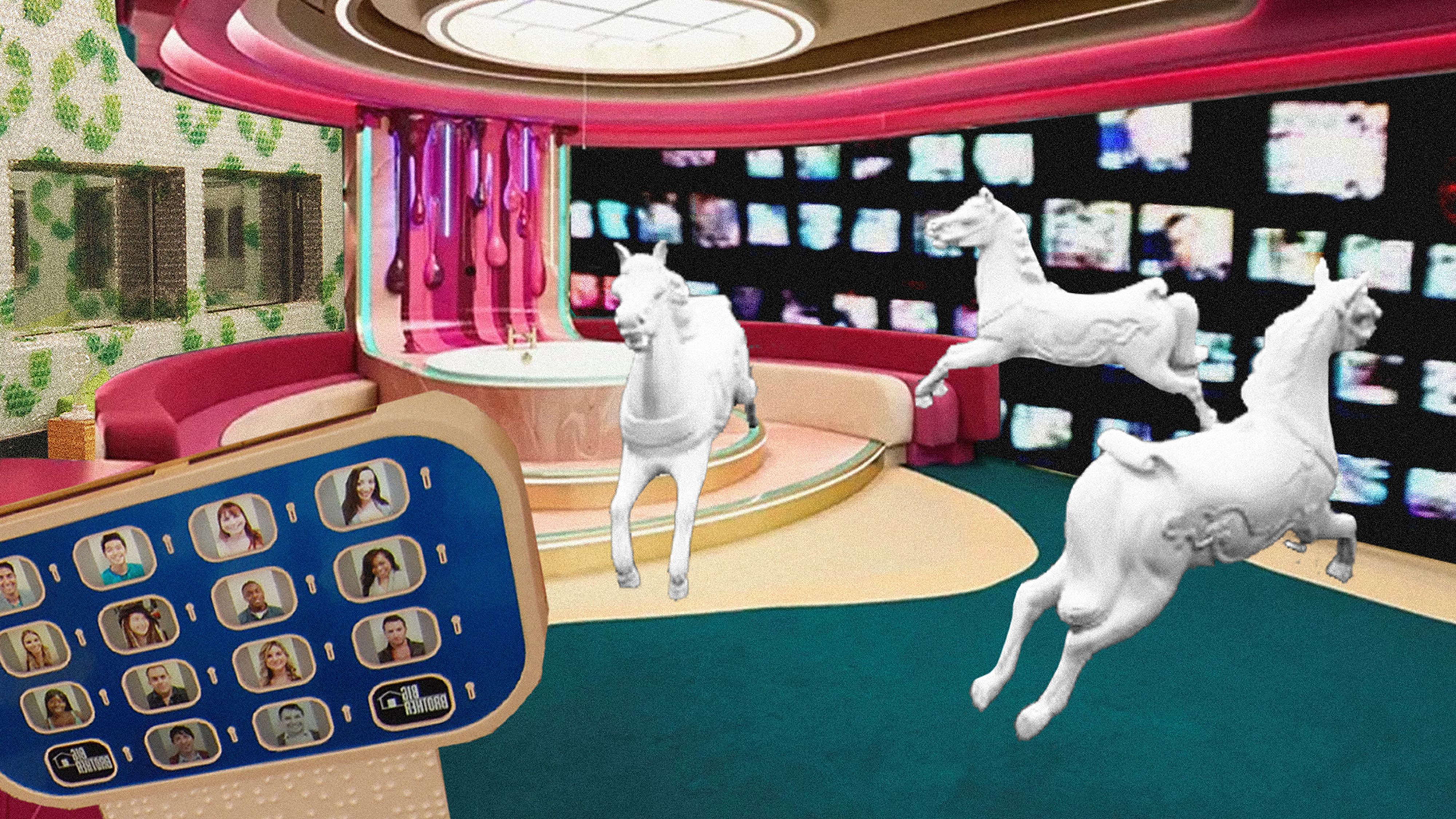
“Recurring design techniques include vibrant wallpapers covered in blown-up patterns; all-over frescos or finishes; Claes Oldenburg-esque sculptures of oversized objects; beds resembling cars, canoes, pool floats, fire trucks, airplane seats, crime scene chalk outlines, clouds and crescents.” Collage by Kassidy Miller for PIN–UP.
The open patio allows contestants to move about freely. Surveillance is diffuse — an invisible membrane — imperceptible enough not to censor behavior. After all, set designers are not just stewards of aesthetics, but also immersive world-builders. Without a film crew or booms dangling, they grant contestants the illusion of autonomy. “It’s important that any contestant on these shows forgets they’re on camera,” Storey explains. “The cast is told not to look at the camera because that breaks the fourth wall. So as a designer you are constantly trying to pull people out of the production aspect of reality and put them into the manipulated, designed reality that we’re providing for them.”
What the patio is to freedom, the bedroom is to captivity. The sprawling, candy colored boudoir is the backdrop for Love Island’s nightly tensions, where both willfully and forcibly coupled Islanders commune under neon niches. With 16-odd beds facing the center of the room, heartbroken exes might endure the sounds of new couples providing each other nightly comforts — a foolproof mechanism for pot-stirring.
Though it’s doubtful that any cast member in Love Island history has complained of a lack of reading material, the absence of everyday objects could be cause for restlessness or unease. Clocks, calendars, news sources, photos — any reminders of the outside world or indications of the passage of time — are removed for total immersion and continuity. Even the phones used on set do not display the time. Who among us would not slowly unravel under such disorienting circumstances?
While Love Island systematized the not-enough-beds technique, Big Brother invented it. In early seasons, production might’ve “put in not quite enough beds, so two guests would always have to share a bed. That’s instant tension, entirely motivated by the set.” Big Brother had its flings, but they were secondary to the competition. In Love Island, intimacy is the competition, and its hidden-camera model demands that contestants sell authenticity around the nonexistent clock.
Despite the risks, Islanders do break form on occasion. One contestant from Season 7, exasperated by the sleeping arrangements, pulled a page from Truman’s book and subversively slept alone outside in the sunken “Soul Ties” lounge. Another once used the pool’s water feature to catch a break, “a rare occurrence,” Connelly noted, “of a contestant using the design of the villa to their advantage.”
As stand-ins for unregulated psychological studies, immersive reality TV shows are incredible demonstrations of total severance from reality itself. There may be no better example of such an experiment than the 1998 Japanese show A Life in Prizes. Predating both The Truman Show and Big Brother, the program used round-the-clock surveillance to show a man in his most “primitive” form. Nasubi, the contestant, unwittingly signs up to live naked, in an unfurnished white room, surviving only on magazine giveaways and slowly going insane. Throughout his 15 months on the show, he was never told that 15 million people tuned in to watch him on TV.
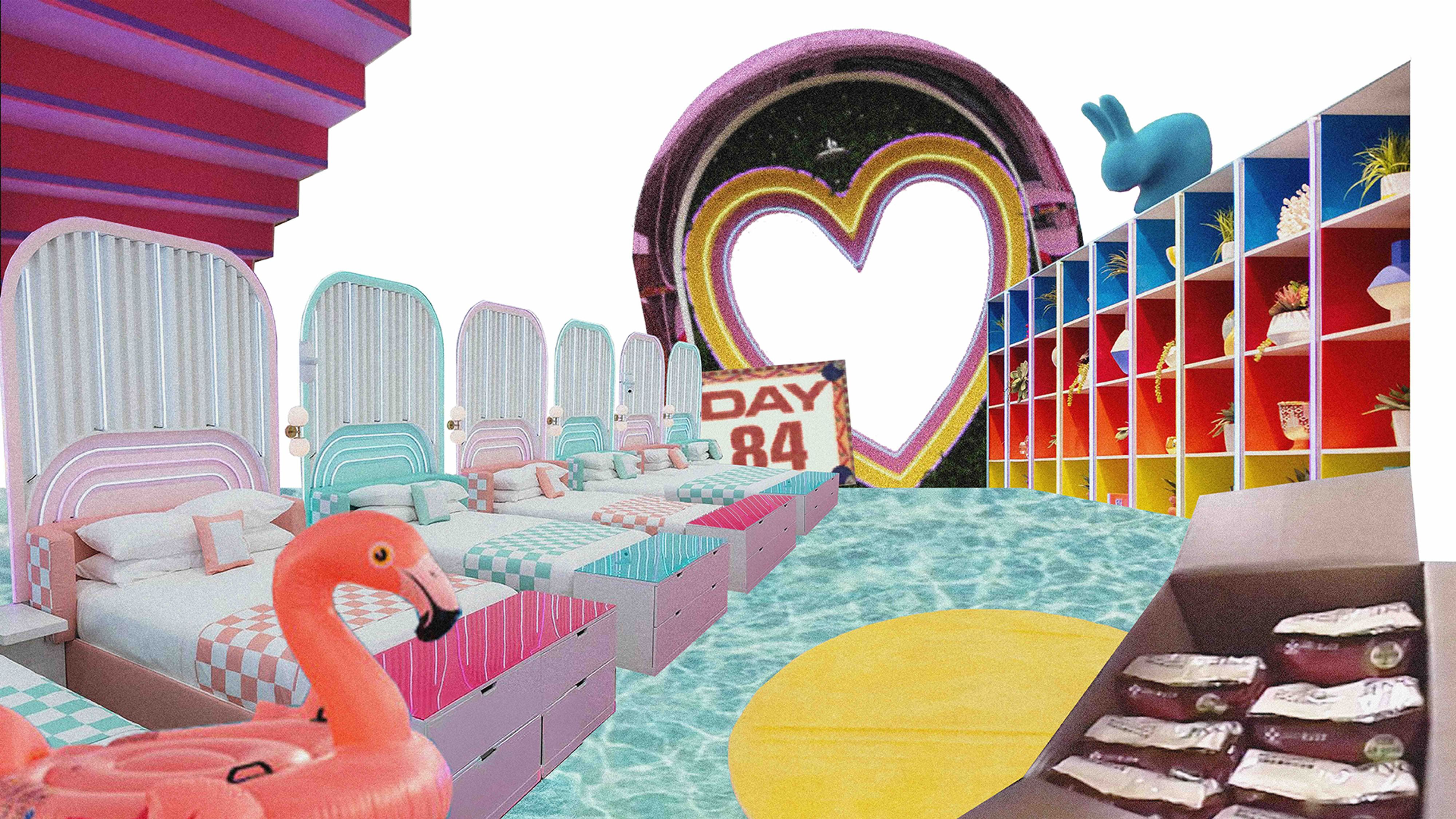
“What the patio is to freedom, the bedroom is to captivity. With 16-odd beds facing the center of the room, heartbroken exes might endure the sounds of new couples providing each other nightly comforts — a foolproof mechanism for pot-stirring.” Collage by Kassidy Miller for PIN–UP.
Now, these experiments bleed into reality, reaching their ultimate form as the “digital cage” becomes a method of state control through surveillance. In normalizing the constant presence of cameras, we’ve arrived at the dystopian future 1984 warned us about. But in this version, we’re all a little Big Brother.
These shows are a manifestation of an increasingly chronic, boundaryless voyeurism — especially in the age of social media. Even without posting our lives, most of us are knowingly being surveilled: at work, on the subway, at the store, on the internet. We all have a different relationship to this surveillance, different reasons for submitting to or resisting it. In that way, mass surveillance has neutered us all. Every uncanny reminder of our lack of privacy is just a breaking of the fourth wall, like production intervening on our real lives.
Reality TV’s purpose is escapism, and set design is intrinsic to its success. It is the place we escape to, the blanket that protects us from our own harsh personal realities and the realities of the world at large. Watching people in their digital cages on screen, we may feel safer, or at least relatively less exposed, severed from our reality and plugged into another world hovering in that distinct space between reality and fiction, projected through hypnotic screens. But the vigilance tactics employed on reality TV shows — hidden mics, remotely controlled cameras, panoptic design, even AI facial recognition — might not be so different from the ones in use in our cities, our workplaces, or our homes. Like our escapist blankets, the constant supervision that promises to protect us only leaves us collectively more vulnerable.
In an interview with Nasubi years after his time on A Life in Prizes, he explains that though the door to his room was unlocked all along, he never felt that leaving was an option. “Psychologically you feel that, rather than escaping or doing something radical, staying put, not causing trouble is the safest option,” he explained. “You lose the will to escape.”