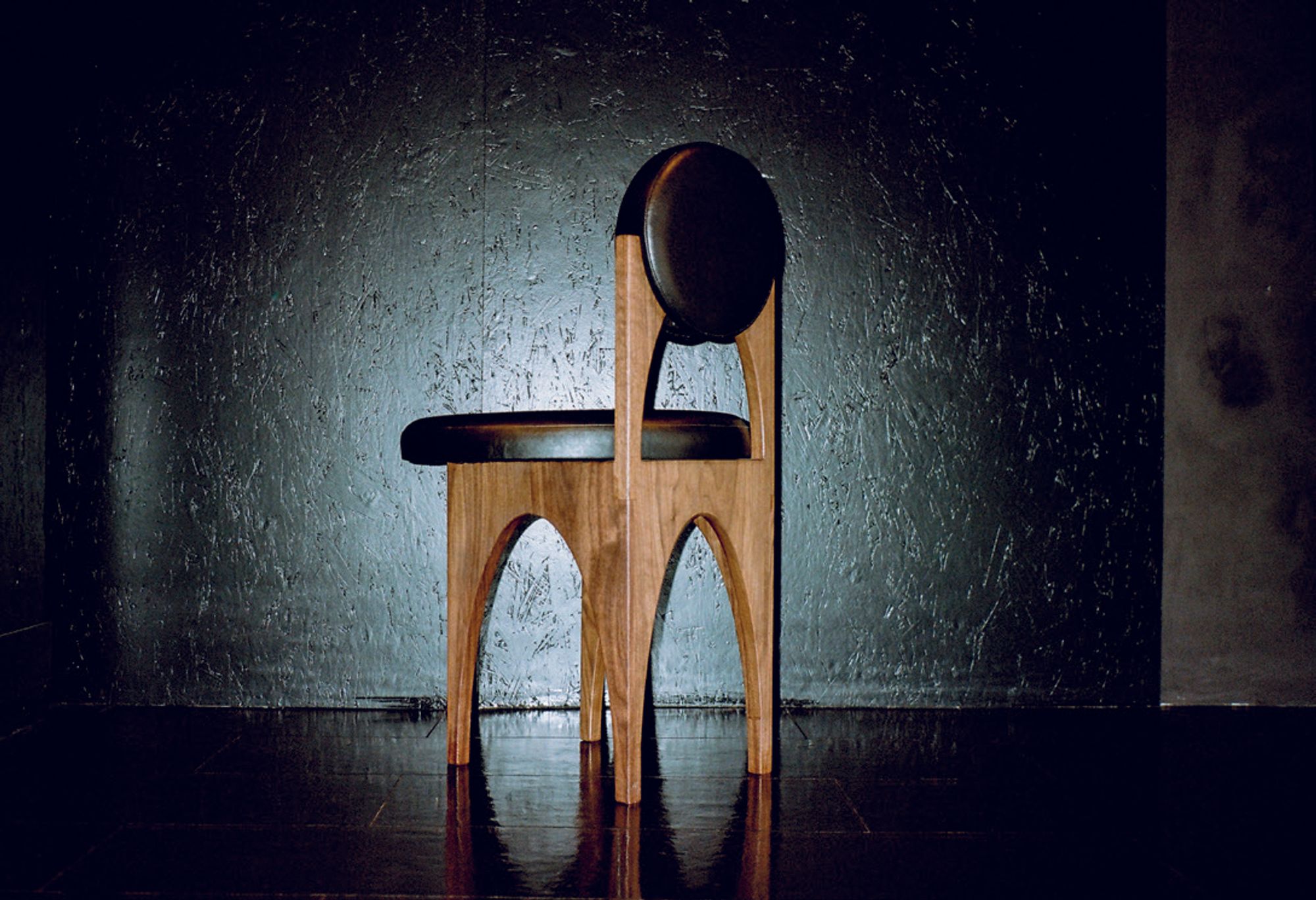
Mariam Issoufou designed much of the restaurant’s furnishings, including vegan leather-backed walnut chairs crafted locally by TW2M. Photography by Ashland Mines for PIN–UP.

Architect Mariam Issoufou and Jon Gray, co-founder of Ghetto Gastro, photographed inside Gourmega, Ghetto Gastro’s first built restaurant in the U.S. and the pair’s first collaboration. Portrait by Ashland Mines for PIN–UP.
At first glance, Jon Gray and Mariam Issoufou make an unexpected pairing. A bonafide New Yorker, Harlem-born Gray emerged from the city’s early 2000s cultural maelstrom with a proposition: that food could be a medium as potent as music, fashion, or art. In 2012, he cofounded Ghetto Gastro, the Bronx-based culinary collective that collapses the boundaries between dinner, design object, political gesture, and performance. Meanwhile, Niger-raised Issoufou founded her architecture practice in Niamey. Mixing academic rigor with material intelligence, she began working with rammed earth and other local construction techniques to design buildings attuned to the particularities of the Sahel climate — an approach that later led to prestigious teaching appointments at ETH Zürich and Harvard. Then came Niger’s 2023 coup, which forced Issoufou to reconsider the future. She ultimately decided to open an office in the United States, where she had previously completed her graduate studies. Since Gray and Issoufou lease office space in the same New York creative hub, WSA, the inevitable encounter soon occurred. It wasn’t long before they also started their first collaboration: Gourmega, Ghetto Gastro’s first brick-and-mortar restaurant in the United States. After a decade of residencies and pop-ups, the restaurant feels both overdue and exactly on time. Resisting the obvious playbook — this is no velvet-rope spectacle à la Jean-Georges — it occupies a modest West Village storefront on a site with a rich history of Black agrarian and cultural life. A community kitchen and gathering point by day, Gourmega becomes an intimate, 14-seat dining experience at night. Deliberately restrained, Issoufou’s subtle interior leaves the limelight to chef Lester Walker’s cuisine, which draws from Afro-Asian rice cultures, Caribbean flavors, and the American South. If the prevailing logic of hospitality is to scale up, Gourmega proposes the opposite — for Gray and Issoufou, one communal table is enough.
Mariam Issoufou designed much of the restaurant’s furnishings, including vegan leather-backed walnut chairs crafted locally by TW2M. Photography by Ashland Mines for PIN–UP.
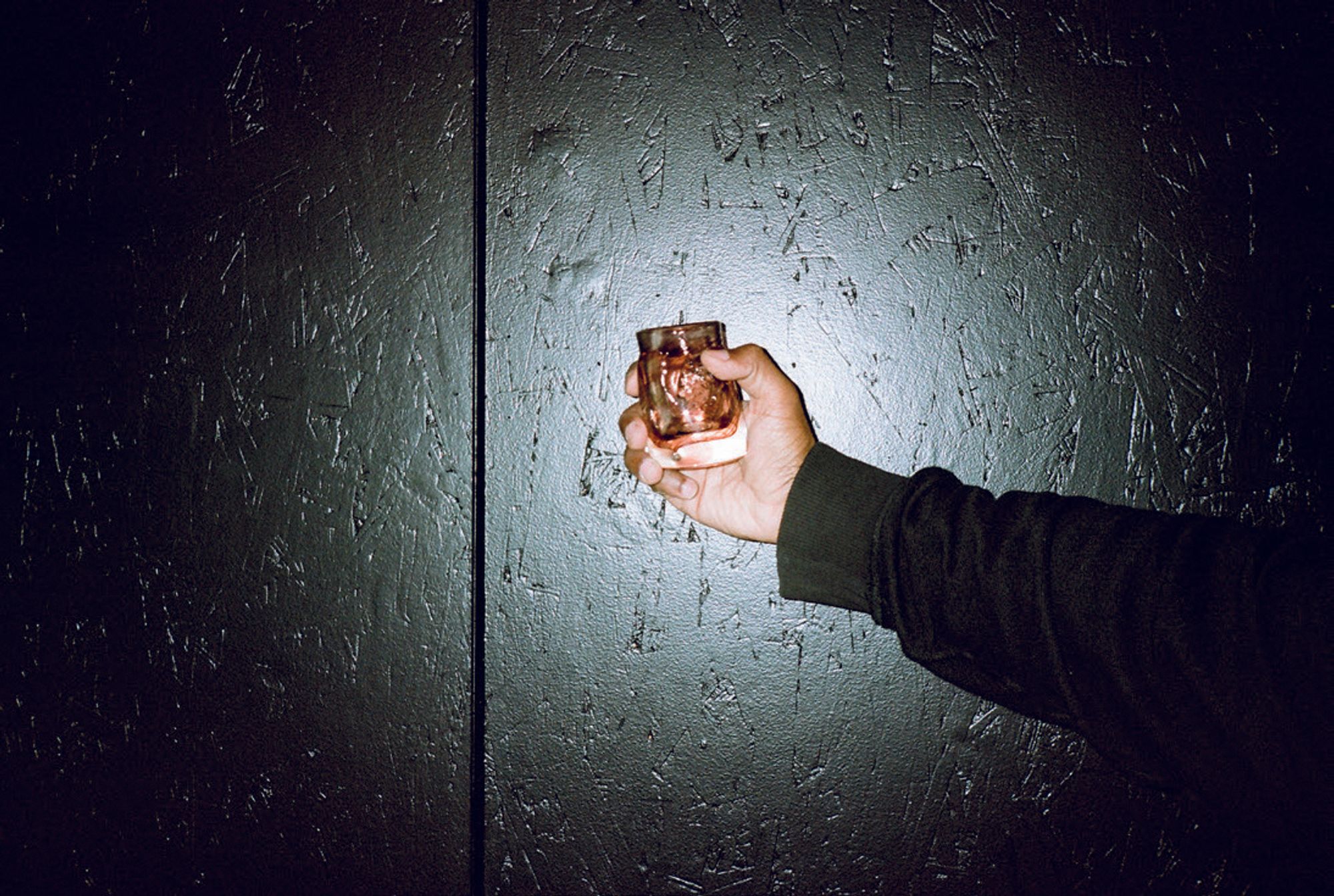
In reference to the site’s history as one of Manhattan’s first Black neighborhoods, the restaurant’s interior features black limewashed walls. Photography by Ashland Mines for PIN–UP.
Felix Burrichter: So how exactly did you two meet?
Jon Gray: It was here at WSA, about 20 feet away from where we are now. We met where they keep the champagne. I love design and architecture. Even more than built space, I love the way architects think. So I was intrigued by seeing Mariam in the halls. One day I dropped by her studio and saw her models, which are beautiful. She started telling me about her process and how sustainability is such a core tenet, using materials like rammed earth while working in harsh environments. I thought, “Man, I wish I met you before, because I don’t have a project right now.”
Mariam Issoufou: Then, a month or two later, I was in Venice for the Rolex Pavilion [which Issoufou designed for the 2025 Architecture Biennale]. The next time I showed up at WSA, that same day we were on site for the restaurant. What you were saying about the project was crazy — that we had three months to design and build it! And because I was coming off a high from Venice, I agreed. [Laughs.]
JG: I knew that your research period for big projects is three months, so I was like, “Well, how about a project where all of it happens in three months?”
What’s behind the name Gourmega?
JG: If you’re from New York and love hip-hop, you’ll get the reference. There’s a really dope MC from Queens named Cormega. I wanted to question who gets to decide what’s gourmet. There’s an explosion of great Caribbean cuisine in New York City right now, and I feel like Ghetto Gastro helped carve that path, so I wanted to look forward. What’s the next story we want to tell? We looked to Asia and found so much in common with what we know, in terms of both ingredients and ethos. Cultures that are more rice-forward tend to eat in a more communal fashion. So the menu is Afro-Asiatic, inspired by this collision of rice cultures and tropical ingredients, with references to the American South and our travels to Brazil, West Africa, and North Africa.
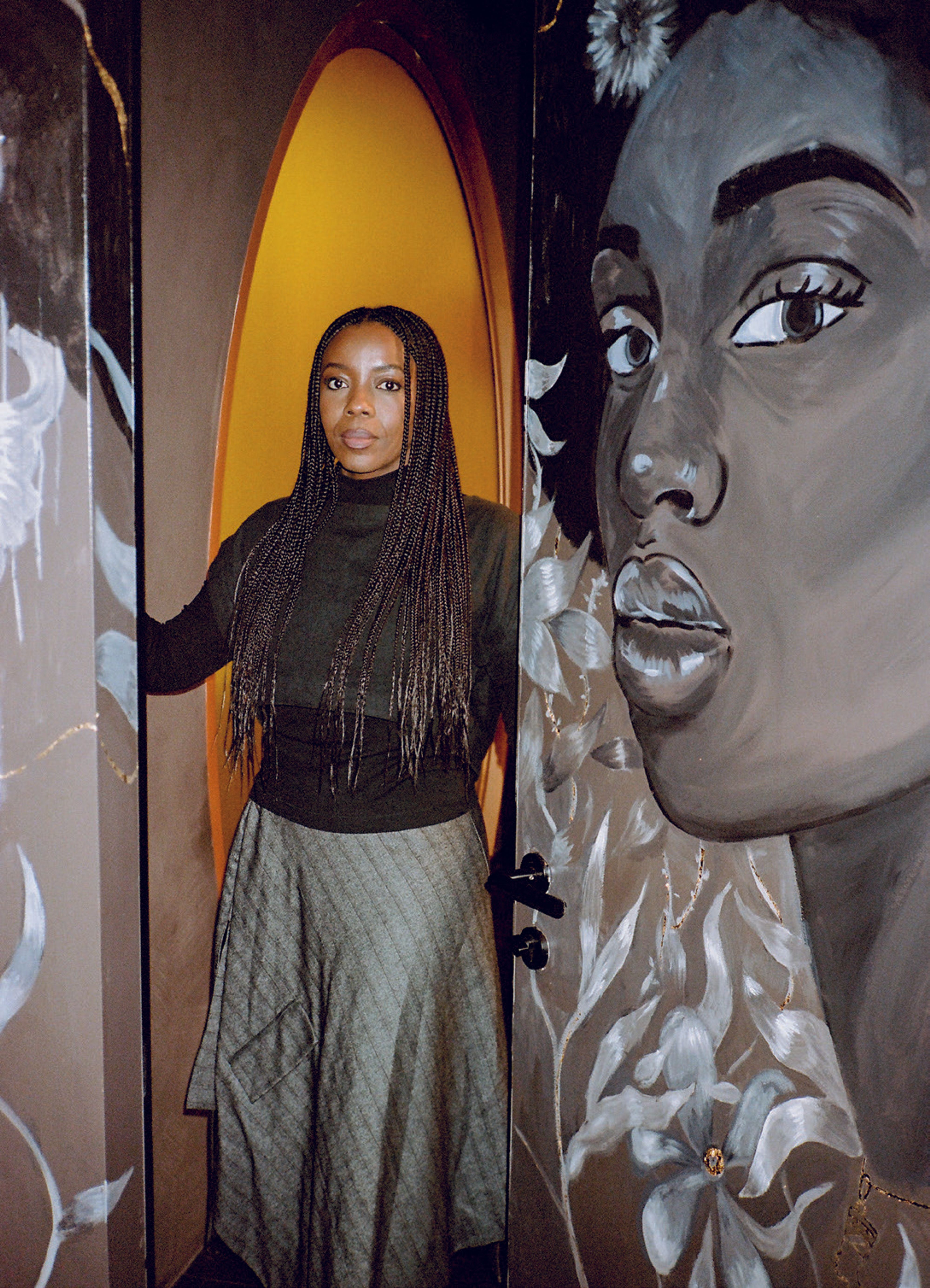
Mariam Issoufou next to one of the works Jon Gray commissioned and curated for the space — a mural by Cheyenne Julien. Photographed by Ashland Mines for PIN–UP.
What were the references for the architectural side of the project?
JG: This is the fun part. Mariam’s research team illuminated that the area we’re in — Greenwich Village, on the border of SoHo — was the site of a lot of Black farmland in the 1600s. It was called the Land of the Blacks or Little Africa. It was where the first African school opened. This was also where “black-and-tan” clubs opened in the 1920s, which were some of the first nightclubs that Black and brown people were able to participate in. So we were inspired by this hotbed of culture.
MI: Those black-and-tan clubs are one of the reasons why Gourmega is black and tan-ish. We spoke a lot about diaspora, which we also represent as a duo. We channeled this New York history but also the wider cultural legacy through materiality and the ideas of community and eating together.one of my very first gestures was interrogating what eating communally even means. I remember the first time I went to a restaurant in the West with a “communal” table, which was long and rectangular. I asked myself, “How is this communal?” Just sitting next to people you don’t know seems insufficient for building community. I’ve also always disliked rectangular tables because they’re inherently hierarchical. In most parts of the world, especially the regions Jon was talking about — Asia, Africa, and the Caribbean — you eat together in a circle, with the same vessel. So, to break down the hierarchy, I designed a table that’s a series of circles. It’s formed in such a way that wherever you sit you can still hear and talk to everyone. It curves in on itself and comes back around. The distances collapse, even if there are 15 or 16 people sitting around it.
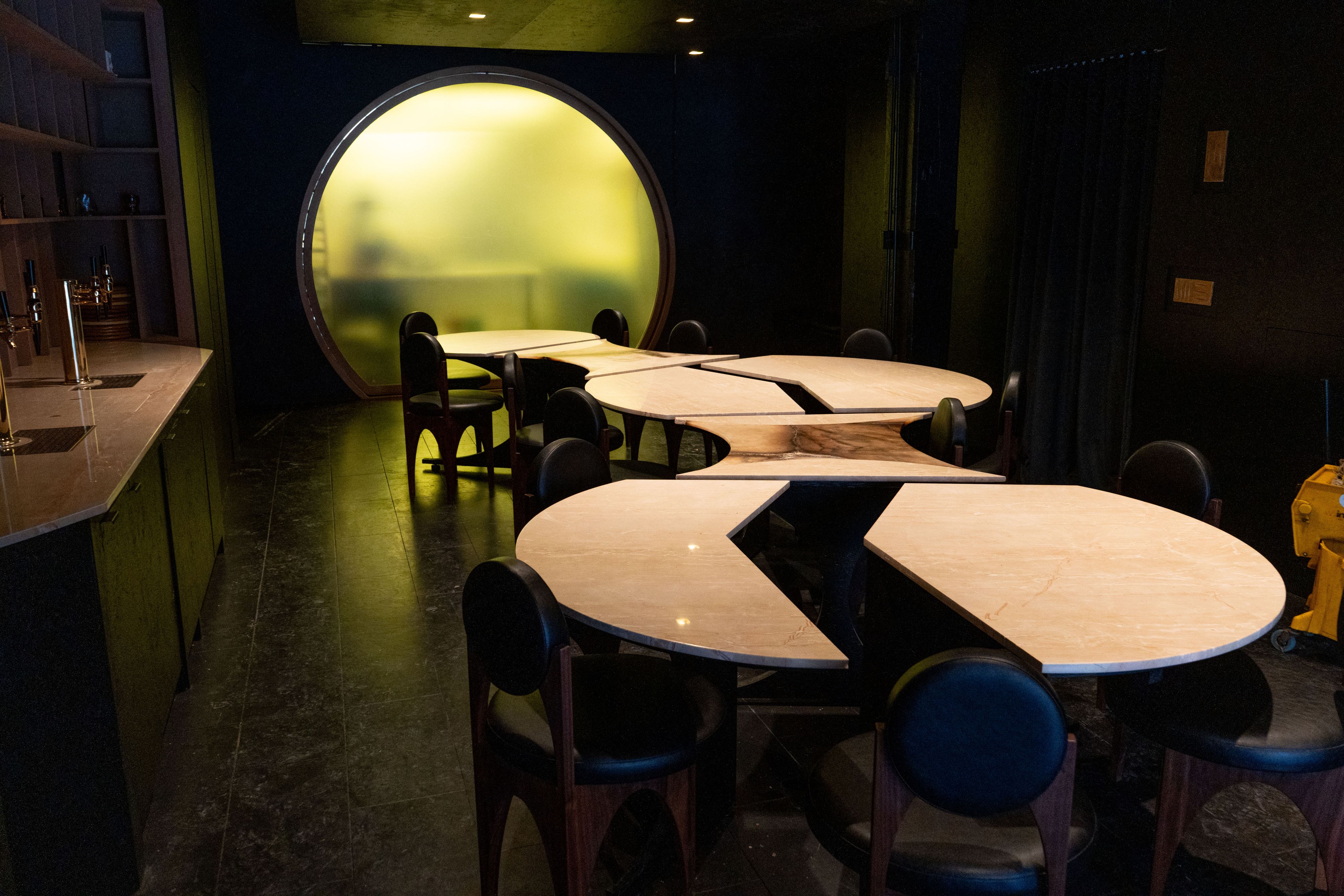
The restaurant’s design replaces the standard hierarchical long table with interlocking circular seating that equalizes conversation, while a circular glass swivel door between the kitchen and dining room reveals one space to the other with each turn. When closed, it frames the silhouettes of chefs at work. Photography by Ashland Mines for PIN–UP.
What was your exchange like?
JG: My best gift is knowing who to work with and letting them do their thing. I’m not trying to over-reference. I don’t want to truncate your dream. This is your vocation, Mariam. I trust myself and I trust you. And then we let the magic happen from there. What I do say is how much money we can spend. I’m firm about that.
MI: He said, “This is the budget, I want a communal table that can seat 14 people, and it needs to be a restaurant by night and a café by day.” And oh, by the way, it shares the building with a soup kitchen run by the nonprofit Rethink Food. You can see it through a big glass wall, a massive industrial kitchen that serves 30,000 meals a week. That was the biggest gift for me. Immediately I was like, “When do I get started? Let’s do this!” And then our research just added to the beauty of the story and the significance of the site.
JG: I’ve been on Rethink’s board since 2020. It’s not technically a soup kitchen. We use the word community kitchen, because people don’t come there to get served. Rethink makes meals and transports them to community partners, whether churches, masjids, synagogues, or centers for the elderly or the unhoused. If Rethink has managed to serve almost 20 million meals across the U.S. to date, it’s because we give grants to community restaurants. To me, a restaurant that amplifies this work, with profits benefiting it, is a lot more interesting than a tasting menu for schmucks with a lot of money.
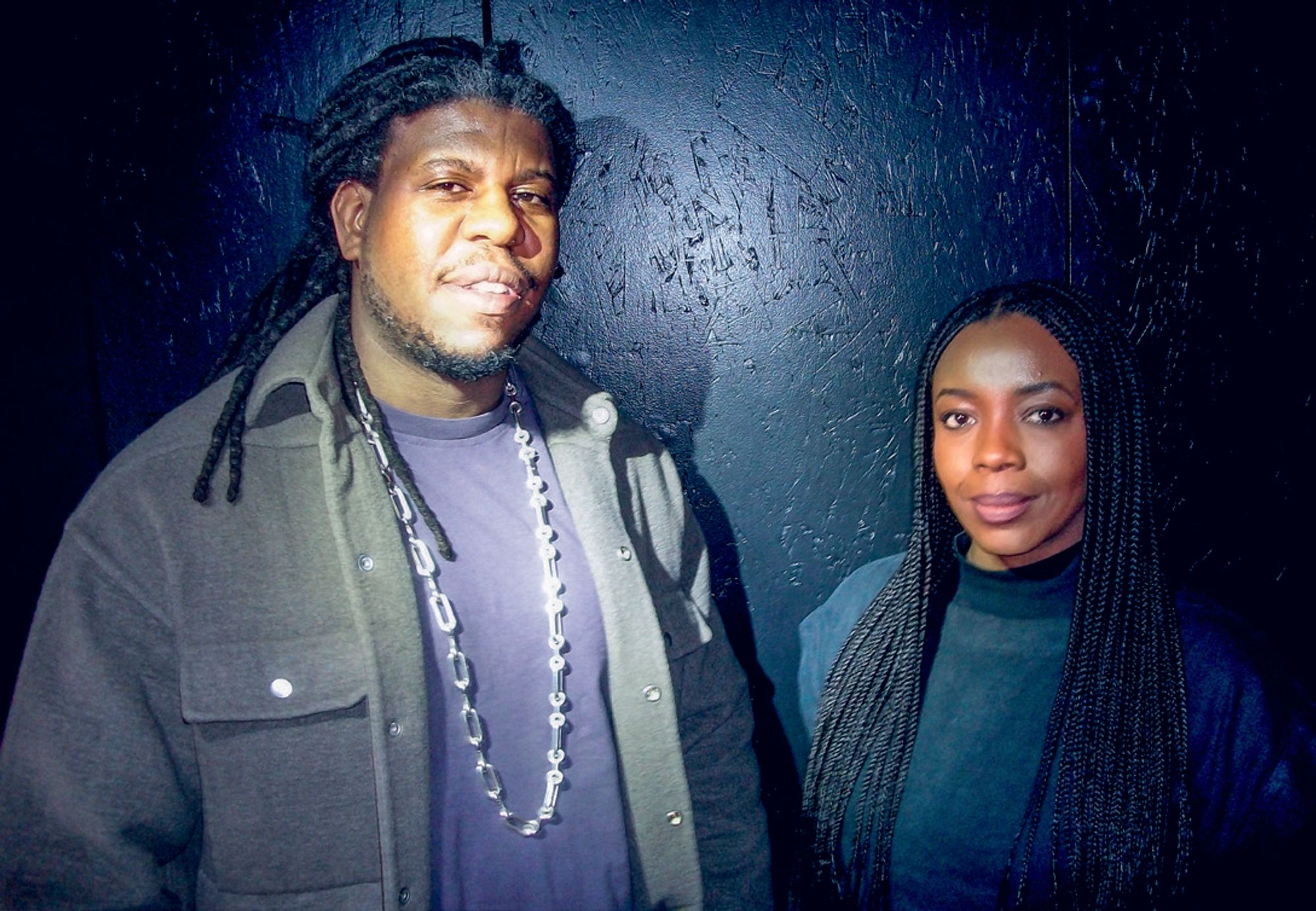
Jon Gray and Mariam Issoufou photographed by Ashland Mines for PIN–UP.
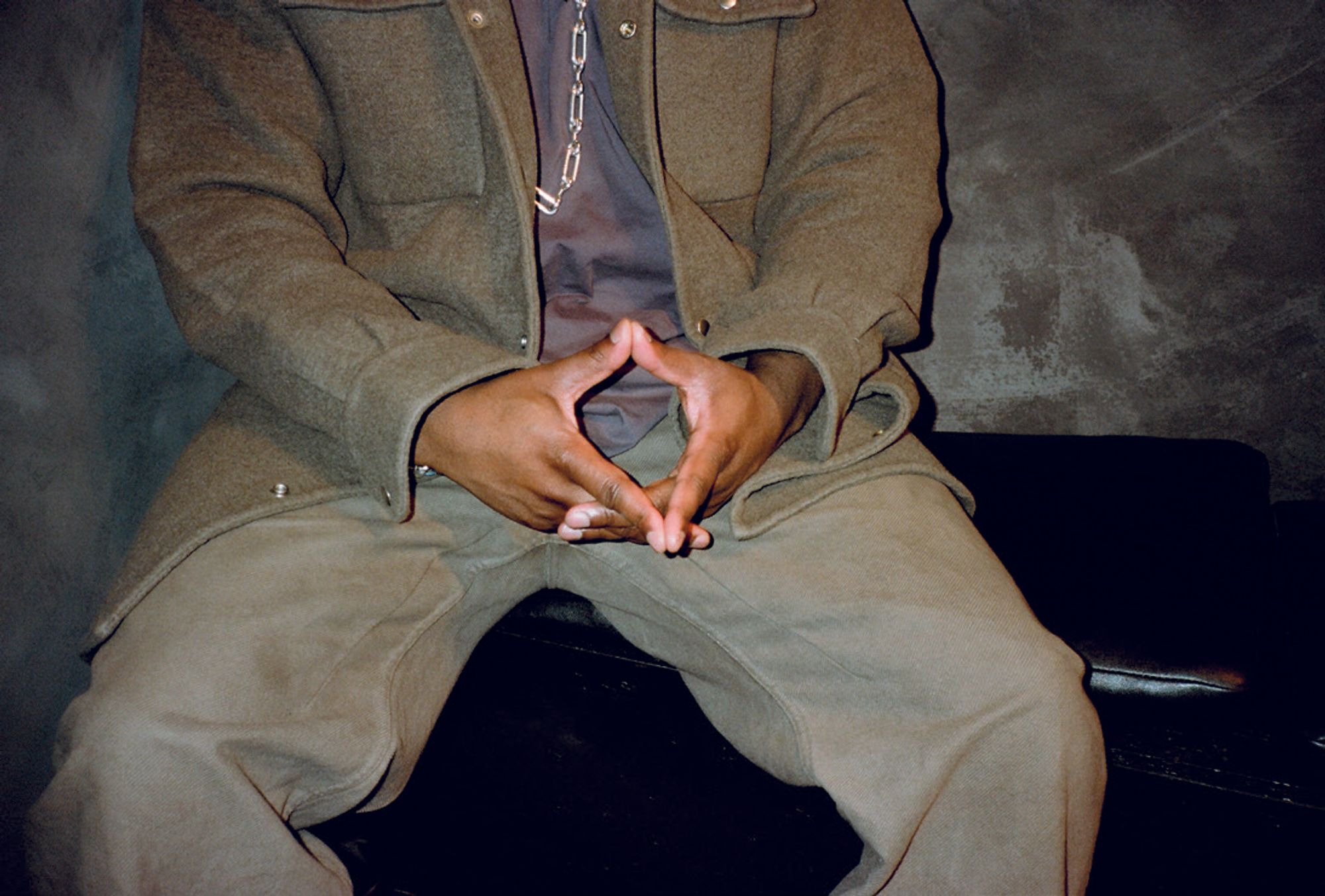
Jon Gray photographed by Ashland Mines for PIN–UP.
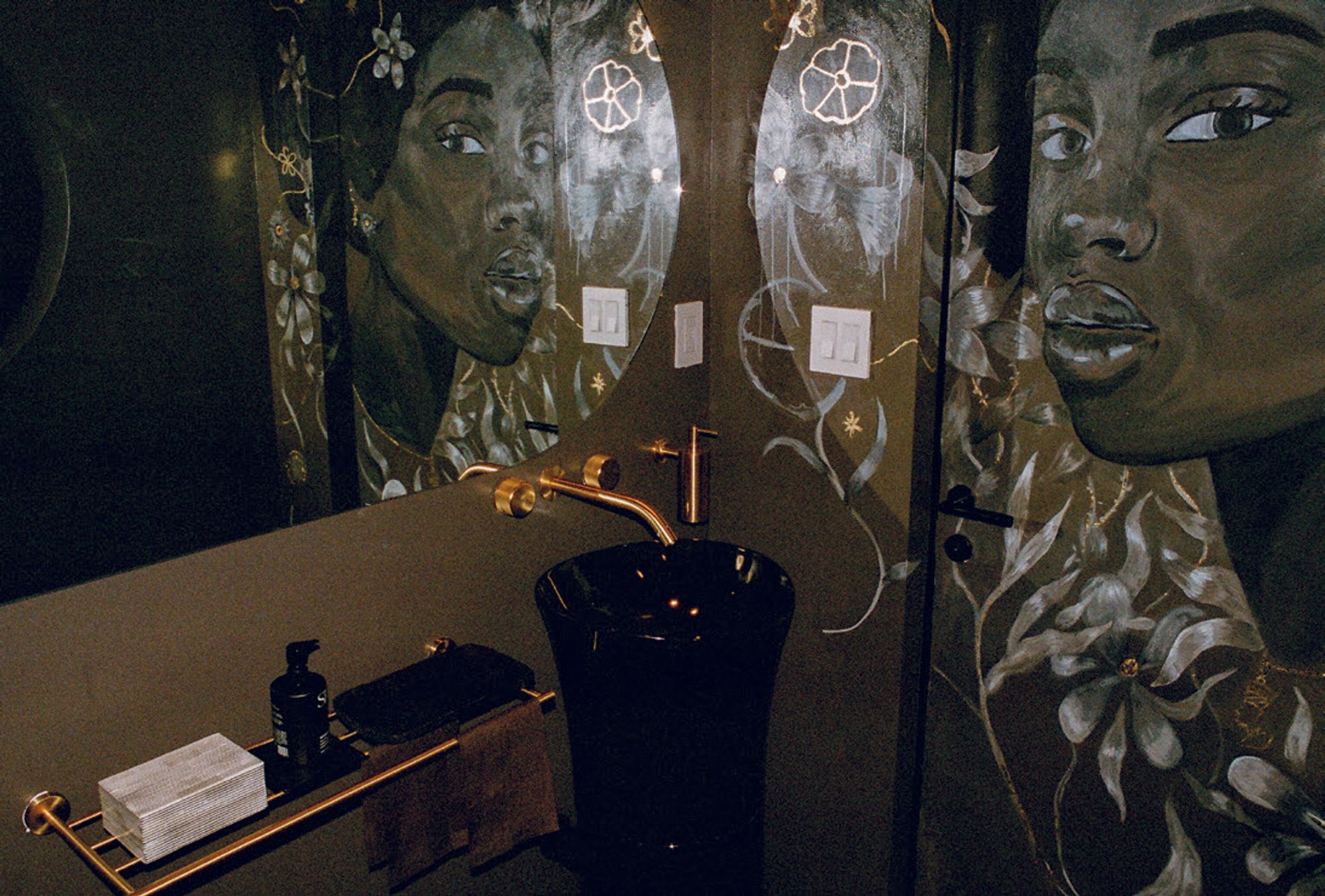
A mural by Cheyenne Julien in Gourmega. Photographed by Ashland Mines for PIN–UP.
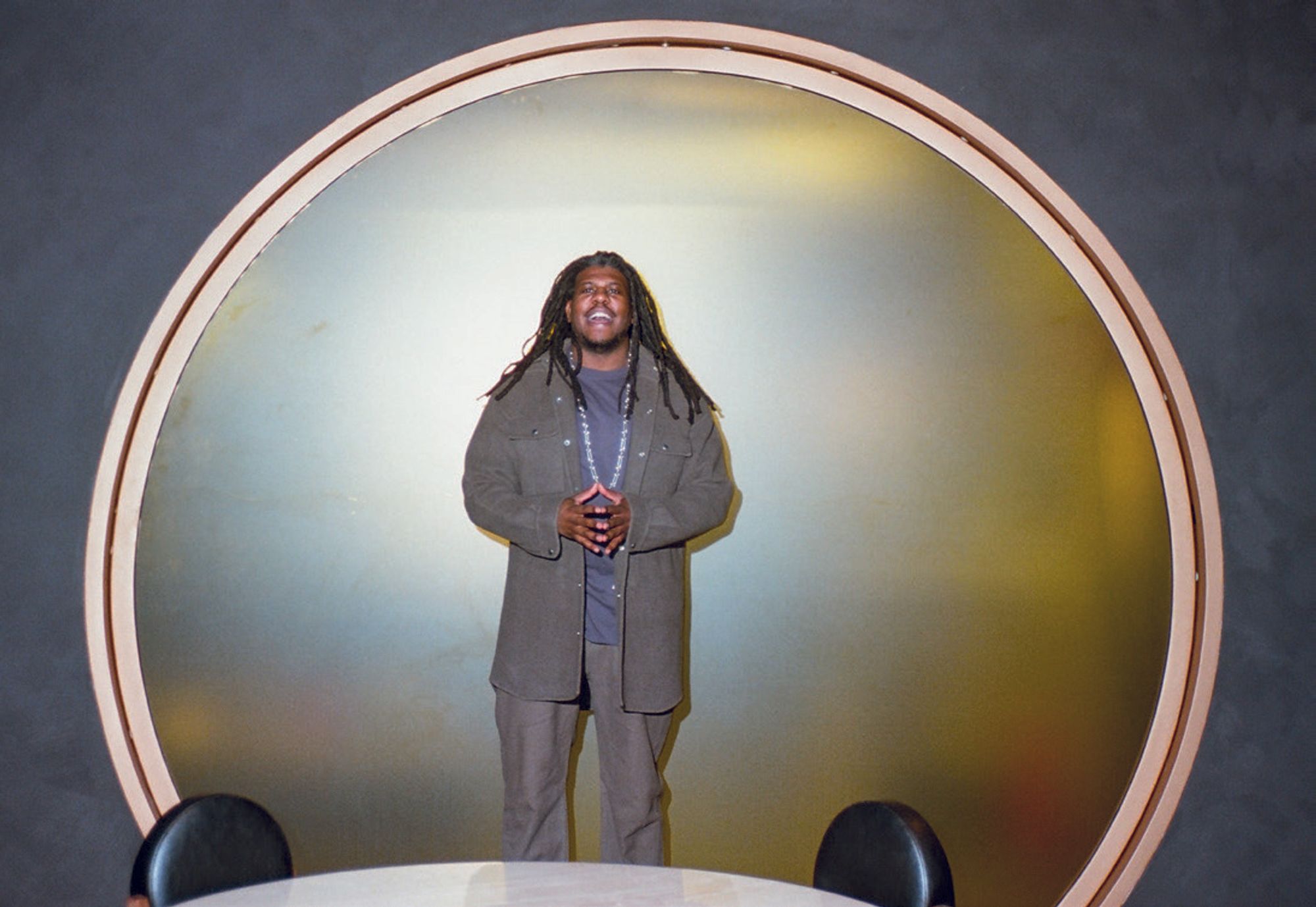
Jon Gray in front of the “sun door” in Gourmega. Photographed by Ashland Mines for PIN–UP.
What were the childhood communal food spaces or experiences that inspired you the most?
JG: I fell in love with food going out to eat with my mother. She was a single mom working a job, getting her master’s, and she often didn’t have time to cook. She was an epicurean. She worked at a fancy hair salon on Fifth Avenue, so she was going to the French bakery nearby for fancy pastries. I’ve been eating good since I was in the womb! [Laughs.] Eating out together was how we bonded. I never thought I would work in food, but even when I had my other professions in the streets, everything I did that was about love, relaxation, joy, or pleasure was around food. I brought the homies from the block to Cafeteria back in the day. Sarah Jessica Parker was in one corner and Fabolous in another. It was like a field trip. This was 2002, when I was still a teenager, driving around hustling drugs. I used to carry the Zagat restaurant guide with me, so if I had to make some runs in a certain neighborhood, I knew where to go. A seismic shift happened when I got introduced to New York nightlife through La Esquina. I was potentially facing a lot of jail time then — ten to life. I was out on bail, and my friends brought me there to cheer me up. I had their burger, which was really thick with Oaxacan cheese, aioli, and jalapenos. And then we went downstairs and I was like, “What the fuck is going on? Madonna’s there.” I was like, “I need to have influence in this environment.” The PR girls started asking me to get tables there for their clients. The reservation was always under my name, which became a myth. “Who’s this Jon guy?”
MI: Having grown up in Niger, I had never not eaten communally. Going to a restaurant was not a thing. Very rarely would we eat at a table. When you have people over, the table is actually seen as inhospitable, and taking someone to a restaurant is seen as incredibly cold. When you really care about somebody, they come to the house, and there’s a whole pageantry that comes with it. Women have this practice on the weekend in Niger called fòyandi. It’s a day-long hangout session. It’s very extra. It’s also a therapy session, to some extent. You’re catching up with each other about life, laughing, joking, and then the food, of course — the ginger and bissap juice, the fruit... It needs to be luxurious. I was always surprised when the statistics said we were the poorest country in the world, because that was not our experience. The GDP numbers are completely meaningless since they don’t measure all the things that matter — the way we help each other out and the generosity.
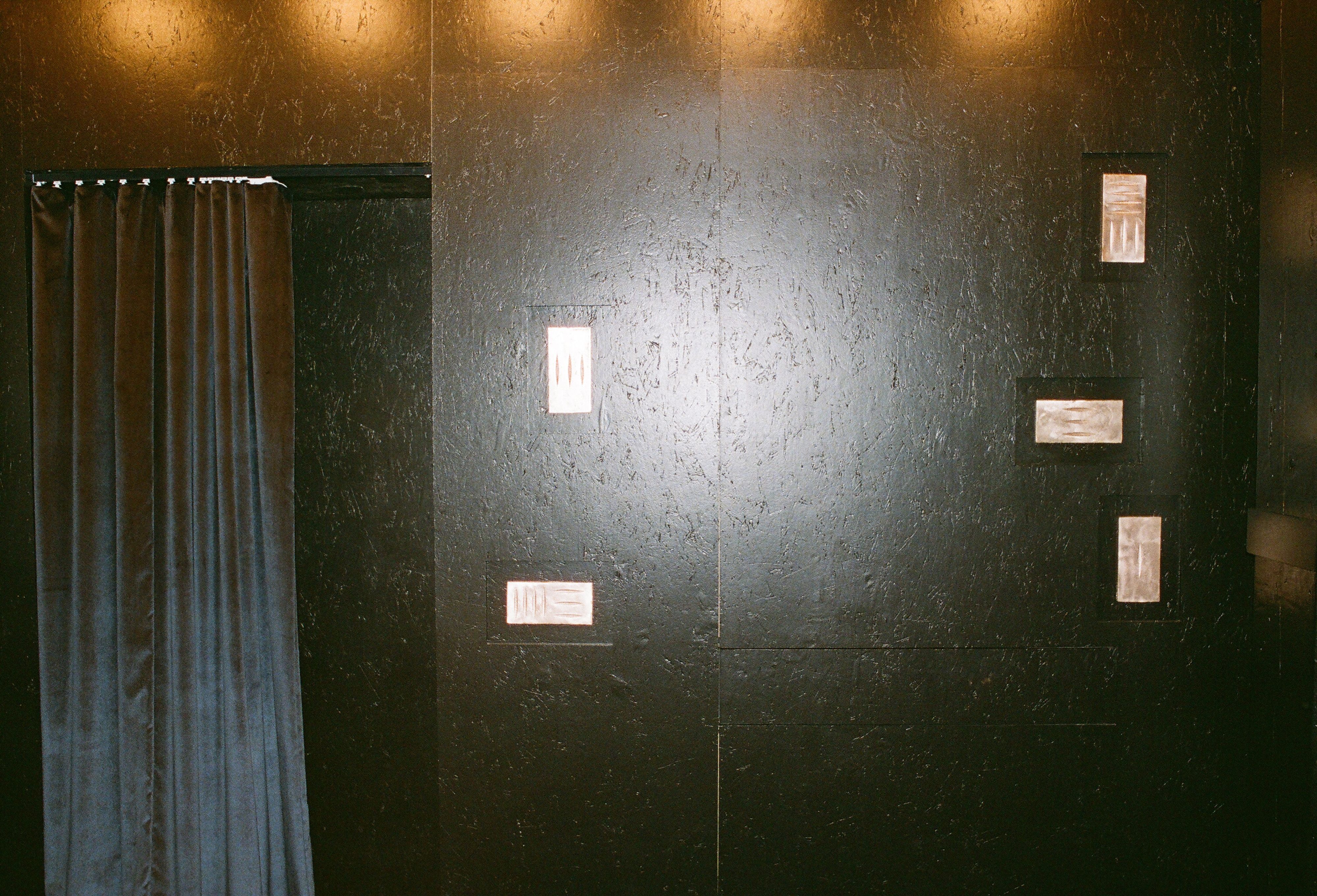
Custom bronze inserts by Nifemi Marcus-Bello on the restaurant’s interior façade evoke the traditional Nigerian practice of facial scarification. Photography by Ashland Mines for PIN–UP.
Speaking of tables, let’s go back to Gourmega. How does intersectional sustainability apply to this project?
MI: For us, it’s how we can achieve both cultural and economic sustainability. In this particular case, it had to with making the project hyperlocal, where the people working on it — the contractors, collaborators — are from here. Jon also involved incredible artists from New York, which was important to me because we make projects that are embedded where they are, not just because they look like the place, but in terms of who works on them and who is contributing. Most of the materials came from nearby. The only thing that didn’t come from New York is what we call our sun door. We didn’t want to close off the kitchen, but we didn’t want absolute transparency either. We were coming off the Rolex Pavilion, with the colored glass and all these round discs, so we continued that language. The idea was that the kitchen would always be present through silhouettes you’d see in the background. Obviously, the door is also an incredibly dramatic moment in terms of the experience of the space. A good third of the budget went into it.
What’s on the menu that you’re most excited about?
JG: Imagine coconut jollof-scented steamed sushi rice with tuna belly and habanero bird chilies. It’s the Pan-African colors — red, black, and green — but in a sushi roll. That’s one of the first courses. We want to experiment with a fufu udon noodle in a pot liquor, like a collard-green dashi. Pastry chef Camari Mick did the dessert, a wara cream-cheese baked Alaska. Wara cheese is from the northeast of Nigeria, close to the Sahel. It’s made by curdling fresh cow’s milk with a leaf extract, typically from the apple of Sodom. We used a different leaf. It’s like a baked Alaska with a little bit of sweet potato, a little bit of guava, kind of a play on the guava and cheese you get in the Caribbean. It’s a diasporic conversation, and we’re just having fun.
Are the two of you already working on another project?
MI: Not yet, but we’d better — this was so much fun! He’s the perfect client because he just lets you do what you want. A lot of my architecture is very serious, but I have a lot of fun designing. Beauty is incredibly important to me, even though I don’t talk about it very much. For this particular project, I just wanted this incredibly beautiful, experiential space. The reason I really loved the idea of making it dark, in addition to the black-and-tan reference, was that I wanted it to be very immersive, very concentrated, where the only thing you see is the table and the sun door. It lets you focus on your meal and on each other. That was what mattered most — distilling the essence of togetherness.
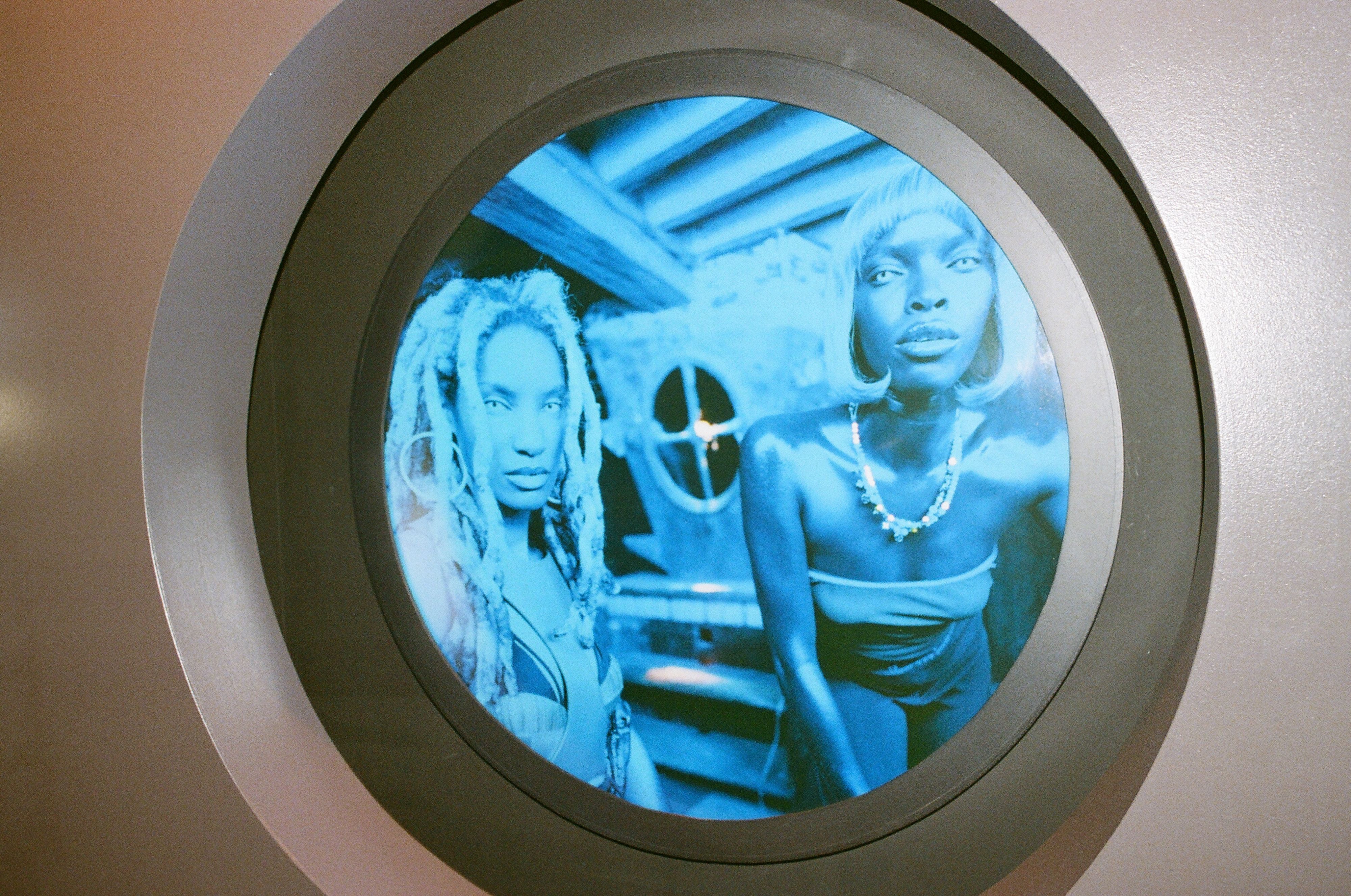
Window detail with artwork by Joshua Woods.