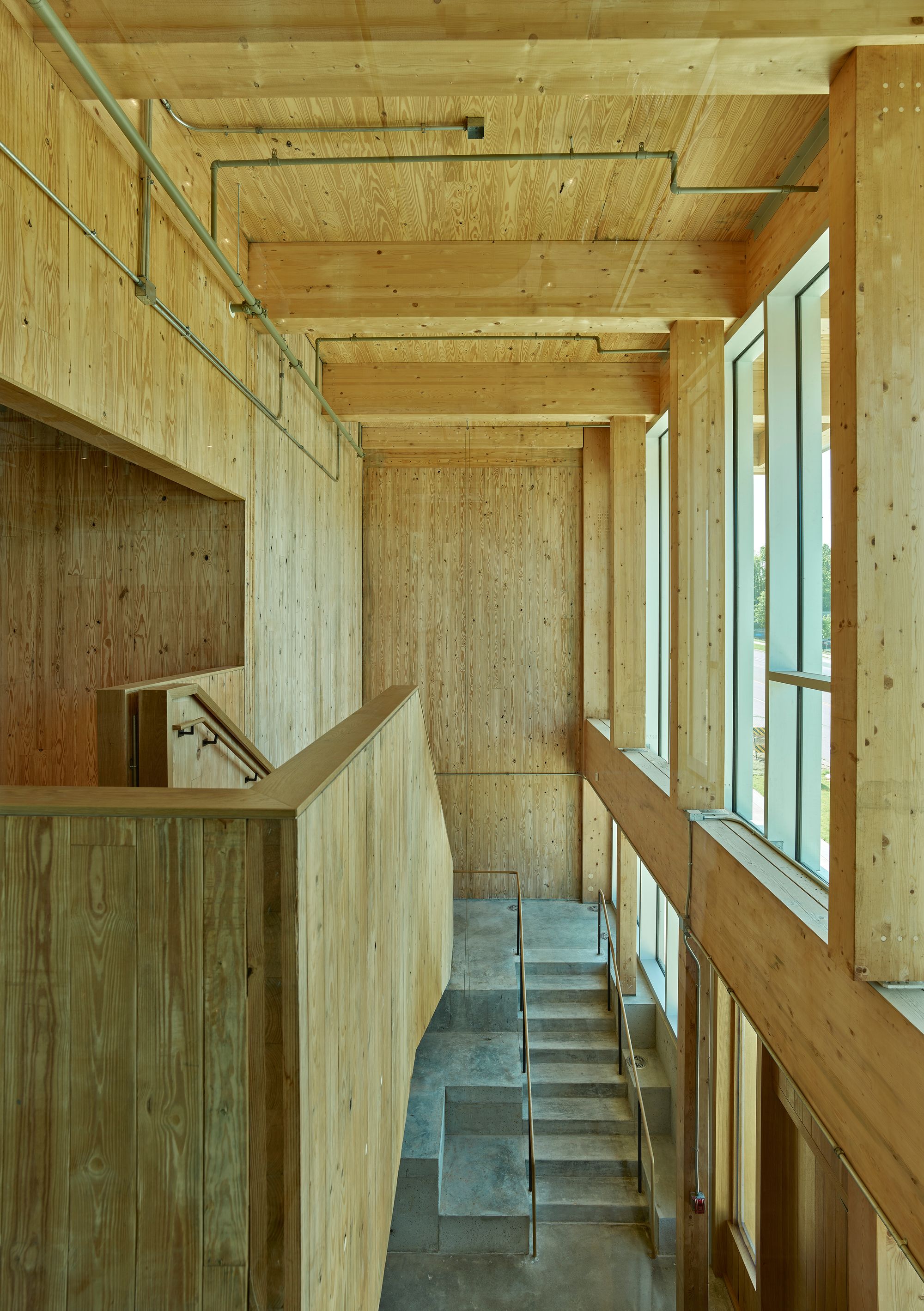
The Anthony Timberlands Center for Design and Materials Innovation designed by Grafton Architects. Photo © Tim Hursley.
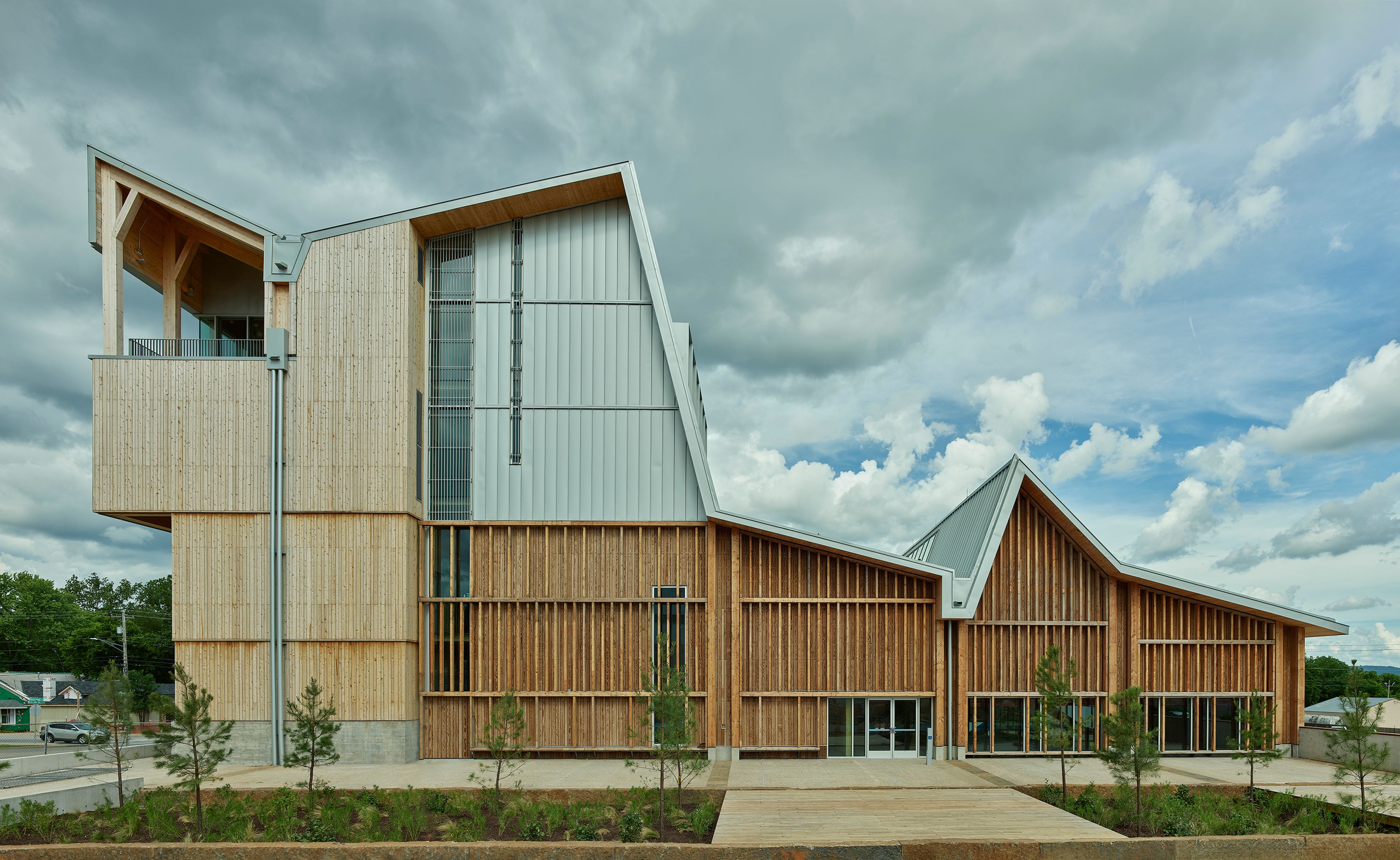
The Anthony Timberlands Center for Design and Materials Innovation at the University of Arkansas in Fayetteville, Arkansas, designed by Grafton Architects. Photo © Tim Hursley.
Yvonne Farrell and Shelley McNamara, the Pritzker Prize-winning duo behind Grafton Architects, make works that invite people to congregate, to sit, to linger. Given the fiscal realities of contemporary construction, they call these moments, like a long stone bench or a door handle welcoming to the touch, little gifts within their larger, architecturally rigorous projects. Generous gestures soften institutional structures, like the Universita Luigi Bocconi (2008) in Milan or The London School of Economics (2022). Last year, the duo opened an ambitious mass-timber building in Fayetteville, Arkansas — their first in the United States. At a time division in this country is painfully acute, Grafton Architects’ designs propose opportunities for communion — like having a hard conversation while driving, two people facing forward looking out at the horizon, suggests Farrell.
Anthony Timberlands Center for Design and Materials Innovation lands on a busy arterial road near the University of Arkansas with a robust gentleness. The 42,000-square-foot center is an extension of the Fay Jones School of Architecture and Design and it’s as much about visionary timber research — there’s a multi-story, state-of-the-art, 11,000-square-foot fabrication and design-build shop at the heart of the facility — as it is about creating a space that supports students’ creative growth. PIN–UP caught up with Yvonne Farrell in her Dublin office to talk about trees, cars, and other ordinary things that seep into her practice.
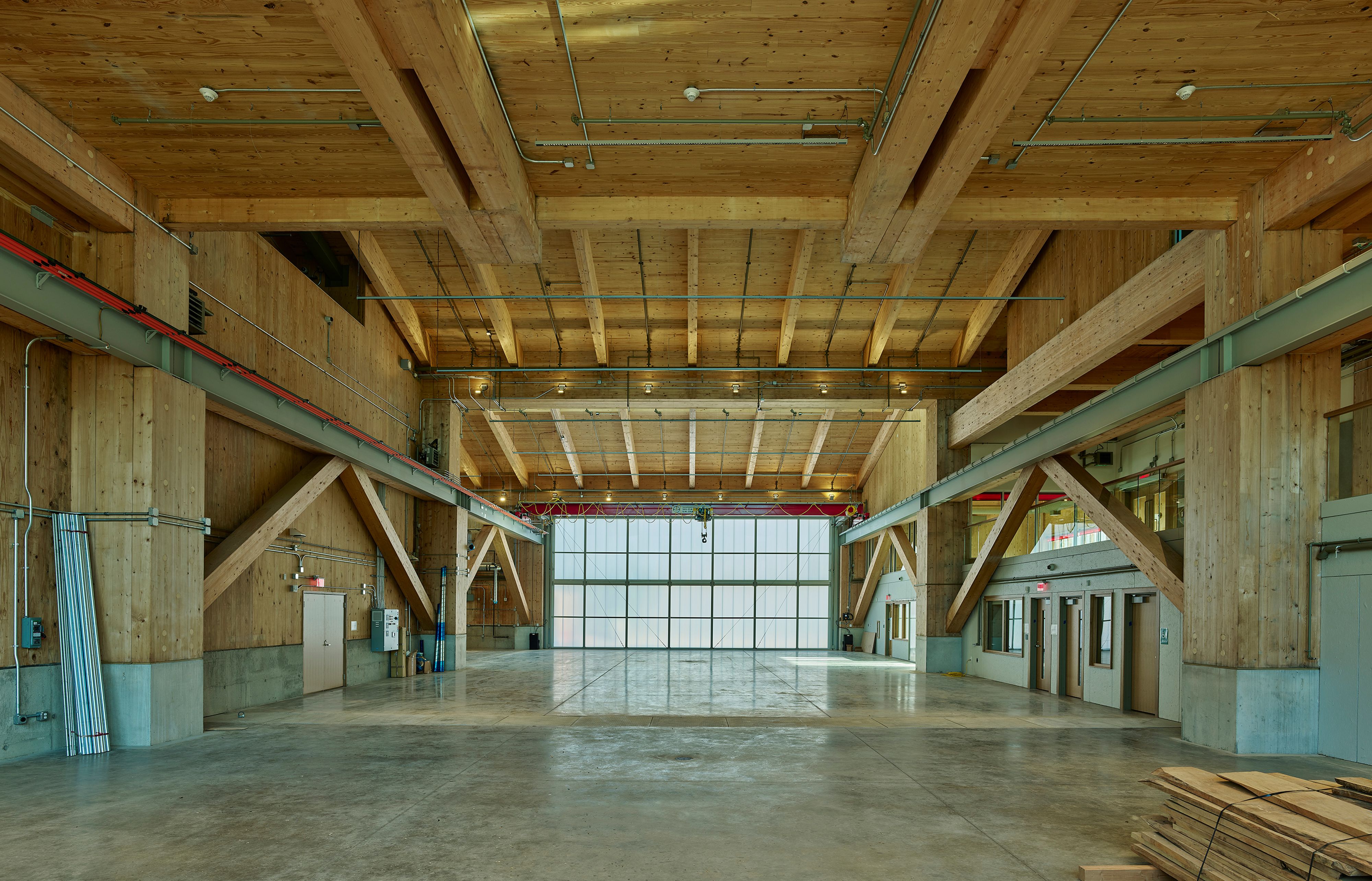
The Anthony Timberlands Center for Design and Materials Innovation designed by Grafton Architects. Photo © Tim Hursley.
Mimi Zeiger: Grafton Architects has built projects all over the world — Europe, Latin America, Asia — but this is your first project in the United States. How has your experience in Arkansas shaped how you design?
Yvonne Farrell: The focus of the Anthony Timberlands Center competition was on timber and what that means in terms of the climate and global decarbonization. We have done many buildings in concrete. We have done buildings in brick. We were specifically interested in the deep research into timber that a project like this would give us. When architects arrive at a place, there are two options: you can enter with a predisposed idea or product and make it fit, or you can try to discover the lay lines of a place, and its culture and climate. We’re looking for hunches. In the brief, Peter MacKeith, Dean of the Fay Jones School of Architecture, described Arkansas as no-nonsense state, but he also conjured a sense of poetics. He has 10 years of experience working in Finland immersed in timber and is a colleague of architect and writer Juhani Pallasmaa, author of The Eyes of the Skin: Architecture and the Senses (1996). Each page of another text Pallasmaa wrote for a conference held in Fayetteville is a mastery of sensual description of the emotional impact that timber has on people. We were drawn to the project’s combination of ordinariness and aspiration beyond functional architecture. We’re interested in how fragile the planet is — whether we’re building in Peru, France, Italy, or South Korea, each place has this unique character that we would like to discover. We live on the island of Ireland, and it’s notorious for a lot of rain. When we researched northwest Arkansas, we were surprised at how heavy the rain can be there, and that became part of the conceptualizing: How do we provide protection from the sky? From that question we went about finding form and finding a relationship to the fabulous barns of the Ozarks.
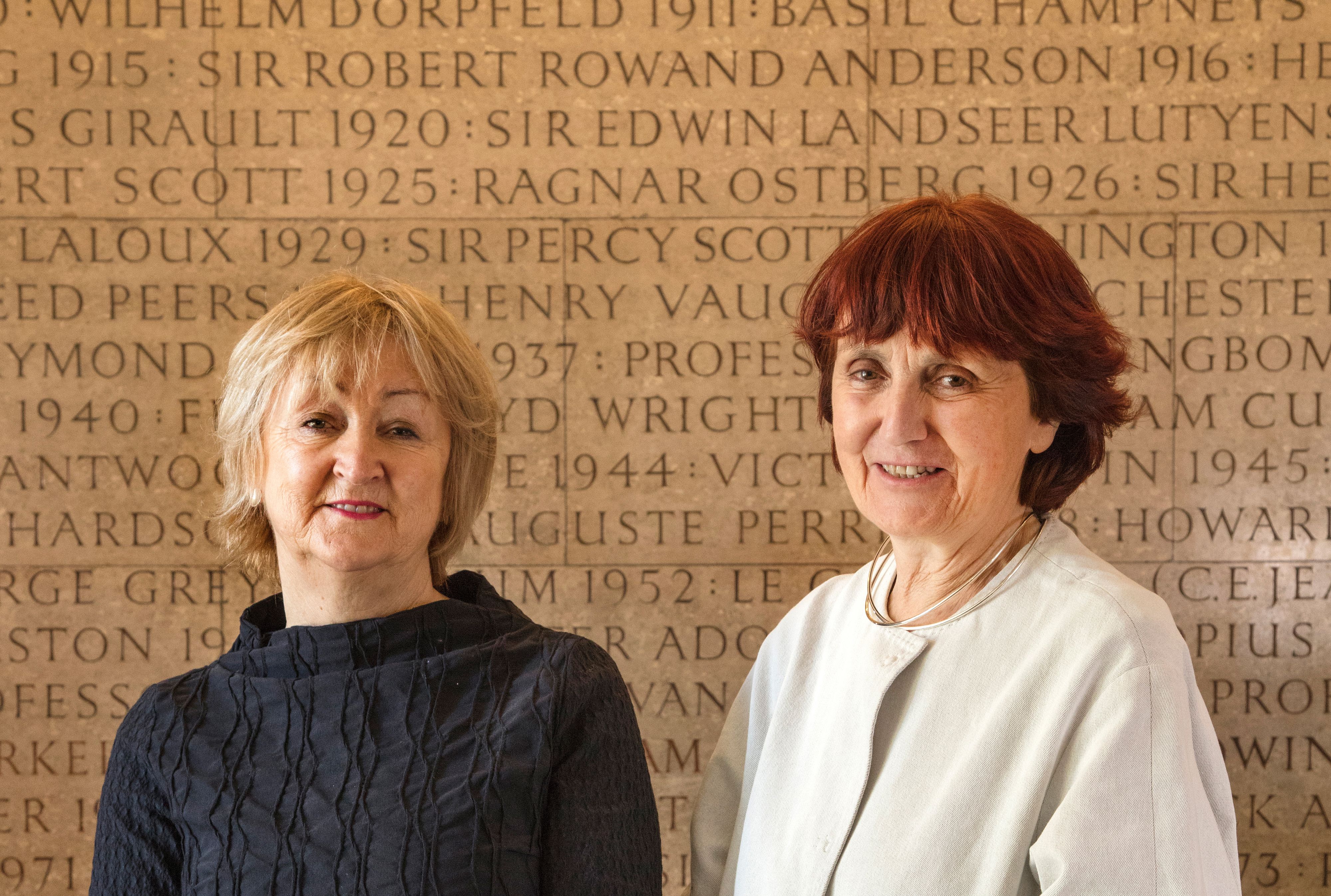
Yvonne Farrell and Shelley McNamara of Grafton Architects. Photo © Morley von Sternberg courtesy of Grafton Architects.
The Anthony Timberlands Center for Design and Materials Innovation designed by Grafton Architects. Photo © Tim Hursley.
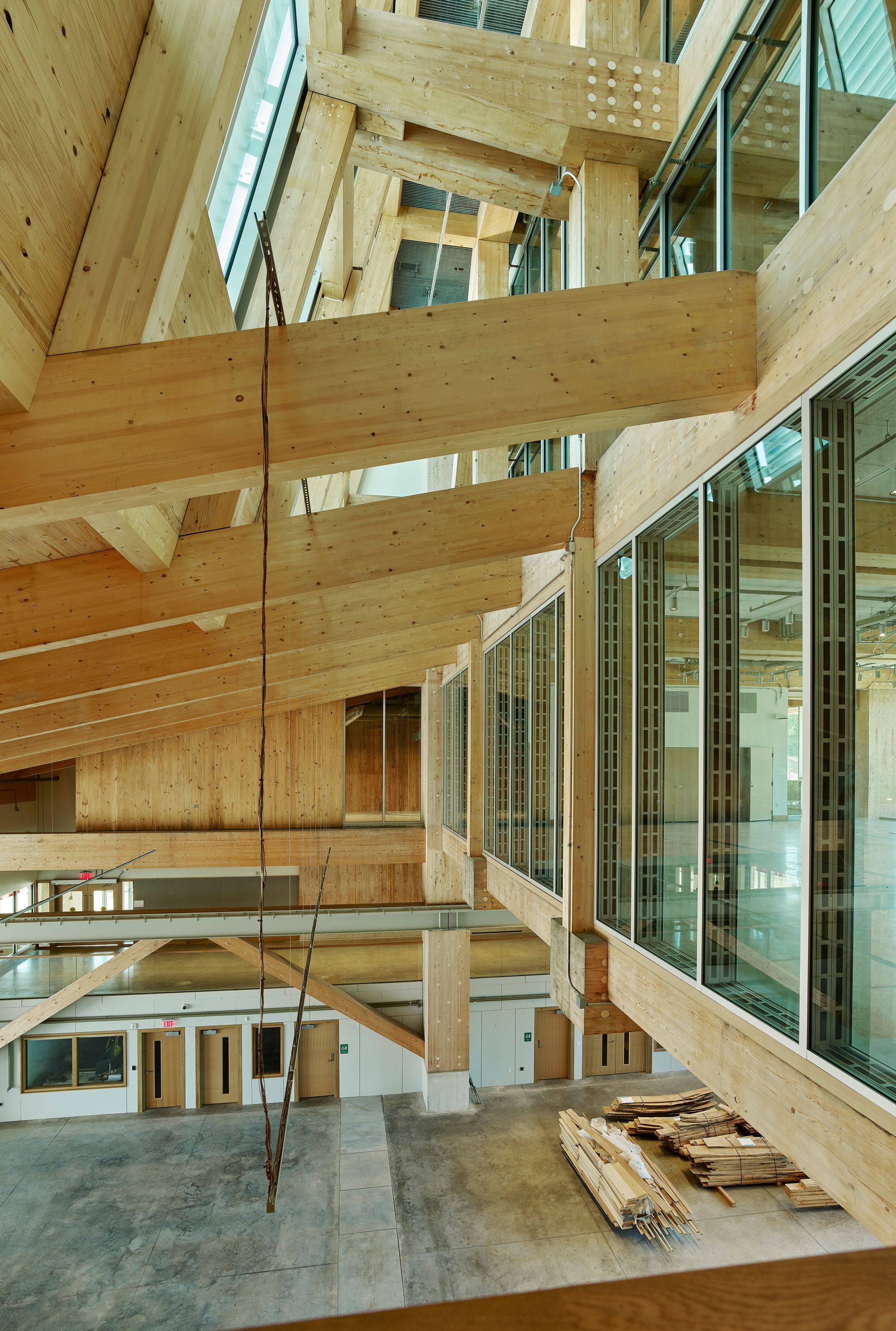
The Anthony Timberlands Center for Design and Materials Innovation designed by Grafton Architects. Photo © Tim Hursley.
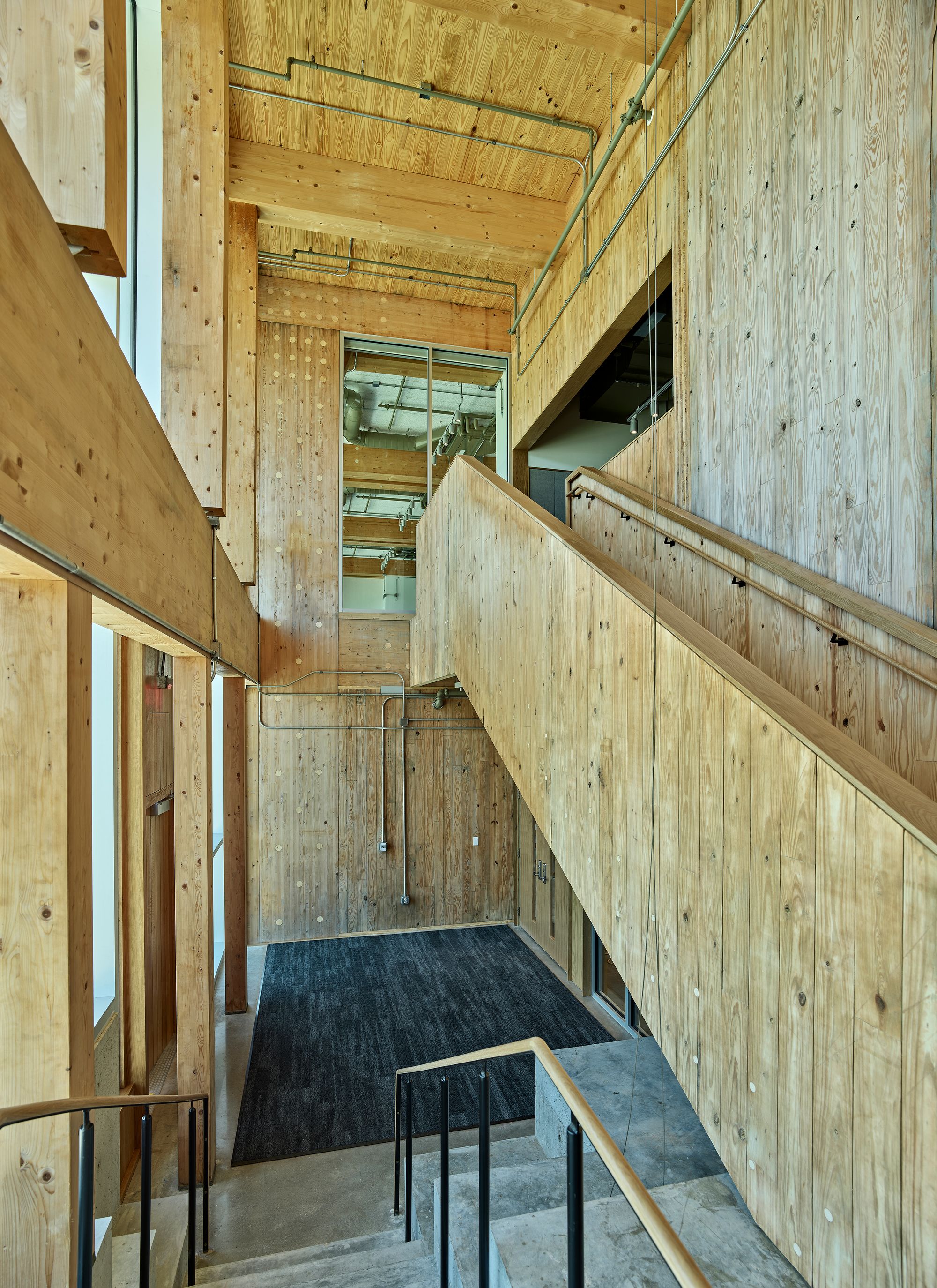
The Anthony Timberlands Center for Design and Materials Innovation designed by Grafton Architects. Photo © Tim Hursley.
I’m struck by some of the words that you’ve used: fragile, sensual, poetic. You’ve said before that designing architecture is an emotional experience — terrifying, even. Could you speak to the idea of the emotive versus a pragmatic approach to architecture? What does it mean for architecture to elicit an emotional response?
Architects are not sculptors. Architects are approached by people who have a need, who have — maybe — the finances to make something, and who come with a list in hand, and say, “Can you translate this into space?” We take the function very seriously. But there’s another component, which is the emotional possibility that lives in the cross-section. If you envision the building in sections, you can find those overlapping connections where relationships are built up between different spaces. The emotional component also can do with scale, like in Arkansas. At the Anthony Timberlands Center, the big room where things are made becomes the heart, the connector, because it reaches up to the upper studios. When you’re in the auditorium, you can see the fabulous, contemporary machinery down there where students are making — it’s an educational shish kabob. And emotion is about touch. Pallasmaa was commissioned to design the door handle, which he beautifully described as a welcome hand. So, it’s touch: bronze on the door, the texture of the oak. And it’s sound. Sound is the resonance within a building, and timber has a different tone than a stone or a concrete building. Emotion is not “wow.” We’re not interested in that kind of wowness. You know? It’s more that you feel that this is a respectful vessel.
MZ: The center sits on Martin Luther King Jr. Boulevard, an arterial road that connects the satellite site to campus. The building is also across the street from a large Walmart. In 2022, you told The Architect’s Newspaper that this represented a particular kind of American urbanism.
YF: Well, the car in the United States is like a jacket. It’s an outer skin. Given the scale of your country, the car and the truck are part of culture — it’s about dimension and speed. The university said in the initial competition brief that they wanted the building to have a presence on the boulevard, so we stacked all the things that could be stacked to form a relationship with Fayetteville on the busy road. So, when you’re driving home, you might see the elevation lit up and students working. In the States, you have those amazing trucks that drive over enormous distances. When you’re in the workshop at the center, you see these trucks revving their way up an incline coming towards you from the east to west. It has a certain kind of vibrancy.
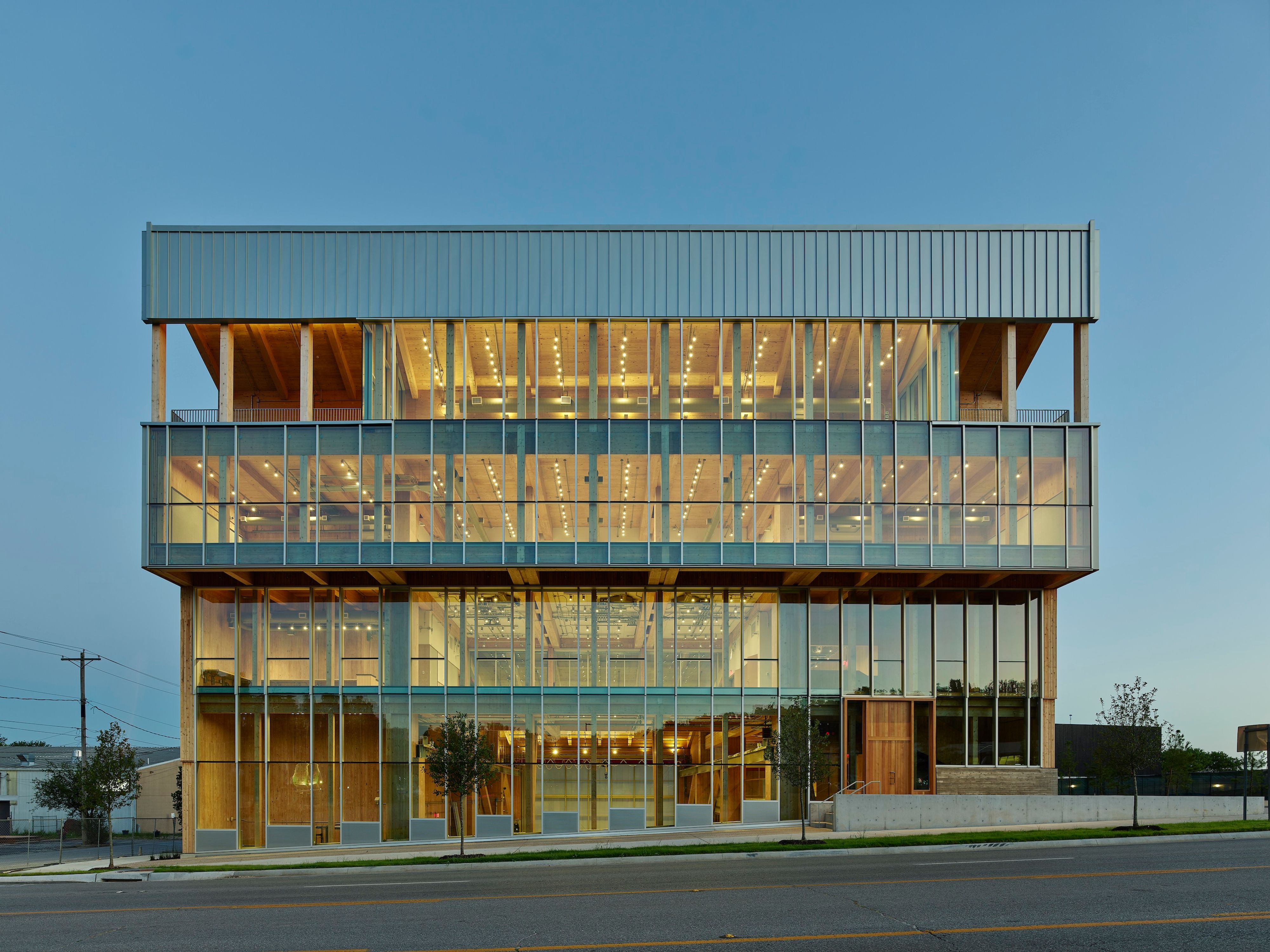
The Anthony Timberlands Center for Design and Materials Innovation, designed by Grafton Architects. Photo © Tim Hursley.
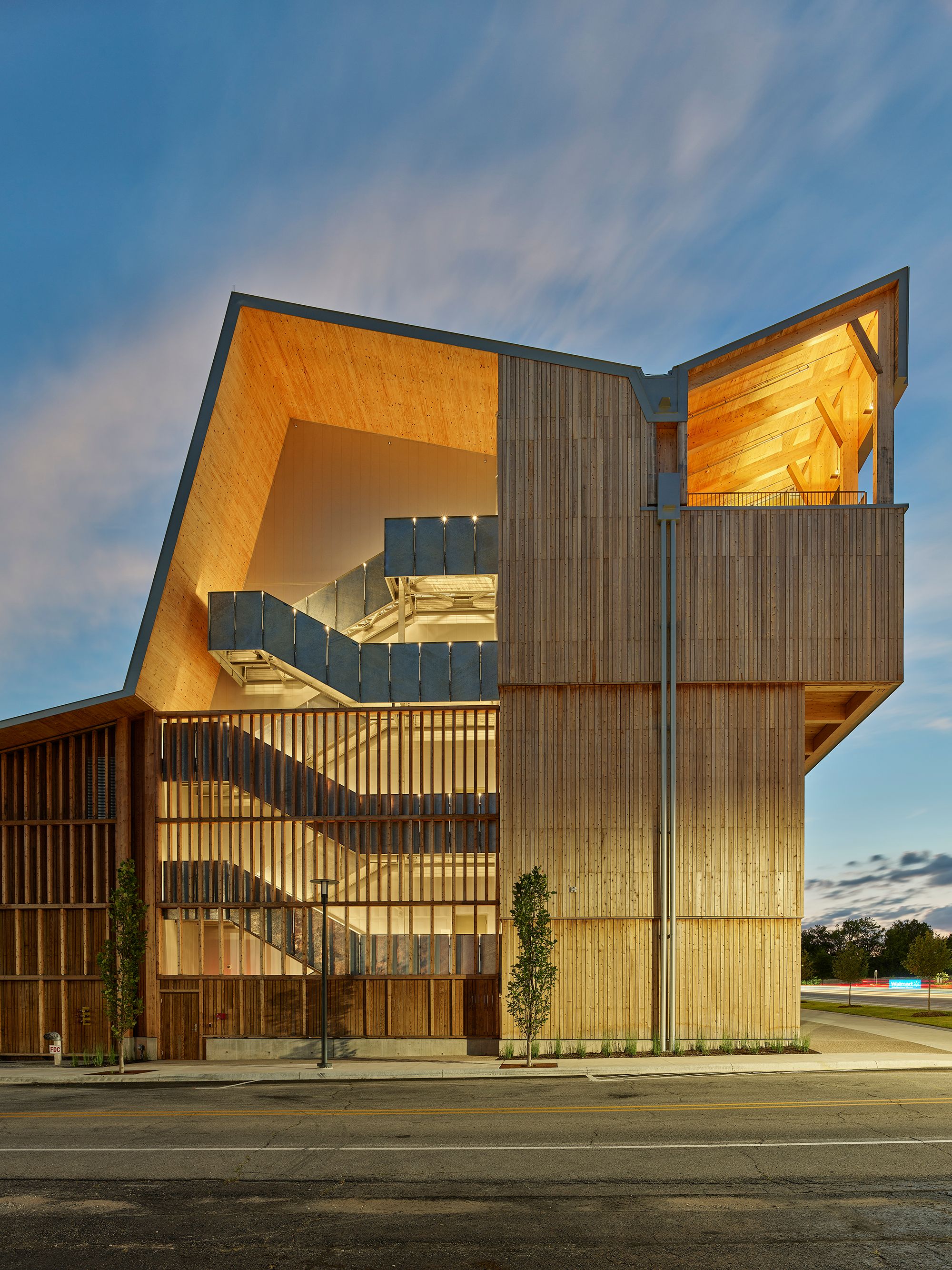
The Anthony Timberlands Center for Design and Materials Innovation designed by Grafton Architects. Photo © Tim Hursley.
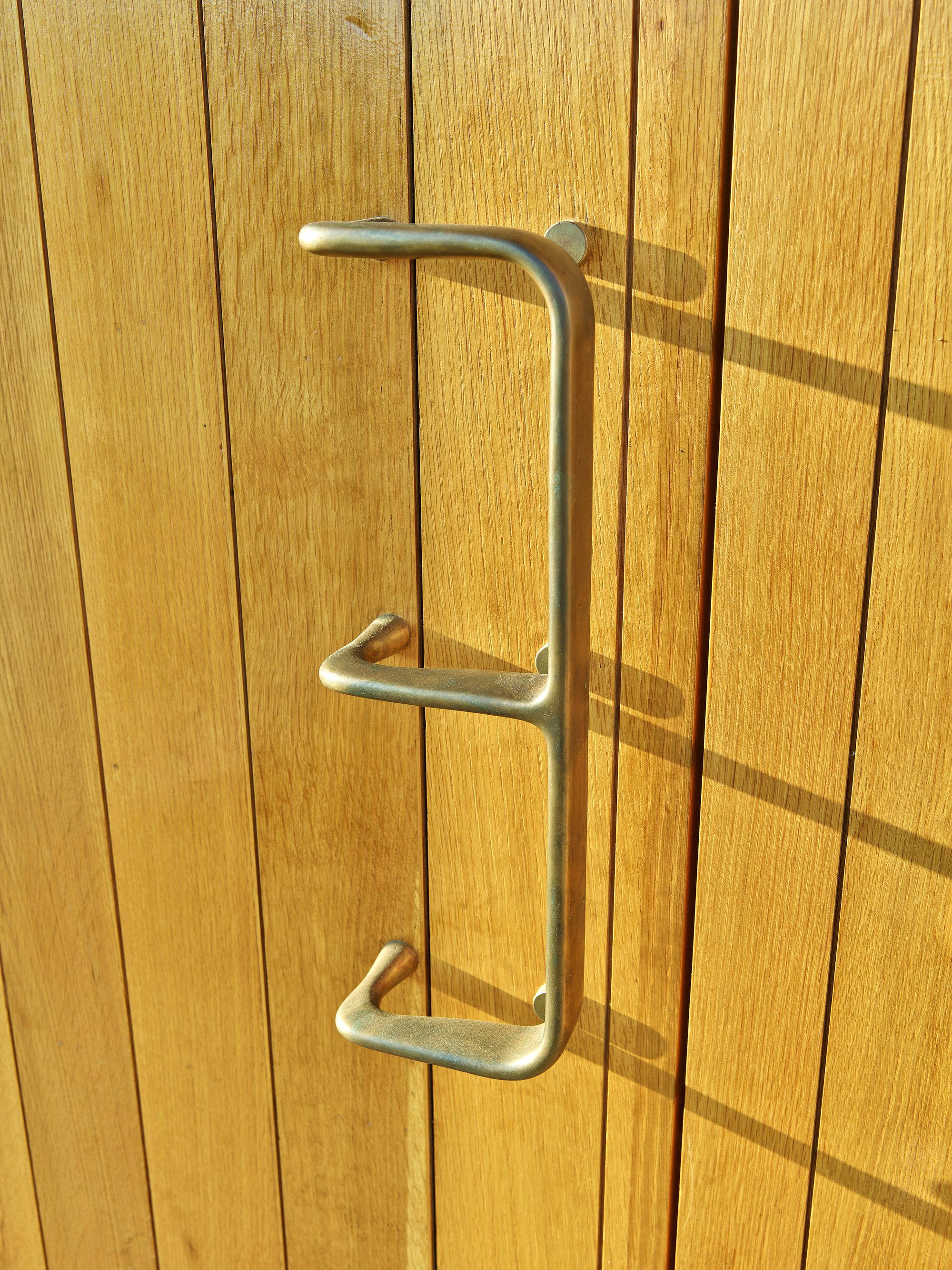
The door handle designed by Juhani Pallasmaa in the Anthony Timberlands Center for Design and Materials Innovation. Photo © Tim Hursley.
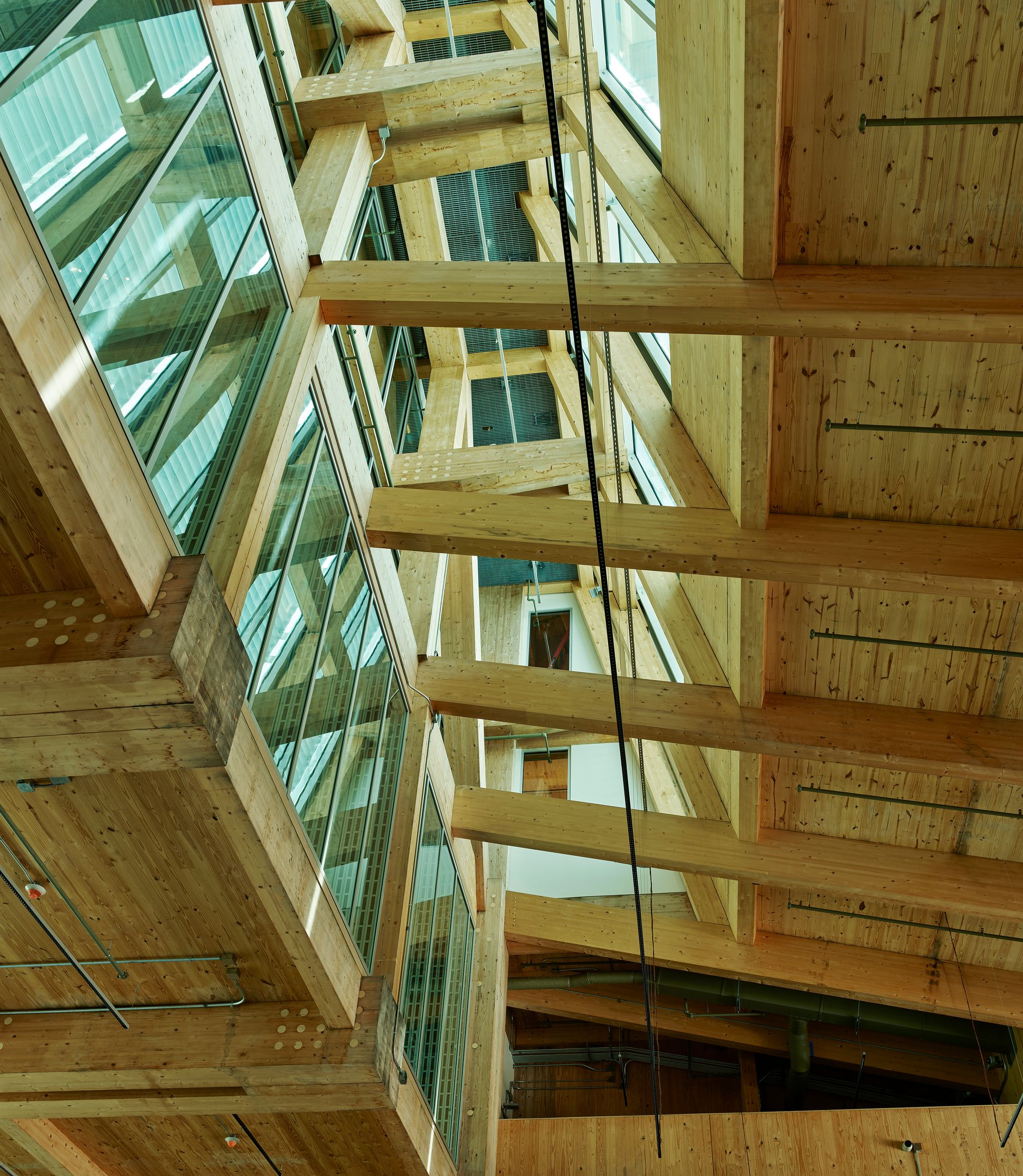
The Anthony Timberlands Center for Design and Materials Innovation designed by Grafton Architects. Photo © Tim Hursley.
The Anthony Timberlands Center is 42,000 square feet and uses a whole range of different kinds of timber, from hand-tooled to innovative mass timber components. I’m curious about the difference between handicraft and high-tech making.
When we won the competition, we thought we’d be wandering around the forests of Arkansas, choosing this or that tree. But the industry of timber is about transforming smaller pieces to be able to do bigger work and less about craft as it would be with a door or bench.It’s different when you see somebody whittling, when you touch a chair handle that hundreds of people, maybe even through the generations, have touched. It’s amazing. When I was a child, there were Hawthorn trees, that cattle would rub themselves against, and the bark of the tree would become like leather because of this friction over time. Timber is a marvelously elegant material, but it does have limits, and it does morph into an industrialized material at certain scales. Yet there’s ongoing research into the glues used in timber manufacturing and there’s also a push to make concrete a more sustainable material. I think that the future is hybrid.
It’s a time of deep polarization in the U.S. When you curated the 2018 Venice Architecture Biennale, the theme was “Freespace” and Grafton Architects’ buildings are famous for bringing people together. How might architecture play a role in gathering us, perhaps not in agreement, but within a shared space?
I was reading recently about what happens when algorithms feed you information so you think a certain way. As it keeps feeding you, you get more and more convinced of that certain way, and other people become more and more othered. Societies are diminished by that kind of strategy, yet architecture has this incredible ability to gently hold you. You ask about how people meet. Students meet by a shared need for a cup of coffee, or by bumping into another on a stairway. As humans, we’re social beings, and architecture has this fantastic ability to orchestrate ordinary things. You’ve asked a very big question: What can architecture do to encourage people to trust each other? I think blurring boundaries is a lovely thing. You’re neither outside nor inside. Some ambiguity is a great thing. Architecture is about gently making that tissue between your private world and your public world safe, so that you can be yourself. You know, those students sitting up in the studio terraces in the Anthony Timberlands Center, they’re looking out at the hills in Arkansas. It’s a beautiful landscape and a busy road. Architecture holds people, so they might be their best self.
There’s something really beautiful in architecture allowing people to just be — the pretense drops away.
Architecture doesn’t have to be the Taj Mahal. We’re trying to make things that are meaningful enough that they don’t have to be standing on their head to do that. We have to have the courage to stand our ground on decency, generosity, and respect. Somebody should know where the door is. A building should say “Welcome, would you like to sit on that comfortable seat?” Life is difficult, and so the role of architecture should be to make it as poetic as possible, in an ordinary way — a nice high ceiling, a window you can open, and a little terrace for your table. We have to push against the so-called extraordinary; we should make really good ordinary things.
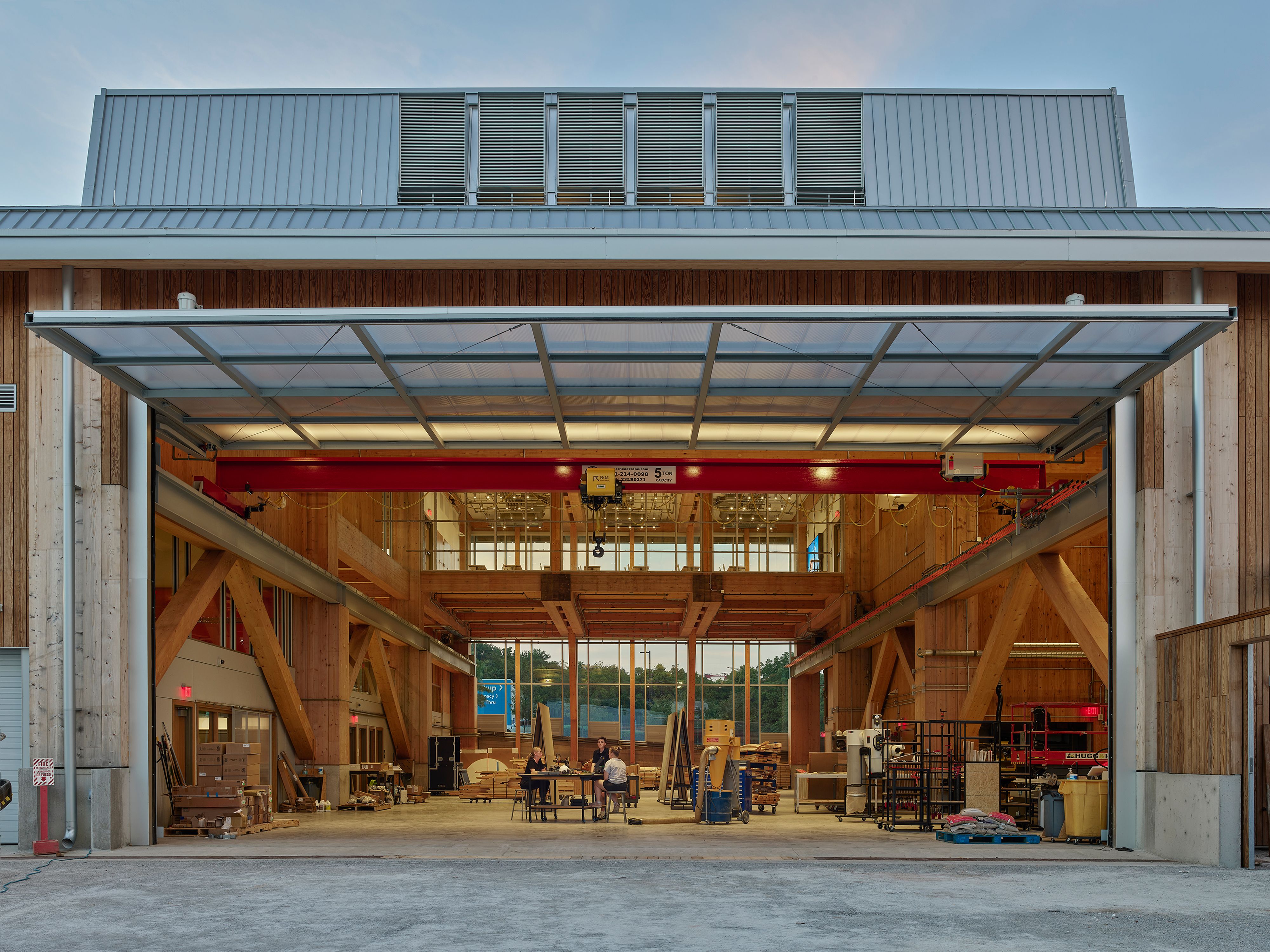
The Anthony Timberlands Center for Design and Materials Innovation designed by Grafton Architects. Photo © Tim Hursley.
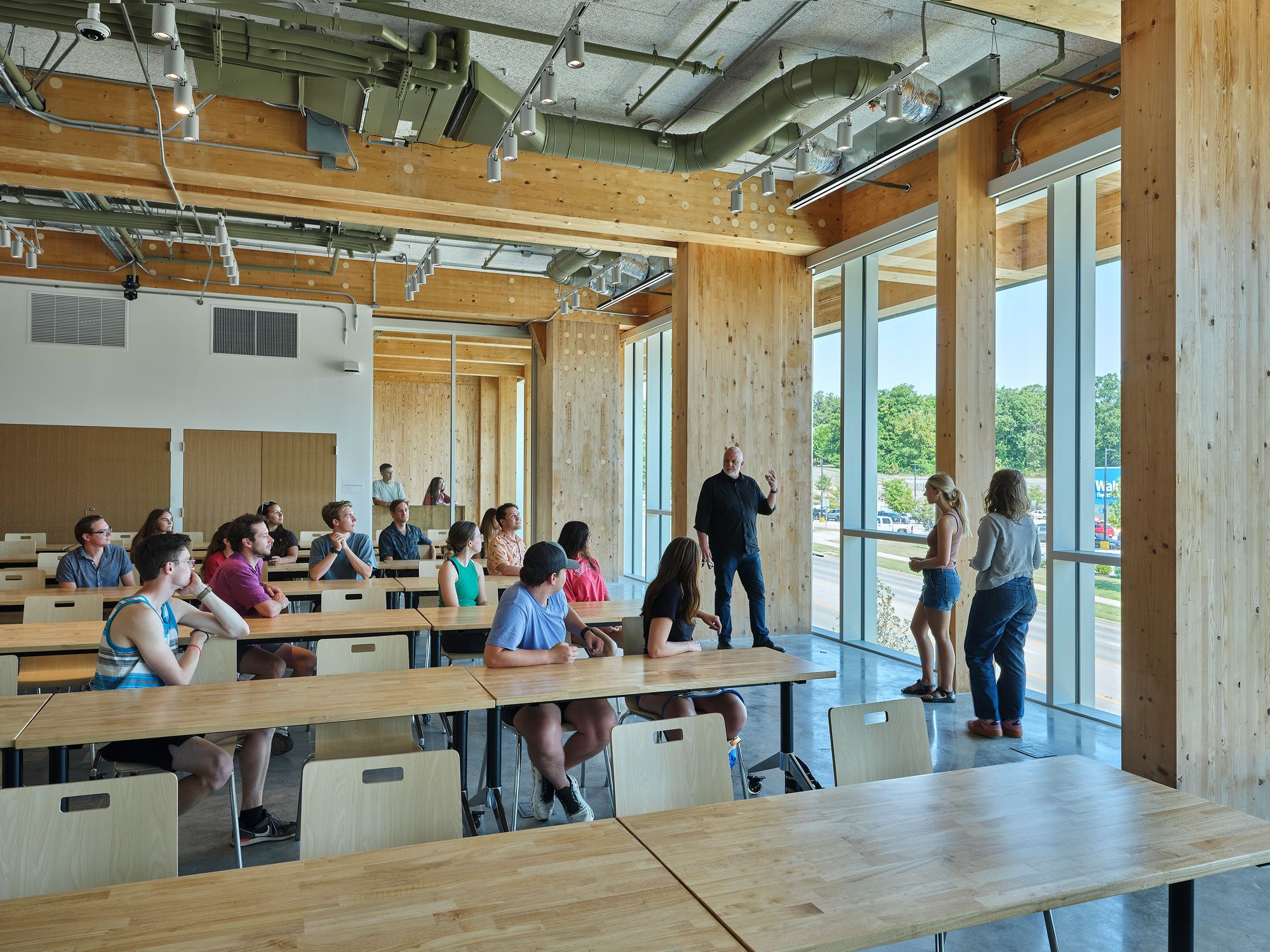
The Anthony Timberlands Center for Design and Materials Innovation designed by Grafton Architects. Photo © Tim Hursley.
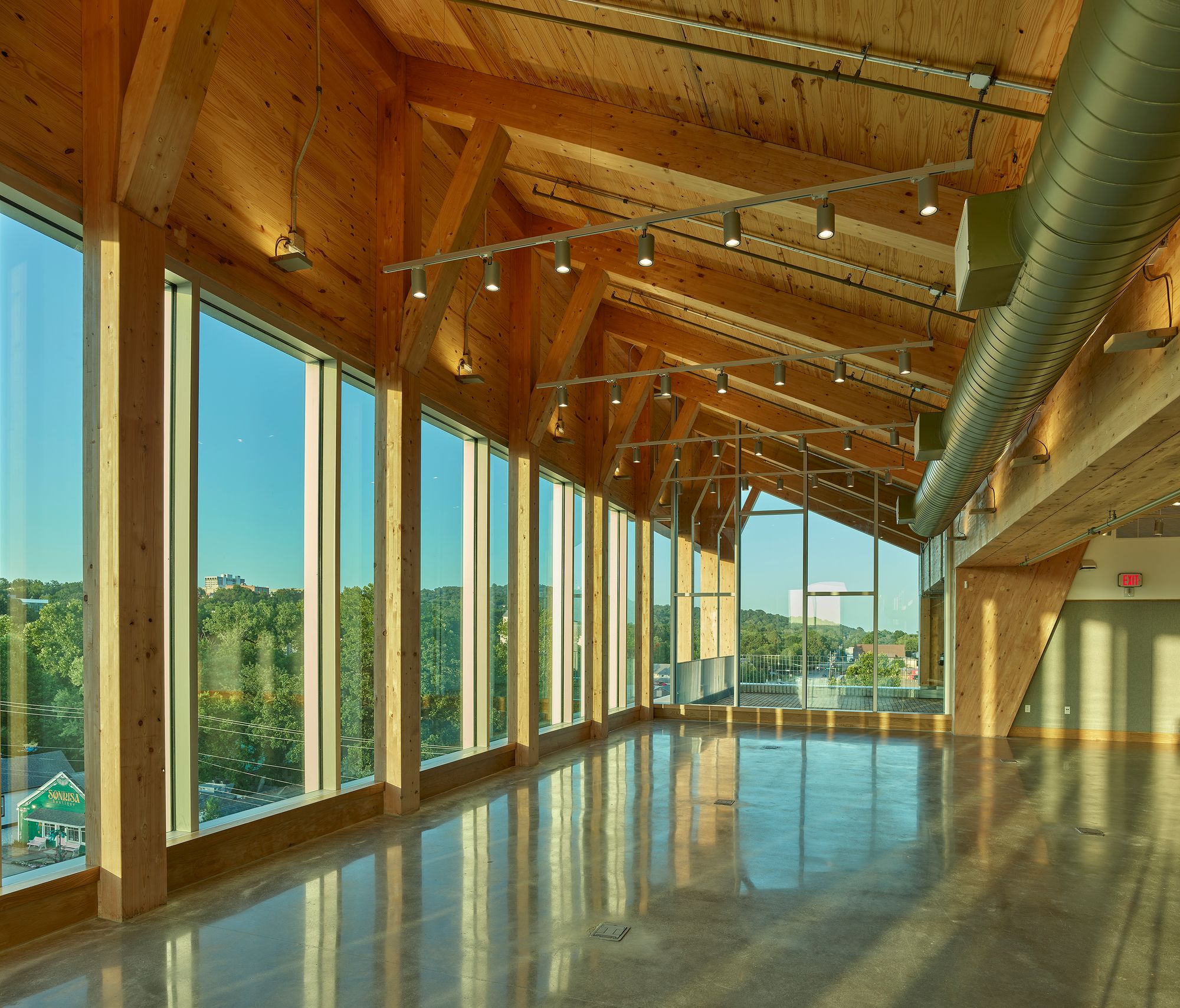
The Anthony Timberlands Center for Design and Materials Innovation designed by Grafton Architects. Photo © Tim Hursley.